
You want to know what a mini split costs to run before you commit, or your electric bill went up and you're wondering if it's the culprit. Mini splits are among the most efficient ways to heat and cool, but the number depends on your unit's size, your climate, how you use it and your local electricity rate.
This guide breaks down how much electricity a mini split really uses, in watts, kWh, and dollars, plus the factors that push the number up or down and the practical steps that lower it. The wattage figures are typical ranges (your unit's rated draw is on its nameplate), and cost figures use current electricity-rate data. Use the calculator to get a number for your specific situation.
A typical 12,000 BTU mini split draws roughly 400 to 1,200 watts depending on how hard the compressor is working, which comes to about 3 to 10 kWh per day at 8 hours of use, or roughly 500 to 900 kWh over a cooling season. Mini splits are efficient because their inverter compressors modulate speed: once a room reaches temperature, the unit throttles down and draws far less than its maximum. Your cost is that energy use times your local electricity rate; the calculator below works it out.
kWh Cost Calculator
Estimated electricity cost for any appliance.
Enter your unit's average draw in watts, which is its capacity divided by its SEER2 rating: a 12,000 BTU unit at 20 SEER2 averages about 600 watts while cooling. The worked cost figures are in what a mini split costs to run below.
Rated watts vs. what it actually draws
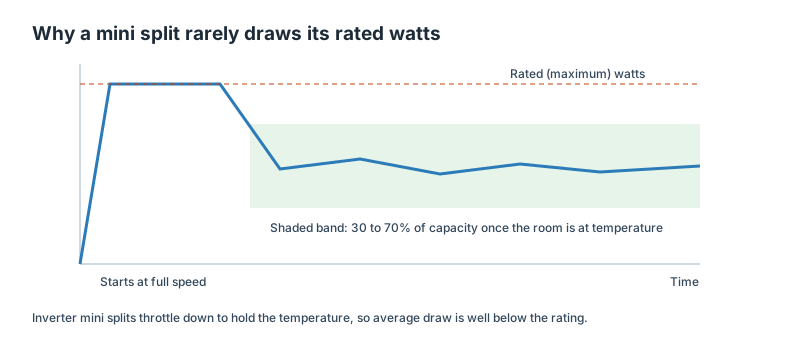
Every mini split has a rated wattage, its maximum draw at full compressor speed.
But one thing matters most for your bill: inverter mini splits rarely run at maximum. They typically operate at a fraction of their rated capacity once a room reaches the set temperature, throttling down to just maintain it. So the "average" draw over a day is well below the rated number.
| Mini split size | Rated (max) watts | Typical average watts (cooling) |
|---|---|---|
| 6,000 BTU | ~450–650W | ~200–400W |
| 9,000 BTU | ~600–800W | ~300–500W |
| 12,000 BTU | ~800–1,200W | ~400–700W |
| 18,000 BTU | ~1,200–1,800W | ~600–1,100W |
| 24,000 BTU | ~1,600–2,400W | ~900–1,500W |
| 36,000 BTU | ~2,400–3,600W | ~1,400–2,200W |
At a typical 400 to 1,200 watts and about 8 hours of use a day, a 12,000 BTU unit draws roughly 3 to 10 kWh daily, which is watts times hours divided by 1,000. Over a cooling season that comes to about 500 to 900 kWh; the cost-by-size table below reaches the same ballpark using full-load-equivalent hours instead of clock hours.
Heating mode typically draws somewhat more than cooling for the same BTU output, because the outdoor unit works harder to extract heat from cold air, and in extreme cold, supplemental electric resistance heat may engage, which raises consumption significantly. That's why a mini split's heating cost depends heavily on your climate.
What drives your usage up or down
Your actual electricity use can swing widely from the typical figures based on these factors:
| Factor | Effect on usage | Why |
|---|---|---|
| Bigger indoor/outdoor temperature gap | Higher | Unit works harder to bridge a larger difference |
| Poor insulation | Higher | Room gains or loses heat faster |
| Dirty filters | Higher | Restricted airflow forces the compressor to work harder |
| Dirty coils | Higher | Reduced heat-transfer efficiency |
| Wrong-sized unit (over or under) | Higher | Oversized short-cycles; undersized runs at max continuously |
| Sunny, unshaded room | Higher | Solar heat gain adds to the cooling load |
| More occupants and heat-generating equipment | Higher | People and appliances add heat the unit must remove |
| Lower SEER2 rating | Higher | Less efficient conversion of electricity to cooling |
The pattern: a right-sized unit, in a well-insulated room, with clean filters, run at a sensible temperature, uses far less than a neglected or poorly-matched one.
How to cut your mini split's electricity use
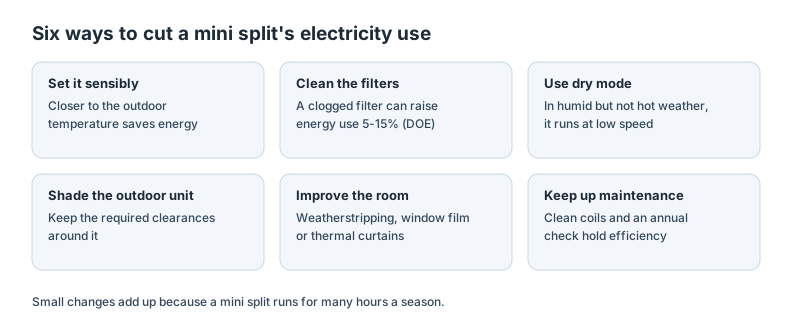
These practical steps genuinely reduce consumption:
Set the temperature sensibly. Per the Department of Energy, each degree you let the thermostat settle closer to the outdoor temperature saves energy. In cooling, every degree warmer you can tolerate reduces the load; the DOE notes that setting it colder than you need doesn't cool any faster, it just runs up the bill.
Clean the filters regularly. A clogged filter is one of the biggest efficiency killers, per the DOE it can increase energy use by 5 to 15% by restricting airflow. Most mini split filters are washable, check them regularly and rinse when dirty.
Use dry mode in humid conditions. In humid (but not very hot) weather, dry mode removes moisture while the compressor runs at low speed, so it generally uses less power than full cooling. Savings vary by unit, since it's a manufacturer feature without a fixed standard; see our dry mode guide for how it works.
Shade the outdoor unit. A condenser in direct sun works a bit harder than one in shade, so shading it (while keeping the manufacturer's required airflow clearance, and never enclosing it) helps efficiency.
Improve the room's insulation. Weatherstripping, insulating window film, or thermal curtains reduce the heat your room gains or loses, so the mini split works less. These are low-cost improvements that pay back over time.
Keep up with maintenance. Clean coils and an annual check keep the system running at its rated efficiency; a neglected unit drifts toward the higher end of the usage ranges.
What a mini split costs to run
Your running cost is the electricity the unit uses times your rate. The energy use follows from the unit's capacity and its efficiency rating:
- Cooling kWh per year = BTU × full-load hours ÷ (SEER2 × 1,000).
- Heating kWh per year = BTU × full-load hours ÷ (HSPF2 × 1,000).
Full-load hours are the hours the unit would run at full capacity to deliver a season's cooling or heating. A mild summer might be 600, a hot one 2,000 or more; the 1,500 hours below is an example assumption, not a fixed figure.
Cost by size
At 20 SEER2, 1,500 full-load cooling hours and 18 cents per kWh:
| Size | kWh per year | Cost per year | Per month over an assumed 5-month season |
|---|---|---|---|
| 9,000 BTU | 675 | $122 | $24 |
| 12,000 BTU | 900 | $162 | $32 |
| 18,000 BTU | 1,350 | $243 | $49 |
| 24,000 BTU | 1,800 | $324 | $65 |
| 36,000 BTU | 2,700 | $486 | $97 |
Efficiency matters as much as size. A 12,000 BTU unit at 16 SEER2 uses about 1,125 kWh a year ($203), and one at 25 SEER2 about 720 kWh ($130).
Your electricity rate
The same 900 kWh costs about $111 a year at North Dakota's 12.36 cents per kWh and about $417 at Hawaii's 46.28, the lowest and highest state averages for January to July 2026 (EIA). The same mini split can cost close to four times as much to run in the priciest state as in the cheapest. Our kWh cost calculator lists every state.
Against central air
For the same 12,000 BTU of cooling over 1,500 hours, a central air conditioner at the 14.3 SEER2 federal minimum would use about 1,259 kWh, about $227 a year. So a 20 SEER2 mini split uses about 29% less electricity for the same cooling, and a ductless system also avoids the duct losses that push a central system's running cost higher still.
Frequently asked questions
How much electricity does a mini split use per month? It depends on the unit size, how many hours it runs, your climate, and your rate. A 12,000 BTU unit running several hours a day might use roughly 150 to 300 kWh a month in active cooling season, more in extreme heat or cold. Multiply your kWh by your electricity rate for the cost, or use the calculator for an estimate.
Are mini splits cheaper to run than central air? Generally yes. Mini splits avoid duct losses, which the DOE puts at about 30% of a cooling system's energy consumption, and their inverter compressors modulate to match demand, so they usually use less electricity than a comparable ducted system. See our mini split vs. central air comparison.
Does a mini split use a lot of electricity in winter? It can, in cold climates. Heating draws more than cooling for the same output, and in extreme cold, supplemental electric resistance heat may engage, raising consumption.
A cold-climate-rated model is more efficient at low temperatures. Your heating cost depends heavily on your climate and electricity rate.
How can I reduce my mini split's electricity use? Set the temperature sensibly (closer to outdoor temp), clean the filters regularly (a dirty filter can add 5 to 15% per the DOE), use dry mode in humid weather, shade the outdoor unit, and improve room insulation. A right-sized, well-maintained unit run at a reasonable temperature uses far less than a neglected one.
What uses more electricity, a mini split or window AC? For the same cooling, a mini split's inverter compressor is typically more efficient than a standard window unit's single-speed compressor, especially over a full season, because it modulates rather than cycling fully on and off.
How many amps does a mini split use? Amps = watts ÷ volts. Most mini splits run on 230 or 240 volts, so a unit drawing 1,200 watts pulls about 5 amps and one drawing 2,400 watts about 10 amps; some small units run on 115 volts, which doubles the amps for the same watts.
For wiring, the running draw isn't the number to use. The outdoor unit's nameplate lists the minimum circuit ampacity (MCA) for sizing the wire and the maximum overcurrent protection (MOP) for the breaker; see wire size for 220-volt circuits.
How much does a mini split cost to run per month? A 12,000 BTU unit at 20 SEER2 costs about $32 a month over an assumed five-month cooling season at 18 cents per kWh. Larger units, lower ratings, hotter climates and higher rates raise it.
How many watts does a 12,000 BTU mini split use? About 600 watts on average at 20 SEER2 (12,000 ÷ 20). It draws more at full speed and less when it throttles down, so the average sits well below the rated maximum.
About these figures
The efficiency figures, that inverter compressors modulate rather than running at full power, that a dirty filter can increase energy use by 5 to 15%, that thermostat setback saves energy, and that ducts lose about 30% of conditioning energy (relevant to the mini-split-vs-central comparison), reflect U.S. Department of Energy and ENERGY STAR guidance. The SEER2 and HSPF2 cost formulas follow the federal test procedures in 10 CFR Part 430.
State electricity rates are EIA averages for January to July 2026 and change over time. Mini split wattage figures are typical ranges, not fixed values, your unit's rated draw is on its nameplate, and actual consumption depends on size, climate, usage, and efficiency.
For a cost estimate at your rate, use the calculator above.
Sources & References
Related Articles
AC Dry Mode Explained: What It Does & When to Use It
explainer • 7 min read
What Is a Mini Split and How Does It Work? (Ductless AC Explained)
explainer • 10 min read
Mini Split Air Conditioners: Cost, Efficiency and Installation (2026)
guide • 11 min read
Mini Split Installation Cost: What to Expect (2026 Guide)
cost-guide • 9 min read