
Your AC is doing something wrong. Maybe it's making a noise it didn't used to, or there's water where there shouldn't be, or your electric bill jumped, or it just won't turn on. And you're standing there thinking is this a quick fix I can do myself, or is this a "call someone and brace for a bill" situation?
This page sorts that out. It's a whole-system troubleshooter: find your symptom below, and we'll tell you the likely cause, whether it's a DIY fix or a pro call, and what to check first.
Where a problem needs its own deep dive, such as an AC that runs but won't cool, we link to it. Cost and efficiency figures come from the DOE, ENERGY STAR and the EPA.
Start here: match your symptom to the section below. Most AC problems fall into one of a handful of buckets, and the fix ranges from "replace a filter" to "call a technician." The trick is knowing which is which before you spend money.
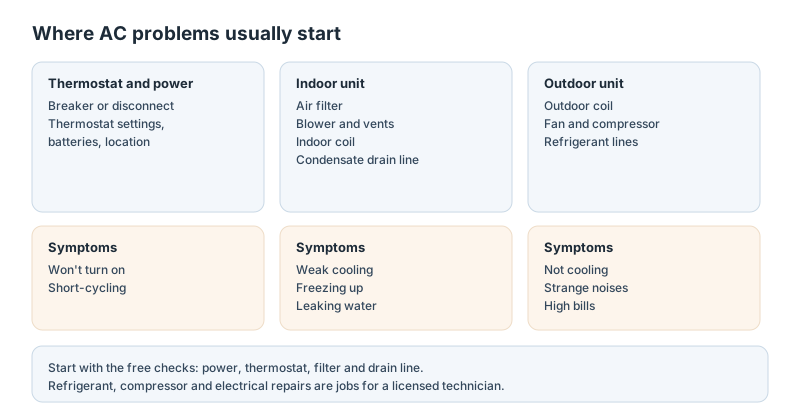
Quick triage: what's your symptom?
| Your AC is... | Most likely | DIY or pro? | Jump to |
|---|---|---|---|
| Running but not cooling (or weak) | Dirty filter, low refrigerant, dirty coils | Mix, start DIY | See our full AC not cooling guide |
| Not turning on at all | Power, thermostat, tripped breaker | Often DIY | Won't turn on, below |
| Making a strange noise | Depends on the noise (see table) | Mix | Strange noises, below |
| Leaking water | Clogged drain line | Usually DIY | Water leaks, below |
| Blowing warm air | See the not-cooling guide | Mix | AC not cooling |
| Short-cycling (on/off rapidly) | Oversizing, thermostat, or a fault | Often pro | Short-cycling, below |
| Freezing up (ice on the unit) | Airflow or refrigerant | Mix | Frozen unit, below |
| Driving up the electric bill | Efficiency loss, dirty system, old unit | Mix | High bills, below |
If your problem is that the AC runs but doesn't cool, that's the single most common AC complaint and it has its own complete walkthrough, so start there: AC not cooling: the full diagnostic. The sections below cover everything else.
AC won't turn on at all
Before you assume the worst, work through the cheap, common causes in order. Most "dead AC" calls turn out to be one of these:
- Check the thermostat. Is it set to "cool" and below room temperature? Are its batteries dead? A blank or frozen thermostat is a surprisingly common culprit.
- Check the breaker. Look in your electrical panel for a tripped breaker (it'll be in the middle position, not fully on). Flip it fully off, then on. If it trips again immediately, stop, that's an electrical fault that needs a pro, not repeated resets.
- Check the disconnect and the condensate safety switch. There's usually a disconnect box near the outdoor unit, make sure it's engaged. And many systems have a float switch in the drain pan that cuts power when the pan fills with water (see water leaks, below). A full pan can shut the whole system off.
- Check the furnace switch. Central AC often shares the air handler with the furnace, and there's a switch (looks like a light switch) on or near it that someone may have flipped off.
If all of those check out and it still won't start, it's likely a failed capacitor, contactor, or control board, which is a technician's job.
Strange noises (and what each one means)
Noise is your AC telling you something. The type of noise narrows it down fast:
| Noise | Likely cause | Urgency |
|---|---|---|
| Buzzing | Electrical (relay, capacitor, loose part) | Get it checked |
| Clicking (constant) | Failing thermostat or control | Moderate |
| Banging / clanking | Loose or broken part in the compressor/fan | Turn off, call a pro |
| Screeching / squealing | Fan motor bearing or belt | Pro soon |
| Hissing | Refrigerant leak or pressure issue | Pro (and it means low refrigerant) |
| Rattling | Loose panel, debris in the unit, or twigs | Often DIY (power off first) |
A single new noise usually isn't an emergency, but banging or grinding means turn the unit off and get it looked at before you cause more damage. A loud metal-on-metal sound can mean a part has come loose inside the compressor, and running it makes it worse.
Water leaking from the indoor unit
This one is common and usually fixable yourself. Your AC pulls humidity out of the air, and that water is supposed to drain away. When it leaks instead, it's almost always the drain:
- Clogged condensate drain line is the number-one cause. Algae and gunk build up and block the line, so water backs up and overflows the pan. You can often clear it by locating the drain line (a PVC pipe near the indoor unit) and using a wet/dry vac on the outdoor end, or flushing it.
- Full or rusted drain pan. If the pan under the unit is cracked or rusted through, it needs replacing.
- Frozen coil that's now melting (see frozen unit, below), a coil that iced up will drip a lot of water once it thaws.
- Clogged air filter, believe it or not, a dirty filter can cause the coil to freeze and then leak. Check it first; it's the cheapest fix in HVAC.
If the drain line clog keeps coming back, that's worth a service visit, chronic clogs sometimes point to a slope or installation issue.
AC short-cycling (turning on and off rapidly)
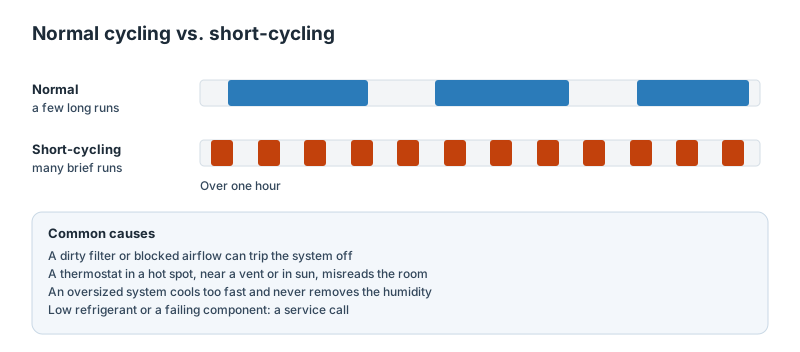
If your AC kicks on, runs briefly, shuts off, and repeats, that's short-cycling, and it's hard on the system (and your bill). Causes range from simple to serious:
- Dirty air filter or blocked airflow, restricted airflow can trip the system off. Check the filter first.
- Thermostat location or fault, a thermostat in a hot spot (near a vent or in sunlight) misreads the room and cycles wrong.
- An oversized system. If your AC was sized too big for your home, it cools too fast, shuts off, and repeats, never running long enough to remove humidity. This is an installation problem, and it's common, which is why proper sizing (a Manual J load calculation, per ACCA) matters so much when you replace a system.
- Low refrigerant or a failing component, these need a pro.
Occasional cycling is normal. Rapid cycling (multiple times an hour) is not, and if the filter and thermostat check out, it's a service call.
The unit is freezing up (ice on the coils or lines)
Ice on an air conditioner always comes down to one of two things: not enough airflow, or not enough refrigerant.
- Airflow problems (the DIY side): a dirty filter, closed or blocked vents, or a dirty evaporator coil restrict airflow, the coil gets too cold, and condensation freezes. Turn the AC off, let it thaw completely (this can take hours), replace the filter, and make sure vents are open. If it stops freezing, that was it.
- Low refrigerant (the pro side): a refrigerant leak drops the pressure, the coil gets too cold, and it ices up. This one needs a technician, both to fix the leak and to recharge it (and handling refrigerant is federally regulated under EPA Section 608).
Running a frozen AC can damage the compressor, so shut it off the moment you see ice and let it thaw before troubleshooting.
Your electric bill jumped (but the AC "works")
An AC that still cools but costs more to run is quietly losing efficiency. The usual suspects:
- A dirty system. A clogged filter, dirty coils, or blocked airflow all force the system to run longer for the same cooling. Regular maintenance (per DOE and ENERGY STAR) is the cheapest way to keep efficiency up.
- Leaky ductwork. According to ENERGY STAR, duct leaks can reduce a system's efficiency by as much as 20%, that's conditioned air you paid for, leaking into your attic or crawlspace. Sealing accessible ducts is one of the higher-return fixes.
- Thermostat habits. Per the DOE, a programmable thermostat can save you up to 10% a year on heating and cooling by easing the temperature back while you're away, and each degree closer to the outdoor temperature saves energy. And DOE notes cranking it colder than you need doesn't cool any faster; it just runs up the bill.
- An aging or failing system. An older, low-efficiency AC simply costs far more to run than a modern high-efficiency one. If your unit is past the 15-to-20-year life the DOE gives a central AC and bills keep climbing, the math may favor replacement, run the numbers before pouring money into repairs.
When it's genuinely a "call a pro" situation
Where the line between DIY and a professional falls:
You can usually handle yourself:
- Filter changes
- Clearing a drain line
- Resetting a breaker (once)
- Checking the thermostat
- Clearing debris around the outdoor unit
- Opening blocked vents
- Letting a frozen unit thaw
Call a professional for:
- Anything involving refrigerant (federally regulated, requires certification)
- Electrical faults (a breaker that keeps tripping, burning smells, buzzing)
- Compressor or fan-motor noises
- Repeated short-cycling after the basics check out
- Any repair where the cost approaches half the price of a new system on an aging unit
There's no shame in the DIY checks, most AC "problems" really are a dirty filter or a clogged drain. But refrigerant and electrical work aren't DIY, both for safety and because the law requires certification for refrigerant handling.
Frequently asked questions
Why is my AC running but not cooling? That's the most common AC complaint, and it has several possible causes (dirty filter, low refrigerant, dirty coils, and more). It has its own complete walkthrough: see our AC not cooling guide for the full diagnostic.
Why is my AC leaking water inside? Almost always a clogged condensate drain line, water backs up and overflows the pan. You can often clear it with a wet/dry vac. A dirty filter causing the coil to freeze (then drip when it thaws) is another common cause, so check the filter too.
Why does my AC keep turning on and off? Short-cycling. Check the air filter and thermostat first. If those are fine, common causes are an oversized system, low refrigerant, or a failing component, the last two need a technician.
Should I turn off my AC if it's frozen? Yes. Running a frozen AC can damage the compressor.
Turn it off, let it thaw completely (hours), then replace the filter and check for blocked airflow. If it keeps freezing, you likely have low refrigerant, which needs a pro.
When should I call an HVAC technician instead of fixing it myself? Call a pro for anything involving refrigerant (federally regulated), electrical faults (a breaker that keeps tripping, burning smells), loud compressor/fan noises, or repeated short-cycling after the basics check out. DIY is fine for filters, drain lines, thermostats, and clearing debris.
About these figures
The efficiency and savings figures are from primary sources: duct-leakage losses ("as much as 20%") are from ENERGY STAR, thermostat savings ("up to 10% a year on heating and cooling with a programmable thermostat") are from the U.S. Department of Energy, and general maintenance guidance follows DOE and ENERGY STAR. Refrigerant handling is regulated under EPA Section 608, and proper system sizing follows ACCA (Manual J). Cost ranges are general market figures, labeled as such, not fixed numbers.