
Standing in front of a wall of air filters with MERV numbers from 1 to 16, the question is simple but nobody answers it straight: which one do I actually need? Is a higher number always better? And is the high-MERV filter going to choke my furnace and cost me more?
The short answer comes first, then the full chart. This page covers the MERV scale from ASHRAE Standard 52.2, the standard that defines it, what each level captures, which suits your home, and whether a high-MERV filter hurts your system (it depends more on filter thickness than on the MERV number).
For most homes, MERV 8 to 13 is the right range. MERV 8 handles basic dust and protects your equipment; MERV 11 adds finer particles like pet dander and smoke; MERV 13 is the sweet spot for air quality (it's the first level that captures a meaningful share of bacteria and virus-carrying particles) and is what the EPA points to for better filtration. Go higher than 13 only if your system was designed for it.
What MERV actually measures
MERV stands for Minimum Efficiency Reporting Value. The word "minimum" is the important part: it reflects a filter's worst-case performance during testing, not its average or peak.
ASHRAE designed it that way so you know the floor of what you're getting, not the ceiling. In practice, your filter usually performs better than its MERV number suggests.
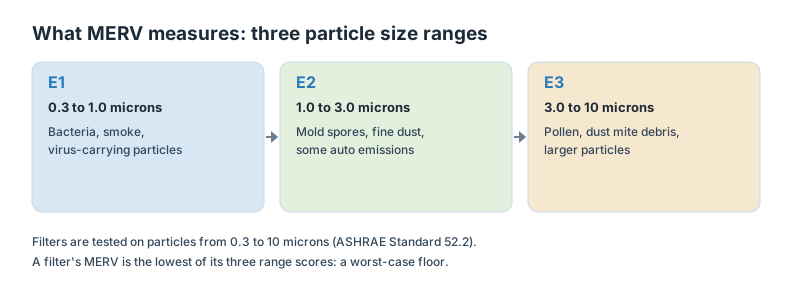
Under ASHRAE Standard 52.2, filters are tested against particles from 0.3 to 10 microns, grouped into three size ranges:
- E1 (0.3–1.0 microns): the smallest, bacteria, smoke, virus-carrying particles.
- E2 (1.0–3.0 microns): fine, mold spores, fine dust, some auto emissions.
- E3 (3.0–10 microns): coarse, pollen, dust mite debris, larger particles.
A filter's MERV is the lowest of its three range scores, which is why it's a genuine worst-case floor.
The complete MERV rating chart (ASHRAE 52.2)
These are the minimum efficiency thresholds straight from ASHRAE Standard 52.2. A filter must meet the number in each range to earn that MERV.
| MERV | E1 (0.3–1.0 µm) | E2 (1.0–3.0 µm) | E3 (3.0–10 µm) | What it captures | Typical use |
|---|---|---|---|---|---|
| 1–4 | , | , | under 20% | Large dust, lint, pollen | Basic equipment protection |
| 5–6 | , | , | 20–35% | Dust, pollen, mold spores | Minimum home comfort |
| 7–8 | , | ≥20% (M8) | 50–70% | Pet dander, dust mite debris | Standard home filter |
| 9–10 | , | 35–50% | 75–80% | Fine dust, auto emissions | Better home, allergy help |
| 11 | ≥20% | ≥65% | ≥85% | Fine pet dander, smoke, smog | Allergy/pet homes |
| 12 | ≥35% | ≥80% | ≥90% | Finer particles | High-end residential |
| 13 | ≥50% | ≥85% | ≥90% | Bacteria, virus carriers, smoke | Highest common home level |
| 14–16 | 75–95% | ≥90% | ≥95% | Most bacteria, fine smoke | Hospitals, clean rooms |
Notice the pattern: MERV 8 and below aren't even rated for the smallest (E1) particles. MERV 11 is where a filter first has to prove it catches some of them (≥20%), and MERV 13 is the first level that captures at least half of that smallest, most health-relevant range. That's why 13 is the number the EPA points to for better indoor air.
"Which MERV do I actually need?"
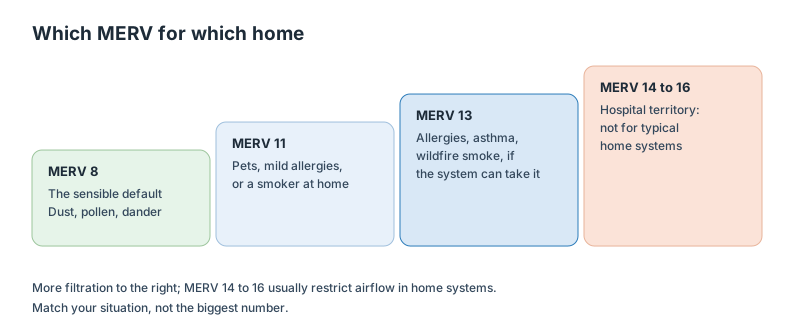
Match your situation, not the biggest number:
- MERV 8: the standard, sensible default for a typical home with no special concerns. Captures dust, pollen, and pet dander well, protects your equipment, and lets air flow freely. If you just want a good filter and change it regularly, this is it.
- MERV 11: step up if you have pets, mild allergies, or a smoker in the home. It adds meaningful capture of finer particles (dander, smoke) without much airflow penalty.
- MERV 13: the strongest choice for allergies, asthma, wildfire smoke, or the cleanest air a standard system can reasonably deliver. It starts capturing bacteria and virus-carrying particles, and it's what the EPA recommends where the system can handle it; the EPA also notes that filters rated MERV 7 to 13 are nearly as effective as true HEPA filters for most airborne indoor particles.
- MERV 14–16: hospital and clean-room territory. Don't put these in a typical home system, most residential HVAC can't move air through them properly, and you'll do more harm than good (see below).
"Will a high-MERV filter choke my furnace?" (The real answer)
This is the worry that keeps people on MERV 8 when they'd benefit from 11 or 13, so let's get it right. The common claim is "higher MERV restricts airflow and strains your system." That's partly true, but the real driver isn't what most people think.
It's filter depth, not the MERV number, that mostly determines airflow resistance. A thin 1-inch MERV 13 filter restricts airflow noticeably.
A 4-inch or 5-inch MERV 13 filter (the deep media type) has far more surface area, so it can deliver the same filtration with much less resistance. Depth is the lever.
So the practical rules:
- For a standard 1-inch filter slot: MERV 8 to 11 is the safe range; MERV 13 in a 1-inch is possible but check your system, and change it before it loads up.
- If you have a 4-inch or 5-inch media cabinet: you can run MERV 13 comfortably, this is the ideal setup for high filtration.
- The universal rule: a clogged filter of any MERV restricts airflow far more than a clean high-MERV one. Whatever you choose, change it on schedule. A dirty MERV 8 strains your system more than a fresh MERV 13.
If you want MERV 13 filtration and only have a 1-inch slot, the better long-term move is often to have a deeper media cabinet added, rather than forcing a thick-equivalent filter into a slot that can't handle the airflow.
One thing the label won't tell you
Two quick clarifications that trip people up:
- "HEPA" is not a MERV rating. The MERV scale for home filters runs 1 to 16 under ASHRAE Standard 52.2, and true HEPA (99.97% at 0.3 microns) is a separate standard that sits above the top of it. True HEPA is too restrictive for most residential ducted systems without a dedicated setup, so portable air purifiers use HEPA while your furnace filter uses MERV.
- UL 900 on a filter is a fire-safety rating, not an efficiency claim. Don't confuse it with MERV.
Frequently asked questions
What MERV rating is best for a home? For most homes, MERV 8 to 13. MERV 8 is a solid default; MERV 11 helps with pets and allergies; and MERV 13 gives the most filtration, and is what the EPA recommends, if your system can handle it. Skip MERV 14 and up in a typical home; it's too restrictive.
Is a higher MERV rating always better? Not for a home. Higher MERV captures more, but above MERV 13, most residential systems can't move air through the filter properly, which reduces airflow and can strain the system. Match the MERV to what your system is designed for.
Does a high-MERV filter restrict airflow? It can, but filter depth matters more than the MERV number. A deep 4–5 inch MERV 13 filter restricts airflow far less than a thin 1-inch one. And a clogged filter of any rating restricts airflow more than a clean high-MERV filter, so change filters on schedule.
What MERV rating removes viruses? MERV 13 is the level that starts capturing a meaningful share (at least 50%) of the smallest 0.3–1.0 micron particles, which include virus-carrying droplet nuclei. It's why the EPA recommends MERV 13 for better filtration, or as high as your system allows. True virus removal at higher rates requires HEPA (portable purifiers).
How often should I change my filter? Depends on the filter and your home, but a common range is every 1–3 months for standard filters (more often with pets or high dust). A loaded filter restricts airflow regardless of its MERV, so err on the side of changing it sooner. See our guide to how often to change your HVAC filter for the full breakdown.
About these figures
The MERV efficiency thresholds (the E1/E2/E3 capture percentages for each MERV level) are from ASHRAE Standard 52.2, the ANSI standard that defines MERV; they're the minimum values a filter must meet to earn each rating. The recommendation of MERV 13 for better indoor air quality, and the finding that MERV 7–13 filters are nearly as effective as true HEPA for most airborne indoor particles, reflect EPA guidance.
The airflow-and-depth relationship follows DOE/PNNL Building America technical guidance on high-MERV filters. Filter prices and change intervals are general ranges, labeled as such, not fixed figures.
Sources & References
- EPA: Guide to Air Cleaners in the Home (MERV 7–13 nearly as effective as true HEPA for most indoor particles)
- DOE / PNNL Building America: High-MERV Filters (MERV 13 recommendation, depth & pressure drop)
- ASHRAE: Standards & Guidelines (Standard 52.2 defines MERV)
- ENERGY STAR: Heat & Cool Efficiently (check filter monthly, change at least every 3 months)
Related Articles
EER Chart for Air Conditioners (Good, Average, Excellent)
reference • 5 min read
HSPF and HSPF2 Explained: Heat Pump Heating Efficiency (2026)
explainer • 6 min read
SEER2 to SEER Conversion: Chart and Formula (2026)
explainer • 6 min read
HVAC Energy Saving Tips: 14 Ways to Cut Heating and Cooling Costs (2026)
guide • 7 min read