calculator-guideComplete Guide

Air Conditioner BTU Calculator: What Size AC Do You Need? (2026)

Use our free BTU calculator to find the exact air conditioner size for your room or home. Covers square footage, climate zones, insulation, ceiling height, and 12+ adjustment factors for accurate AC sizing.

HVAC Base TeamUpdated February 5, 202620 min read

A typical home needs 20 BTU per square foot of cooling capacity, which means a 1,500 sq ft house requires roughly 30,000 BTU (2.5 tons) of air conditioning. However, that baseline number can shift by 30–50% depending on your climate zone, insulation quality, window area, ceiling height, and a dozen other factors — and getting it wrong costs you hundreds of dollars per year in wasted energy or uncomfortable rooms.

This calculator and guide walk you through the exact process HVAC professionals use (ACCA Manual J methodology) to size an air conditioner correctly. Whether you're buying a window unit, a mini split, or a whole-home central system, you'll leave this page knowing your target BTU range within a few percentage points.

Quick BTU Calculator

Use our interactive calculator below to get your recommended AC size. Enter your room or home details, and we'll apply all 12 adjustment factors automatically.

Pro Tip

Pro tip: Run the calculator once with your best guesses, then read the adjustment factor sections below and re-run with more accurate inputs. The difference between a rough estimate and a precise calculation can be 8,000–12,000 BTU — enough to push you into the next tonnage bracket.

The Baseline: BTU Per Square Foot

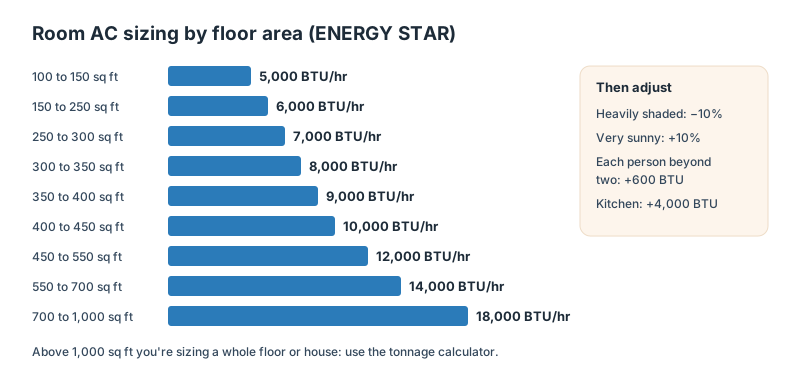
Every AC sizing calculation starts with square footage. The base rule from ENERGY STAR and the DOE is simple: 20 BTU per square foot of living space for cooling. That gives you this starting table:

Room/Home Size (sq ft)Base BTU NeededAC Tonnage Equivalent
150–2505,000— (window unit)
250–3506,000–7,000— (window unit)
350–4508,000–10,000— (window/portable)
450–55010,000–12,0001 ton
550–70012,000–14,0001–1.25 ton
700–1,00014,000–20,0001.25–1.5 ton
1,000–1,20020,000–24,0001.5–2 ton
1,200–1,50024,000–30,0002–2.5 ton
1,500–2,00030,000–40,0002.5–3.5 ton
2,000–2,50040,000–50,0003.5–4 ton
2,500–3,00050,000–60,0004–5 ton
3,000–3,50060,000–70,0005–6 ton
Warning

Don't stop here. This table is a starting point only. A 2,000 sq ft home in Phoenix with west-facing windows might need 52,000 BTU, while the same floor plan in Seattle with good insulation might only need 32,000 BTU. The adjustment factors below can shift your number by 40% or more.

The 12 Adjustment Factors That Change Your BTU Number

HVAC professionals don't just multiply square footage by 20. ACCA Manual J — the gold standard for residential load calculations — accounts for all of these variables. Here's how each one affects your sizing:

1. Climate Zone

Your local cooling design temperature (the outdoor temp your system must handle on the hottest 1% of summer hours) has the biggest single impact on sizing.

DOE Climate ZoneRepresentative CitiesBTU Multiplier
Zone 1 (Hot-Humid)Miami, Key West, Honolulu1.20–1.30
Zone 2 (Hot)Houston, Phoenix, New Orleans, Tampa1.10–1.20
Zone 3 (Warm)Atlanta, Dallas, Las Vegas, Charlotte1.00–1.10
Zone 4 (Mixed)Nashville, St. Louis, Richmond, Albuquerque0.95–1.05
Zone 5 (Cool)Chicago, Denver, Boston, Pittsburgh0.90–1.00
Zone 6 (Cold)Minneapolis, Milwaukee, Burlington0.85–0.95
Zone 7 (Very Cold)Duluth, Fargo, Anchorage0.80–0.90

For example, if your base calculation is 30,000 BTU and you live in Houston (Zone 2), multiply by 1.15 to get 34,500 BTU.

2. Insulation Quality

Insulation LevelDescriptionAdjustment
PoorPre-1980 home, no wall insulation, single-pane windows+30%
Below averageSome insulation, older double-pane windows+15%
AverageR-13 walls, R-30 attic, standard double-pane0% (baseline)
GoodR-19 walls, R-38 attic, Low-E windows−10%
ExcellentR-21+ walls, R-49+ attic, triple-pane, air-sealed−20%

A well-insulated 2026 code-built home can require 20–25% less cooling capacity than a 1970s home of the same size. If you've recently added insulation or replaced windows, factor that in.

3. Ceiling Height

The baseline 20 BTU/sq ft assumes 8-foot ceilings. Taller ceilings mean more air volume to cool.

Ceiling HeightAdjustment
8 ft (standard)0%
9 ft+12%
10 ft+25%
12 ft+50%
Vaulted/cathedral (avg 14 ft)+75%

A 1,500 sq ft home with 10-foot ceilings has the same air volume as an 1,875 sq ft home with 8-foot ceilings. You're cooling volume, not just floor area.

4. Sun Exposure and Window Area

Windows are the largest source of solar heat gain in most homes. The Department of Energy estimates that heat gain through windows can account for 25–35% of residential cooling loads.

Window FactorAdjustment
Few/small windows, mostly shaded−10%
Average windows, some shading0%
Large windows, partial sun exposure+10%
Many/large windows, heavy sun exposure+20%
Floor-to-ceiling glass, west/south facing, unshaded+30%

Direction matters enormously. West-facing windows receive 2–3 times more afternoon heat than north-facing windows. If your main living area has a large west or southwest glass wall, bump your window adjustment toward the high end.

5. Number of Occupants

People generate roughly 600 BTU per hour of sensible heat. The baseline assumes 2 people. For each additional person who regularly occupies the space, add 600 BTU.

OccupantsAdjustment
1–2 people0 BTU (baseline)
3–4 people+600 to +1,200 BTU
5–6 people+1,800 to +2,400 BTU
Home office (1 person, 8 hrs)+400 BTU
Home gym+1,200–1,800 BTU

6. Kitchen Heat

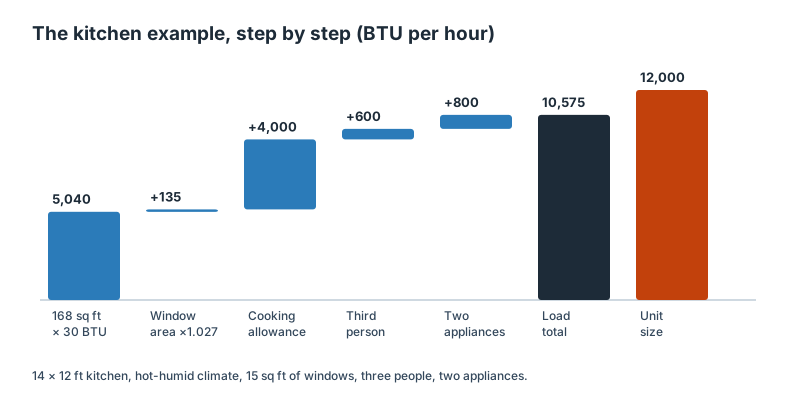
Kitchens generate significant heat from cooking appliances. If the room you're sizing includes or is open to a kitchen, add 4,000 BTU to your total. For commercial-grade ranges or frequent heavy cooking, add up to 6,000 BTU.

7. Heat-Generating Appliances and Electronics

SourceBTU/hr Added
Desktop computer + monitor500–800
Server rack/home lab2,000–10,000
Large-screen TV (65"+)300–500
Grow lights (per 1,000W)3,400
Incandescent lighting (per 100W bulb)340
LED lighting (per 100W equivalent)35

8. Floor Level

FloorAdjustment
Basement−20%
Ground floor (slab)0%
Ground floor (over crawl space)+5%
Second floor+10% to +15%
Top floor under roof+15% to +25%
Attic room/bonus room+30% to +40%

Heat rises, and the top floor of a home can be 8–12°F warmer than the ground floor on a summer afternoon. Bonus rooms above garages are notoriously hot — they often need their own dedicated cooling zone.

9. Ductwork Condition

This factor applies only to central (ducted) systems. Leaky or poorly insulated ducts in unconditioned attics can lose 20–30% of your cooling capacity before the air even reaches your rooms.

Duct ConditionAdjustment
Sealed, insulated, in conditioned space−5%
Average (some leakage, attic runs)0%
Leaky, uninsulated in attic or crawl+15% to +25%

10. Local Humidity

In humid climates (Southeast US, Gulf Coast, coastal areas), your AC does double duty: it cools the air AND removes moisture. High-humidity environments require additional capacity for latent heat removal.

Humidity LevelAdjustment
Dry (desert Southwest, Mountain West)−5% to −10%
Moderate0%
Humid (Southeast, Gulf, Mid-Atlantic summers)+10% to +15%
Very humid (coastal Florida, Hawaii)+15% to +20%

11. Shade and Landscaping

Mature shade trees, awnings, and exterior shading devices can significantly reduce solar heat gain.

ShadingAdjustment
Heavy shade on all sides−10% to −15%
Partial shade (some sides)−5%
No shade, full sun exposure0% to +5%

12. Air Infiltration Rate

Older homes with poor air sealing allow hot outside air to leak in, increasing the cooling load. A blower-door test measures this precisely, but you can estimate.

Air SealingAdjustment
Tight (new construction, blower-door tested)−5% to −10%
Average0%
Leaky (old windows, gaps, no weather stripping)+10% to +20%

How to Calculate Your BTU: Step-by-Step Example

Let's walk through a complete calculation for a real scenario.

Real-World Example

Example: 1,800 sq ft ranch home in Dallas, TX

  • Base calculation: 1,800 × 20 = 36,000 BTU
  • Climate zone (Zone 3, warm): × 1.05 = 37,800 BTU
  • Insulation (average, 1995 build): +0% = 37,800 BTU
  • Ceiling height (9 ft): +12% = 42,336 BTU
  • Windows (large south-facing, partial shade): +15% = 48,687 BTU
  • Occupants (family of 4): +1,200 BTU = 49,887 BTU
  • Open kitchen: +4,000 BTU = 53,887 BTU
  • Floor level (single story, slab): +0% = 53,887 BTU
  • Ductwork (average): +0% = 53,887 BTU
  • Humidity (moderate-high for Dallas): +10% = 59,276 BTU
  • No shade trees: +0% = 59,276 BTU
  • Air sealing (average): +0% = 59,276 BTU

Result: ~60,000 BTU (5 tons)

Compare that to the "quick" estimate of 36,000 BTU (3 tons). The adjustment factors added nearly 67% more capacity. A 3-ton system in this home would run constantly and never reach setpoint on the hottest days.

Real-World Example

Example: 400 sq ft studio apartment in Seattle, WA

  • Base calculation: 400 × 20 = 8,000 BTU
  • Climate zone (Zone 5, cool): × 0.90 = 7,200 BTU
  • Insulation (good, 2015 build): −10% = 6,480 BTU
  • Ceiling height (8 ft): +0% = 6,480 BTU
  • Windows (moderate, east-facing): +5% = 6,804 BTU
  • Occupants (1 person): +0 = 6,804 BTU
  • Kitchenette (small): +2,000 BTU = 8,804 BTU
  • Floor level (3rd floor): +10% = 9,684 BTU
  • Humidity (moderate): +0% = 9,684 BTU

Result: ~10,000 BTU (window unit or small mini split)

The cool climate and good insulation shaved the number down, but the upper floor location and kitchen added it back. A 10,000 BTU window unit or 12,000 BTU mini split handles this space well.

Real-World Example

Example: 3,200 sq ft two-story home in Phoenix, AZ

  • Base calculation: 3,200 × 20 = 64,000 BTU
  • Climate zone (Zone 2, hot): × 1.20 = 76,800 BTU
  • Insulation (below average, 1988 build): +15% = 88,320 BTU
  • Ceiling height (9 ft first floor, 8 ft second): +6% avg = 93,619 BTU
  • Windows (many, west-facing great room): +25% = 117,024 BTU
  • Occupants (5): +1,800 BTU = 118,824 BTU
  • Open kitchen: +4,000 BTU = 122,824 BTU
  • Second floor bedrooms: already factored into floor area
  • Ductwork (attic, some leakage): +15% = 141,248 BTU
  • Humidity (dry): −10% = 127,123 BTU
  • No shade: +5% = 133,479 BTU
  • Air sealing (leaky): +15% = 153,501 BTU

Result: ~150,000 BTU (12.5 tons)

This home likely needs a two-zone system: a 5-ton unit for the first floor and a 3-ton unit for the second floor (or similar split). No single residential unit handles 150,000 BTU alone. This is also a strong case for insulation upgrades and window treatments — improving those two factors alone could shave 30,000+ BTU off the requirement.

AC Tonnage to BTU Conversion Chart

Central air conditioners are sold by the "ton." One ton of cooling equals 12,000 BTU per hour. Here's the full conversion table:

AC TonnageBTU/hrTypical Home Size (sq ft)*
1 ton12,000400–700
1.5 ton18,000700–1,000
2 ton24,0001,000–1,300
2.5 ton30,0001,300–1,600
3 ton36,0001,600–1,900
3.5 ton42,0001,900–2,200
4 ton48,0002,200–2,600
5 ton60,0002,600–3,200

*Assumes average climate, average insulation, 8-foot ceilings. Your actual size may vary 20–40% based on the adjustment factors above.

What Happens When You Size an AC Wrong

Undersized AC: Too Small

An undersized air conditioner will run continuously on hot days without reaching your thermostat setpoint. You'll notice these problems immediately: rooms that never feel comfortable, humidity that won't drop below 60%, and electric bills that spike because the compressor never cycles off. The system also wears out 30–50% faster due to constant run time, shortening a 15-year expected lifespan to 8–10 years.

Oversized AC: Too Big

Oversizing is actually the more common and more costly mistake. An oversized AC cools the air quickly but shuts off before it removes enough moisture. This is called "short cycling" — the compressor runs for 5–8 minutes instead of the ideal 15–20 minute cycle. Short cycling causes higher humidity (the air feels cold but clammy), uneven temperatures (rooms near the air handler freeze while far rooms stay warm), higher energy bills from frequent compressor starts, and accelerated wear on the compressor and contactor.

The DOE estimates that oversized systems use 10–20% more energy than properly sized ones. A study by the Florida Solar Energy Center found that homes with oversized AC systems had indoor humidity levels 10–15% higher than homes with correctly sized equipment.

Warning

The #1 sizing mistake homeowners make: Choosing a bigger unit "just to be safe." A 4-ton system in a home that needs 3 tons doesn't cool better — it cools worse, costs more to run, and breaks down sooner. Always aim for the right size, not the biggest size.

Window AC vs. Mini Split vs. Central AC: Sizing Differences

Different AC types have different sizing considerations:

FeatureWindow ACMini SplitCentral AC
Typical BTU range5,000–25,0006,000–60,00018,000–60,000
Best forSingle rooms1–5 zonesWhole-home ducted
Sizing approachPer-room BTUPer-zone BTUWhole-home Manual J
SEER2 range (2026)10–1515–4214–26
Installation cost$150–$700$2,000–$5,000/zone$3,500–$8,000
Duct lossesNoneNone15–30% if poorly sealed
Humidity controlFairGood–ExcellentGood
Multi-roomNoYes (multi-zone)Yes

If you're sizing a single room, use the per-room calculation. For a whole home, total all rooms and account for ductwork losses if going central. For mini splits, calculate each zone separately.

2026 Efficiency Standards and How They Affect Sizing

As of January 2023, the DOE implemented SEER2 ratings (replacing SEER) for all new residential AC equipment. In 2026, the minimums are:

RegionMinimum SEER2 (Split Systems)Minimum SEER2 (Packaged)
North (DOE regions IV, V)13.413.4
Southeast & Southwest14.313.4

Higher-efficiency units (SEER2 18–26 for central, up to 42 for mini splits) don't change your BTU requirement, but they reduce your operating cost per BTU. A SEER2 20 system costs about 30% less to operate than a SEER2 14 system delivering the same cooling capacity.

Variable-speed and inverter-driven compressors (common in high-SEER2 equipment) also improve comfort at the same BTU rating because they modulate capacity rather than cycling on/off. This makes slight oversizing less problematic with variable-speed systems than with single-stage equipment.

Room-by-Room BTU Sizing Guide

If you're sizing individual rooms (for window units, mini splits, or checking zone balance), use these room-specific guidelines:

Room TypeTypical Size (sq ft)Recommended BTUNotes
Bedroom120–2005,000–6,000Lower occupancy, night use
Master bedroom200–3506,000–9,000Add for en-suite bathroom
Living room200–4006,000–12,000Higher occupancy, electronics
Open-plan living/kitchen400–80012,000–18,000Kitchen adds 4,000 BTU
Home office100–2005,000–7,000Computer equipment adds load
Sunroom150–3008,000–14,000High glass = high solar gain
Garage (insulated)400–60012,000–18,000Minimal insulation, doors
Basement (finished)600–1,2008,000–18,000Cooler ground temps help
Bonus room over garage200–4009,000–15,000Hot in summer, cold in winter

When to Call a Professional for Manual J

While this calculator gives you an excellent estimate, certain situations warrant a full Manual J load calculation by a licensed HVAC contractor:

  • New construction or major renovation: Building codes in many jurisdictions now require Manual J for permits
  • Homes over 3,000 sq ft: Multiple zones and complex ductwork layouts need professional design
  • Unusual construction: Log homes, ICF (insulated concrete forms), SIPs (structural insulated panels), or passive house designs
  • Extreme climates: Design temperatures above 105°F or below −10°F
  • High-performance systems: If you're investing in a $15,000+ system, spend $300–$500 on proper load calculations

A professional Manual J accounts for orientation, exact window specifications (U-factor, SHGC), wall construction R-values, infiltration rates (from a blower-door test), and internal gains with much more precision than any online calculator.

Key Takeaway

Key Takeaways

  1. Start with 20 BTU per square foot, then apply the 12 adjustment factors — climate zone and insulation quality have the biggest impact
  2. One ton = 12,000 BTU. Most homes need 2–5 tons of cooling capacity
  3. Oversizing is worse than slight undersizing — short cycling wastes energy and leaves you humid
  4. Variable-speed systems are more forgiving of sizing imprecision than single-stage units
  5. For accuracy within 5%, use our calculator above. For accuracy within 1%, get a professional Manual J
  6. In 2026, all new systems must meet SEER2 minimums — higher SEER2 saves money but doesn't change your BTU requirement

Frequently Asked Questions

Related Articles