
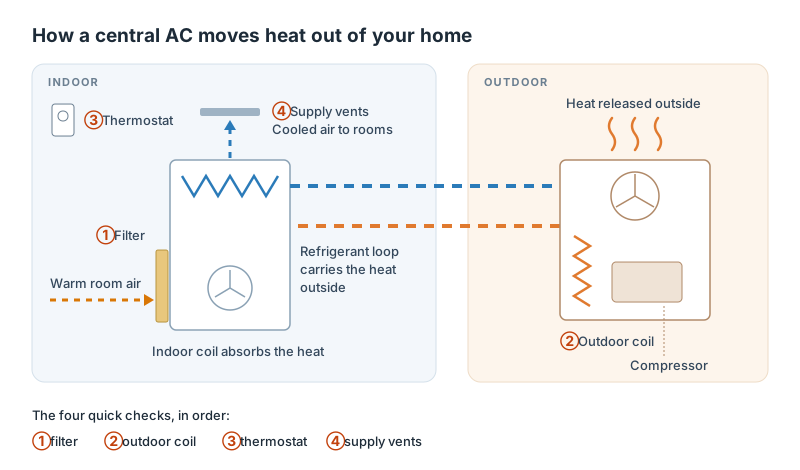
When an air conditioner runs but blows room-temperature air, the cause is almost always one of four cheap, fixable things:
- A clogged air filter
- A dirty outdoor coil
- A thermostat set wrong
- Blocked or closed vents
Work through those first, they solve the large majority of "not cooling" calls and cost nothing but a little time.
The rest of this guide covers the deeper causes, a frozen coil, low refrigerant, a failing compressor, and, just as important, how to recognize when you're past the point of DIY and should hand it to a licensed tech. Many of the common causes take only minutes to check, and several are fixes you can make yourself; the trick is working from the simple checks toward the complex ones, not the other way around.
Cut the power at both the thermostat and the breaker panel before touching any component. Never work on electrical parts while the system is live. If you smell gas, see sparking, or hear grinding, stop and call a professional.
How Cooling Actually Fails
Your AC doesn't "make cold", it moves heat out of your house through a refrigeration cycle. Three things have to work for that to happen:
- Airflow has to move freely over both coils
- The refrigerant charge has to be correct
- The electrical components (compressor, fan motors, controls) all have to fire
Break any one of those and the system will hum along looking fine while your house stays warm.
That's why the fixes below are ordered by how often they're the culprit, not by how dramatic they sound. The vast majority of the time it's airflow.
The Quick Diagnostic
Before you touch anything, measure what's actually happening:
- Set the thermostat 5°F below room temperature and let the system run 15 minutes.
- Hold a thermometer at a supply vent, then at the return vent.
- Subtract: return temperature minus supply temperature.
A healthy system pulls the supply air about 15–20°F colder than the return, that's the normal "temperature split" technicians look for. Land in the 10–15°F range and you've got reduced capacity with several possible causes. Under 10°F points to a real problem, and the fixes below will help you find it.
1. Start With the Filter (a few minutes, no tools)
This is the first thing every tech checks, because it's the most common cause by a wide margin. A clogged filter starves the evaporator coil of the airflow it needs to absorb heat, and the coil can even freeze. Per the U.S. Department of Energy, simply replacing a dirty, clogged filter with a clean one can cut an AC's energy use by 5–15%, and a badly blocked filter can stop cooling outright.
Pull yours and hold it up to a light. If you can't see through it clearly, replace it rather than knocking the dust off, matching the size printed on the frame and the airflow arrow, which points toward the air handler; for most homes a MERV 6–11 filter balances filtration and airflow.
Don't run the system without a filter, even briefly: the evaporator coil collects dust quickly, and cleaning it is a job for a pro.
| Filter Type | MERV Rating | Replace Every | Trade-off |
|---|---|---|---|
| Fiberglass | 1–4 | Monthly | Low airflow resistance, basic filtration |
| Pleated standard | 5–8 | Couple of months | Good balance for most homes |
| High-efficiency | 9–12 | Few months | Better filtration, check monthly |
| Premium pleated | 13–16 | A few times a year | Max filtration, watch airflow closely |
2. Hose Down the Outdoor Coil
The outdoor unit's job is to dump the heat your system pulled from inside. When its coils are packed with grass clippings, cottonwood, or dryer lint, that heat has nowhere to go, so the compressor works harder and cooling drops off, sometimes sharply.
Kill the power at the disconnect first. Pull the top or side panels (usually a few screws), lift out the big debris by hand, and gently straighten any bent fins.
Then rinse the coils with a garden hose from the inside out, so you push dirt back the way it came rather than driving it deeper; a no-rinse coil cleaner helps with greasy buildup, but plain water clears most of it. Let it dry, reassemble, and give it 15 minutes to prove itself.
If the fins are crushed flat across a wide area, or the unit's been running hot for a while, that's worth a professional cleaning, heavy contamination usually needs coil chemistry and a pressure rinse you don't want to improvise near live electrical.
3. Rule Out the Thermostat
It sounds too simple, but a surprising share of "no cooling" calls come down to settings. Confirm the mode is on Cool (not Auto, which can call for heat), the fan is on Auto (not On, which just circulates room-temp air and fools you into thinking the system runs), and no leftover schedule is overriding you.
Then check the thermostat's accuracy: set a thermometer next to it, wait 15 minutes, and compare. More than a couple of degrees off and it's mis-reading the room; recalibrate it, replace the batteries, or move it if it sits in sunlight or above a heat source. For a smart or Wi-Fi model, a dropped network connection or a bad remote sensor can quietly stop a cooling call.
| Problem | What Happens | Fix |
|---|---|---|
| Fan set to 'On' | Circulates room-temp air, poor humidity control | Switch to 'Auto' |
| Auto changeover | System may call heat instead of cool | Set specifically to 'Cool' |
| Schedule override | Programming beats your manual setting | Clear or edit the schedule |
| Dead batteries | Erratic or no response | Replace at each time change |
| Poor location | False readings from sun/heat | Relocate away from heat sources |
4. Open the Vents, But Not Too Many Closed
Closed or furniture-blocked supply vents choke the whole system. Homeowners often close vents in unused rooms to "save energy," but modern systems are engineered to move a fixed volume of air, close too many and you spike static pressure, starve the coil, and can freeze it solid.
Walk the house: open every supply vent's damper fully, clear rugs and furniture off them, and make sure return grilles are unobstructed too. As a working rule, keep most of your vents fully open, closing more than a handful does more harm than the pennies it saves.
Shutting too many of your vents raises static pressure, hurts efficiency, and can freeze the evaporator coil or damage the blower. When in doubt, leave them open.
5. Check the Refrigerant Lines
The two copper lines running between your indoor and outdoor units can get kinked, crushed, or lose their insulation, any of which drags down performance. Follow them end to end and look for obvious damage. The larger suction line (it runs cold) should be fully insulated; bare spots there cost you efficiency and can drip condensation.
What you're really hunting for are the tells of a bigger problem: ice on the lines, oily residue at the connections, or a faint hissing. Those point to a refrigerant leak, note them and move to the refrigerant section below, because that's not a DIY repair.
6. Reset the Breakers and Check the Disconnect
An AC pulls a heavy startup surge, and a tripped breaker or blown fuse on the outdoor circuit can leave the indoor fan running (so it sounds like the system's on) while the compressor sits dead. That combination, air moving, no cooling, is a classic sign to check power.
At the panel, look for an AC breaker that's tripped (handle mid-position); flip it fully off, then back on. At the outdoor unit, open the disconnect box and confirm the switch is on and any cartridge fuses are intact. One caution: a breaker that trips again the moment you reset it is telling you something is wrong downstream, a shorted component or a failing compressor, and that's where you stop and call a pro.
| Symptom | Likely Cause | Action |
|---|---|---|
| Breaker trips immediately | Short or compressor failure | Call an electrician / HVAC tech |
| Burning smell | Overheated wiring or components | Shut off, call a professional |
| Sparking | Loose or damaged connections | Emergency shutdown, call an electrician |
| Repeated trips | Overload or failing component | Professional diagnosis |
Diagnosis is fine; repairs are not. HVAC circuits carry high voltage that can injure or kill. If a fix requires opening wiring or replacing electrical components, that's a licensed job.
7. Inspect the Indoor (Evaporator) Coil
The indoor coil is where heat actually leaves your air. When it's coated in dust, usually because the system ran with a bad or missing filter, it can't absorb heat well, and cooling falls off even though everything's running.
Getting to it means pulling the access panel on the air handler (a few screws). Look for a gray felt of dust on the fins, or ice (if you find ice, jump to the frozen-coil section).
Loose dust comes off with a soft brush and a vacuum, and a no-rinse evaporator cleaner handles the rest. While you're in there, clear the condensate drain pan and drain line, since standing water and algae cause their own cooling and water-damage problems. If the coil is heavily fouled or the fins are damaged, it's a job for a professional.
8. Suspect Low Refrigerant? How to Tell, and Why to Call
Low refrigerant is a common cause of weak cooling, but homeowners need to know one thing up front: an AC doesn't "use up" refrigerant. If you're low, you have a leak, and topping it off without finding the leak just wastes money and vents refrigerant into the atmosphere.
You can't diagnose or fix this yourself, and it's not a gray area, under EPA Section 608, only certified technicians may buy or handle refrigerant. What you can do is spot the signs so you call with the right information:
- Visual: ice on the indoor or outdoor coil, oily film around the line connections, cooling that never catches up no matter how long it runs.
- Sound: hissing or bubbling from the lines.
- Performance: supply air that just won't hit the setpoint, or short, frequent cycling.
A proper repair means the tech finds and fixes the leak, recovers the old charge, evacuates the system, and recharges to spec, not a quick "recharge" that leaks out again by next summer.
| Refrigerant | Typical Systems | Notes |
|---|---|---|
| R-410A | Most residential systems 2006+ | Being phased down under the AIM Act |
| R-22 (Freon) | Pre-2010 systems | Phased out; expensive to service |
| R-32 | Newer high-efficiency systems | Lower global-warming potential |
| R-454B | 2025+ systems | The current low-GWP replacement for R-410A |
9. Thaw a Frozen Evaporator Coil
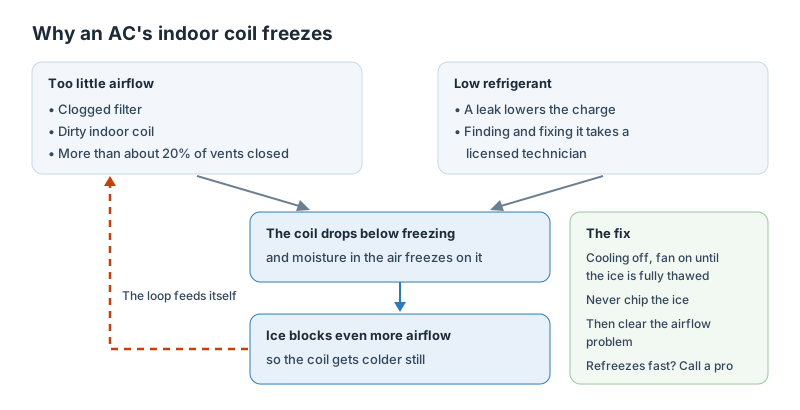
A coil encased in ice can't absorb heat, so you get no cooling despite the system running full tilt. Ironically, it usually traces back to the airflow problems above, a dirty filter, closed vents, or a fouled coil, or to low refrigerant.
The fix starts with patience: turn cooling off, switch the fan to On to move room air across the ice, and wait. Small buildups clear in a couple of hours; a heavy freeze can take most of a day.
Never chip at the ice, or you'll puncture the coil. Once it's fully thawed, put in a fresh filter, open the vents and check the coil; if it freezes again quickly, have a technician check the refrigerant charge.
Cooling with iced coils can slug liquid back to the compressor and destroy it, a seized compressor is one of the priciest repairs there is, often more than the aging unit is worth. Let it thaw completely first.
10. Confirm the System Is Sized Right
If your AC has never really kept up, not just this week, sizing may be the issue, and no amount of maintenance fixes that. An undersized unit runs nonstop and still loses ground on the hottest days; an oversized one short-cycles, cools the air fast but leaves it clammy because it never runs long enough to pull humidity.
The only real answer is an ACCA Manual J load calculation, which weighs your square footage, insulation, windows, orientation, and local design temperature, a rule of thumb on a spec sheet won't cut it. Our BTU calculator gives you a solid first estimate, and for equipment selection the SEER2 rating guide explains what the efficiency numbers actually buy you. Suspect sizing after a renovation, an addition, or a like-for-like swap of an old system that was itself guessed at.
11. Look for Duct Leaks
Even a perfect AC can't cool if the cold air never reaches your rooms. Leaky, poorly insulated ducts are a bigger thief than most people realize: ENERGY STAR estimates that duct leaks can cut a system's efficiency by as much as 20%.
Check the accessible runs in your basement, attic or crawlspace for disconnections, tears and crushed insulation. You can feel for escaping air at the joints with the system running, or hold a stick of incense near the seams and watch the smoke.
Seal with mastic or foil tape rather than cloth duct tape, which fails; the ducts you can't reach, and any balancing or sizing problems, are a contractor's job. Under the 2021 IECC, ducts in attics need R-8 insulation (3 inches in diameter and larger) and ducts in other unconditioned spaces R-6.
12. Compressor and Control-Board Failures
When you've worked through everything above and still have no cooling, you're into the components that need a technician: the compressor itself, the metering (expansion) valve, or the control board and sensors. These are the least common causes on this list, but they're where the big-ticket repairs live, so it's worth knowing the signs before the service call.
Tell-tales include a compressor that won't start despite good power, burning smells or sparking (shut off immediately), refrigerant-leak signs from section 8, or breakers that keep tripping after you've cleared the basics. A tech will run electrical tests on the major components, check refrigerant pressures and temperatures, and measure airflow and static pressure to isolate it.
| Level | What it covers | Who handles it |
|---|---|---|
| Free checks | Filter, vents, thermostat, a rinse of the outdoor coil | You, no parts or tools |
| Diagnostic visit | A tech finds the fault; often credited toward the repair | Licensed tech |
| Minor parts | A capacitor or contactor | Licensed tech |
| Major repair | A refrigerant leak or a failed compressor | Licensed tech |
| Full replacement | When several major parts fail at once | Licensed tech |
The ladder runs cheapest to most expensive to set expectations, it isn't a price quote, and actual pricing swings widely by region, system type, refrigerant, and contractor. Always get an itemized estimate before authorizing major work.
Keeping Cooling Problems From Coming Back
Most of what breaks cooling is preventable with a little rhythm:
- Monthly: check the filter (replace if dirty), clear debris from around the outdoor unit, and confirm vents are open.
- Seasonally: rinse the outdoor coil, and watch for the temperature-split and airflow you established in the diagnostic above.
- Yearly: a professional tune-up, refrigerant check, coil cleaning, electrical inspection, airflow measurement.
A well-maintained system holds closer to its rated efficiency and tends to last longer than a neglected one. A yearly professional tune-up is modest next to the cost and timing of an emergency repair in a July heat wave, though the actual savings depend on your system and climate.
Frequently Asked Questions
Watch for ice on the coils, a hissing sound near the lines, oily residue at the connections, and cooling that never catches up despite long run times. But diagnosis and repair require an EPA Section 608 certified technician, refrigerant isn't a DIY fix, and low charge always means a leak that needs finding, not just topping off.
When You Just Need Relief Right Now
While you work the problem, a few things buy comfort: close blinds on sun-facing windows, run ceiling fans (moving air lets you feel comfortable a few degrees warmer), hold off on the oven and dryer during the hottest hours, and shift a window or portable unit into the room that matters most. None of these fix the AC, they just make the wait bearable.
The Bottom Line
When an AC runs but won't cool, work through it in order. Start with the four free airflow checks (filter, outdoor coil, thermostat and vents), which often resolve the problem, and move to the deeper causes only once those are ruled out.
Hand off anything involving refrigerant, high-voltage wiring or the compressor to a licensed pro, and keep up the monthly and yearly maintenance to avoid most of these problems in the first place.
Sources & References
- U.S. DOE: Energy Saver 101, Home Cooling (PDF), filter energy impact (5–15%), coil cleaning, refrigerant charge, seasonal maintenance
- ENERGY STAR, Duct Sealing: Benefits, duct leaks cut efficiency by as much as 20%
- U.S. EPA, Section 608 Refrigerant Handling Certification, why refrigerant work is pros-only
- ACCA, Manual S Equipment Selection, load calculation and equipment sizing