
You're adding a dryer, an EV charger, a range or a hot tub, and you need to know one thing: what size wire does this 240-volt circuit need? Undersized wire on a high-draw circuit overheats, which is a genuine fire risk, so it's worth getting right.
Wire size isn't just a lookup by amperage, which is what most quick charts leave out. It also depends on whether the load runs continuously (like an EV charger), the wire's temperature rating, copper or aluminum, and the length of the run. This page gives the standard NEC reference sizes and the four factors that change them, so you can understand your circuit instead of copying a number that may not fit it.
The wire-to-amperage pairings follow the National Electrical Code (NEC).
One thing up front, because it's the truth and not a disclaimer we're hiding: a new 240-volt circuit almost always requires a permit and inspection, and in most places it's work a licensed electrician should do or verify. This page will help you understand what your circuit needs and talk to your electrician with confidence, but the sizing has to be confirmed against your specific appliance's nameplate and your local code.
The NEC minimum copper wire sizes for common 240V circuits: 30 amps needs 10 AWG, 40 amps needs 8 AWG, and 50 amps needs 6 AWG. But those are baselines, continuous loads, long runs, aluminum wire, and your appliance's actual nameplate rating can all change what you need. Read the section below before you buy wire.
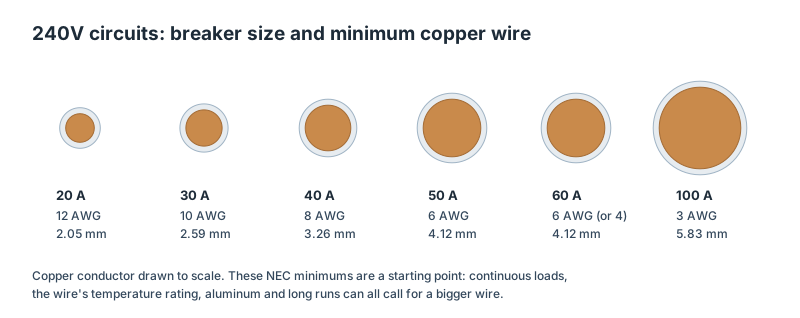
The standard reference sizes (NEC minimums)
For a standard 240V circuit with copper wire at typical conditions, these are the NEC minimum wire gauges by breaker size. This is your starting point, not your final answer (the next section explains why).
| Breaker / circuit | Minimum copper wire | Common use |
|---|---|---|
| 20 amp | 12 AWG | Small 240V appliances |
| 30 amp | 10 AWG | Electric dryer, small AC |
| 40 amp | 8 AWG | Electric range, water heater |
| 50 amp | 6 AWG | Range, EV charger, hot tub, sub-panel |
| 60 amp | 6 AWG (or 4 AWG) | Larger sub-panel, some EV |
| 100 amp | 3 AWG | Sub-panel |
These follow the NEC ampacity tables (Table 310.16) and the small-conductor rule (NEC 240.4(D)), which is why, for example, 10 AWG copper is capped at 30 amps on a branch circuit even though its raw ampacity is slightly higher.
These sizes assume NM-B cable, which is held to the 60°C column. Individual THHN conductors in conduit with 75°C terminations carry more (8 AWG copper is rated 50 A at 75°C), and air conditioners follow their nameplate MCA and MOP under NEC Article 440.
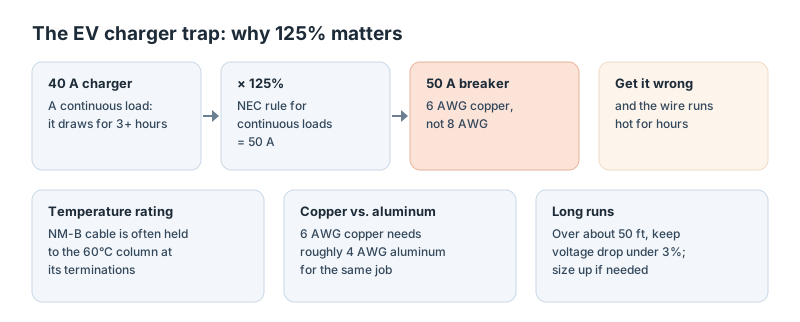
The four things that change your wire size (this is the important part)
If you take one thing from this page, take this: the table above is a starting point, and four factors can push you to a larger wire. This is where simplified charts get people into trouble.
1. Continuous loads need 25% more (the EV charger trap). The NEC requires circuits for continuous loads (anything drawing for 3+ hours, like an EV charger or an electric heater) to be sized at 125% of the load. This is the single most common dangerous mistake. A 40-amp EV charger draws 40 amps continuously, so people grab 8 AWG (rated for 40–50 amps).
But the 125% rule means that 40-amp continuous load needs a 50-amp breaker and 6 AWG copper, not 8 AWG. Getting this wrong means the wire runs hot for hours at a time.
2. Wire temperature rating matters (the 60/75/90°C columns). The same gauge wire has different ampacity depending on its insulation's temperature rating, and cheaper NM-B cable (Romex) is often held to the lower 60°C column at its terminations. A 6 AWG wire that's rated for 50 amps in one column may only be rated lower in another. This is why "6 AWG = 50 amps" isn't universally true, it depends on the wire type and how it's terminated.
3. Copper vs. aluminum are not interchangeable. Aluminum wire carries less current than copper of the same gauge, so it has to be sized up. A circuit that needs 6 AWG copper needs roughly 4 AWG aluminum for the same job.
Mixing these up, using an aluminum gauge as if it were copper, is a classic and dangerous undersizing error. If you have aluminum wire, every size in the table above goes up.
4. Long runs need thicker wire (voltage drop). On runs longer than about 50 feet, voltage drop becomes significant. The NEC recommends keeping voltage drop under 3% on a branch circuit, and a long run can require going up a wire size (or more) to stay within that, even though the ampacity table says the smaller wire is "fine." An EV charger 150 feet from the panel might need 4 AWG instead of the 6 AWG the amperage alone suggests.
The one number that overrides everything: your appliance nameplate
For hardwired 240V equipment, especially AC units and EV chargers, the appliance's data plate has the final word. Look for two ratings:
- Minimum Circuit Ampacity (MCA): the smallest circuit the unit can safely use, this tells you the minimum wire size.
- Maximum Overcurrent Protection (MOP): the largest breaker you can put on the circuit.
Size your wire and breaker to these nameplate numbers, not to a generic chart. The manufacturer engineered those values for that specific unit. If the nameplate and a general table ever disagree, the nameplate wins.
"Can I do this myself?"
Some 240V work is within reach of an experienced DIYer, and some jurisdictions let homeowners pull their own permit for work on their primary residence. But three things are true:
- A new 240V circuit almost always requires a permit and an inspection. This isn't bureaucratic box-ticking, the inspection exists precisely because a wiring error on a high-draw circuit is a fire risk, and an inspector catches the mistakes (wrong gauge, missing continuous-load upsizing, improper terminations) that a homeowner doesn't know to look for.
- The failure mode is severe. A mistake here doesn't cause an inconvenience; it causes overheating inside your walls. That's a different risk category than swapping an outlet.
- The cost of getting it right is small relative to the stakes. Having a licensed electrician size, install, and certify a 240V circuit is not expensive compared to the consequences of an undersized one.
Our recommendation: use this page to understand your circuit, then have a licensed electrician do or verify the work and handle the permit. If you do it yourself, at minimum pull the permit and get it inspected; the inspection is your safety net.
Frequently asked questions
What size wire do I need for a 240V dryer? A standard electric dryer is a 30-amp circuit, which needs 10 AWG copper wire on a 30-amp breaker (typically 10/3 cable with ground, for a NEMA 14-30 outlet). This is one of the most standardized residential circuits. Confirm against your dryer's nameplate.
What size wire for a 50-amp 240V circuit? The NEC minimum is 6 AWG copper for a 50-amp circuit. But if it's a continuous load like an EV charger, remember the 125% rule, and on long runs, voltage drop may require upsizing.
Aluminum would need to be larger (about 4 AWG). Always confirm against the appliance nameplate and your local code.
What wire do I need for a 40-amp EV charger? This is the classic trap. A 40-amp EV charger is a continuous load, so the NEC 125% rule means it needs a 50-amp breaker and 6 AWG copper, not the 8 AWG that 40 amps alone would suggest. On long runs it may need to go larger still for voltage drop.
Is 240V wiring something I can do myself? It depends on your experience and local rules, but a new 240V circuit almost always requires a permit and inspection, and the fire risk from an error makes it work most people should have a licensed electrician do or verify. If you DIY, pull the permit and get it inspected, that's your safety check.
Does copper or aluminum wire change the size I need? Yes, significantly. Aluminum carries less current than copper of the same gauge, so every size goes up.
A circuit needing 6 AWG copper needs roughly 4 AWG aluminum. Never substitute one for the other by matching gauge numbers, that's a dangerous undersizing error.
About these figures
The wire-to-amperage pairings and the rules that govern them are from the National Electrical Code (NEC / NFPA 70), specifically the conductor ampacity tables (Table 310.16), the small-conductor rule (240.4(D)), the continuous-load 125% requirement, and the voltage-drop recommendations (210.19). Because wire sizing depends on conductor material, insulation temperature rating, ambient conditions, load type, and run length, the sizes here are minimum references for typical conditions, not universal answers, and every circuit should be sized to the specific appliance's nameplate ratings (MCA/MOP) and verified against your local code and inspection. For any 240V installation, confirm the design with a licensed electrician; the NEC itself is the authoritative standard, adopted (sometimes with amendments) by your local jurisdiction.
Sources & References
Related Articles
3-Phase Power Calculator: kW to Amps, Amps to kW (2026)
calculator • 5 min read
Electrical Panel Upgrade Cost: 100 to 200 Amp (2026 Guide)
cost-guide • 8 min read
How Many Amps Does a House Use? (Service Size and Load, 2026)
explainer • 7 min read
Water Heater Wire & Breaker Size Chart: AWG Gauge & Amps (2026)
reference • 8 min read