KEEP+

3-Phase Power Calculator: kW to Amps, Amps to kW (2026)

Free 3-phase power calculator to convert between kW, amps, and kVA. Includes formulas for 208V, 240V, 480V, and 600V systems with power factor calculations and wire sizing guidance.

HVAC Base TeamUpdated February 5, 202616 min read

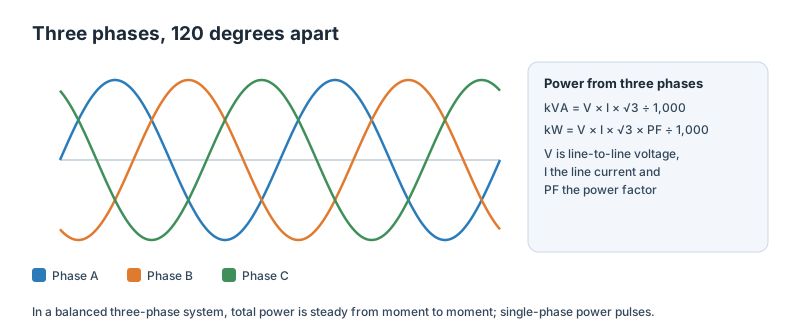
For 3-phase power at 480V with power factor 0.85: 10 kW = 14.2 amps, and 50 amps = 35.3 kW. The formulas differ from single-phase because 3-phase power uses three conductors carrying current 120° out of phase with each other, resulting in the √3 (1.732) factor that appears in all 3-phase calculations.

Use the calculator below for instant conversions, then review the formulas and reference tables for common 3-phase HVAC and commercial equipment.

3-Phase Power Formulas

kW to Amps (3-Phase)

Amps = (kW × 1,000) ÷ (Volts × √3 × Power Factor)

For 480V at PF 0.85: Amps = kW × 1,000 ÷ (480 × 1.732 × 0.85) = kW × 1.415

Amps to kW (3-Phase)

kW = (Amps × Volts × √3 × Power Factor) ÷ 1,000

For 480V at PF 0.85: kW = Amps × 480 × 1.732 × 0.85 ÷ 1,000 = Amps × 0.707

kVA to Amps (3-Phase)

Amps = (kVA × 1,000) ÷ (Volts × √3)

For 480V: Amps = kVA × 1,000 ÷ (480 × 1.732) = kVA × 1.203

Amps to kVA (3-Phase)

kVA = (Amps × Volts × √3) ÷ 1,000

For 480V: kVA = Amps × 480 × 1.732 ÷ 1,000 = Amps × 0.831

Important

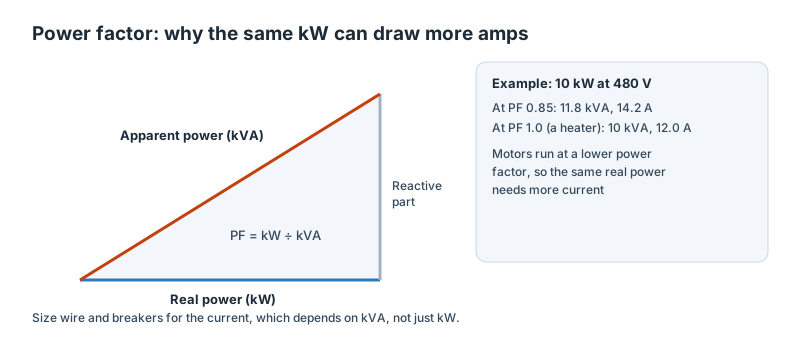
Power Factor (PF) is crucial for kW calculations. kVA is "apparent power" (volts × amps). kW is "real power" (what actually does work). The relationship: kW = kVA × PF. Motors typically have PF of 0.80–0.90. Resistive loads (heaters) have PF of 1.0. Always check equipment nameplates for actual PF.

Quick Reference Tables

kW to Amps Conversion (Various Voltages, PF = 0.85)

kW208V240V380V480V600V
13.27A2.83A1.79A1.42A1.13A
26.53A5.66A3.58A2.84A2.27A
39.80A8.49A5.37A4.25A3.40A
516.3A14.2A8.94A7.09A5.67A
7.524.5A21.2A13.4A10.6A8.51A
1032.7A28.3A17.9A14.2A11.3A
1549.0A42.5A26.9A21.3A17.0A
2065.3A56.6A35.8A28.4A22.7A
2581.7A70.7A44.7A35.5A28.4A
3098.0A84.9A53.7A42.5A34.0A
40131A113A71.6A56.7A45.4A
50163A142A89.4A70.9A56.7A
75245A212A134A106A85.1A
100327A283A179A142A113A

Motor HP to Amps (3-Phase, Full Load)

HP208V230V460V575V
14.6A4.2A2.1A1.7A
1.56.6A6.0A3.0A2.4A
27.5A6.8A3.4A2.7A
310.6A9.6A4.8A3.9A
517.5A15.2A7.6A6.1A
7.525.3A22.0A11.0A9.0A
1032.2A28.0A14.0A11.0A
1548.3A42.0A21.0A17.0A
2062.1A54.0A27.0A22.0A
2578.2A68.0A34.0A27.0A
3092.0A80.0A40.0A32.0A
40120A104A52.0A41.0A
50150A130A65.0A52.0A
60177A154A77.0A62.0A
75221A192A96.0A77.0A
100285A248A124A99.0A

Values from NEC Table 430.250 (Induction motors, Design B)

Amps to kW Conversion (480V, Various Power Factors)

AmpsPF 0.80PF 0.85PF 0.90PF 1.00
106.65 kW7.07 kW7.49 kW8.31 kW
2013.3 kW14.1 kW15.0 kW16.6 kW
3019.9 kW21.2 kW22.5 kW24.9 kW
5033.2 kW35.3 kW37.4 kW41.6 kW
7549.8 kW53.0 kW56.1 kW62.4 kW
10066.5 kW70.7 kW74.9 kW83.1 kW
15099.7 kW106 kW112 kW125 kW
200133 kW141 kW150 kW166 kW
300199 kW212 kW225 kW249 kW
400266 kW283 kW299 kW333 kW

Understanding 3-Phase Power

What Is 3-Phase Power?

3-phase power uses three conductors, each carrying alternating current that peaks at different times (120° apart). This provides:

  1. More efficient power delivery: ~1.73× the power of single-phase with only 1.5× the conductors
  2. Smoother motor operation: Constant power delivery (no pulsing like single-phase)
  3. Smaller equipment: Motors, generators, and transformers are physically smaller for the same power rating

3-Phase vs. Single-Phase Comparison

PropertySingle-Phase3-Phase
Conductors2 (hot + neutral) or 2 hots3 hots (+ neutral for 4-wire)
Power formulaV × I × PFV × I × √3 × PF
10kW at 240V41.7A (PF 1.0)24.1A (PF 1.0)
Motor smoothnessPulsating torqueConstant torque
Residential useStandardRare (large homes)
Commercial useSmall loadsStandard
Wire sizing (10kW)LargerSmaller

Common 3-Phase Voltages

VoltageConfigurationCommon Use
208V3-phase wyeSmall commercial HVAC, motors
240V3-phase deltaMotor loads, welders
380V3-phase wye (European)International equipment
480V3-phase wyeLarge commercial/industrial HVAC
600V3-phase wye (Canada)Industrial in Canada
Good to Know

208V 3-phase is NOT the same as 240V single-phase. In a 208V 3-phase wye system, 208V is the line-to-line voltage (120V line-to-neutral × √3 = 208V). Equipment rated for 240V single-phase may not work correctly on 208V 3-phase — the voltage is 13% lower, which affects motor performance and heater output.

3-Phase HVAC Equipment Sizing

Commercial Air Conditioners and Chillers

Cooling CapacityTypical kW208V Amps480V AmpsWire (480V)
5 tons6–8 kW20–26A8–11A14 AWG
7.5 tons9–12 kW29–39A13–17A14–12 AWG
10 tons12–16 kW39–52A17–23A12–10 AWG
15 tons18–24 kW59–78A25–34A10–8 AWG
20 tons24–32 kW78–104A34–45A8–6 AWG
25 tons30–40 kW98–131A42–57A6–4 AWG
30 tons36–48 kW117–157A51–68A4–3 AWG
40 tons48–64 kW157–209A68–90A3–1 AWG
50 tons60–80 kW196–261A85–113A1–1/0 AWG

Rooftop Units (Packaged HVAC)

Unit SizeCompressor HPFan HPTotal kW480V Amps
3 ton3 HP0.5 HP3.5–4.5 kW5–7A
5 ton5 HP1 HP5.5–7 kW8–10A
7.5 ton7.5 HP1.5 HP8–10 kW11–14A
10 ton10 HP2 HP10–13 kW14–18A
15 ton15 HP3 HP15–20 kW21–28A
20 ton20 HP5 HP20–27 kW28–38A
25 ton25 HP7.5 HP27–35 kW38–50A

Electric Heating (3-Phase)

Heating ElementkW208V Amps240V Amps480V Amps
5 kW513.9A12.0A6.0A
10 kW1027.8A24.1A12.0A
15 kW1541.7A36.1A18.0A
20 kW2055.6A48.1A24.1A
25 kW2569.4A60.1A30.1A
30 kW3083.3A72.2A36.1A
40 kW40111A96.2A48.1A
50 kW50139A120A60.2A

Electric heating has PF = 1.0, so kW = kVA

Wire Sizing for 3-Phase Circuits

NEC Table 310.16 Ampacity (3-Phase, Copper, 75°C)

Wire GaugeAmpacityTypical Use
14 AWG20ASmall motors, controls
12 AWG25A5 HP motors at 480V
10 AWG35A7.5 HP motors at 480V
8 AWG50A15 HP motors at 480V
6 AWG65A20 HP motors at 480V
4 AWG85A25–30 HP motors at 480V
3 AWG100A40 HP motors at 480V
2 AWG115A50 HP motors at 480V
1 AWG130ASub-feeders
1/0 AWG150A75 HP motors at 480V
2/0 AWG175A100 HP motors at 480V
3/0 AWG200AService entrance
4/0 AWG230AService entrance
250 kcmil255ALarge feeders
300 kcmil285ALarge feeders
350 kcmil310ALarge feeders
500 kcmil380AMain service
Warning

Motor circuits have special sizing rules. NEC Article 430 requires conductors sized at 125% of motor full-load current, and overcurrent protection sized up to 250% for standard motors (to handle starting current). Always reference NEC Tables 430.248–430.250 for motor FLA values rather than nameplate data.

Power Factor Correction

Why Power Factor Matters

Low power factor means:

  • Higher current for the same real power
  • Larger wire sizes needed
  • Utility penalties (commercial accounts)
  • Reduced transformer capacity
Load TypeTypical Power Factor
Incandescent lighting1.00
Resistive heating1.00
LED lighting (good ballast)0.90–0.98
Fluorescent lighting0.85–0.95
AC motors (full load)0.85–0.90
AC motors (partial load)0.50–0.80
VFD-driven motors0.95–0.99
Welders0.50–0.70

Calculating Capacitor kVAR for Correction

kVAR needed = kW × (tan(cos⁻¹(PF₁)) - tan(cos⁻¹(PF₂)))

To correct 100 kW load from PF 0.75 to PF 0.95:

  • tan(cos⁻¹(0.75)) = 0.882
  • tan(cos⁻¹(0.95)) = 0.329
  • kVAR = 100 × (0.882 - 0.329) = 55.3 kVAR

Real-World Examples

Example 1: Sizing Wire for 3-Phase RTU

Scenario: 20-ton rooftop unit, 480V 3-phase. Nameplate: 30 kW, PF 0.85.

Calculation:

  • Amps = 30,000 ÷ (480 × 1.732 × 0.85) = 42.5A
  • 125% for continuous load = 53.1A
  • Wire: 6 AWG copper (65A ampacity)
  • Breaker: Per NEC 440, up to 175% of 42.5A = 74.4A → 70A or 80A

Example 2: Converting HP to kW

Scenario: 25 HP motor, 480V, 3-phase. What's the power draw?

From NEC Table 430.250: 25 HP at 460V = 34A FLA

Power calculation:

  • kVA = 34 × 480 × 1.732 ÷ 1000 = 28.3 kVA
  • Assuming PF 0.87: kW = 28.3 × 0.87 = 24.6 kW

Verification: 25 HP × 0.746 kW/HP = 18.65 kW mechanical output. At ~75% motor efficiency: 18.65 ÷ 0.75 = 24.9 kW input. ✓

Example 3: Panel Load Calculation

Scenario: New commercial HVAC installation with:

  • (2) 10-ton AC units at 14 kW each
  • (1) 30 kW electric heater
  • (4) 2 HP exhaust fans at 2.5 kW each

Total load:

  • AC units: 2 × 14 = 28 kW
  • Heater: 30 kW
  • Fans: 4 × 2.5 = 10 kW
  • Total: 68 kW

Current at 480V, PF 0.85:

  • Amps = 68,000 ÷ (480 × 1.732 × 0.85) = 96.3A
  • With demand factors, likely ~80A effective

Service: 200A, 3-phase, 480V service with room for growth

Example 4: Comparing 208V vs. 480V Wiring Cost

Scenario: 50 kW load requires wiring. Compare 208V and 480V options.

VoltageAmps (PF 0.85)Wire SizeApprox. Cost (100 ft, 3 conductors)
208V163A2/0 AWG$800–$1,200
480V70.9A4 AWG$200–$350

Savings at 480V: ~$500–$850 in wire costs alone, plus smaller conduit, easier installation.

Key Takeaways

Key Takeaway
  • 3-phase formula: Amps = kW × 1000 ÷ (V × √3 × PF) — the √3 factor (1.732) is essential
  • Power factor matters: PF 0.85 is typical for motors; PF 1.0 for resistive heating
  • 480V uses ~2.3× less current than 208V for the same power — smaller wire, lower cost
  • Motor FLA from NEC tables, not nameplates — use Tables 430.248–430.250
  • kVA ≠ kW — kW = kVA × Power Factor (real power vs. apparent power)
  • Motor circuits: Wire at 125% of FLA, breakers up to 175–250% of FLA
  • Always verify voltage configuration: 208V 3-phase ≠ 240V single-phase

Frequently Asked Questions

Related Articles