
You're deciding between a mini split and central air, and you want to know which is better for your situation. It does depend, but on a small number of specific things you can check, and this guide walks through them.
It compares the two on the eight things that matter (efficiency, cost, installation, zoning, aesthetics, noise, maintenance and resale) and gives a clear decision framework, with efficiency figures from the DOE and ENERGY STAR.
The short answer: if your home already has ductwork in good condition, central air is usually the simpler and often cheaper choice. If you don't have ducts, need to condition specific rooms, or want room-by-room temperature control, a mini split delivers better efficiency and value. The single biggest factor is whether you already have usable ductwork, that one thing tips most decisions.
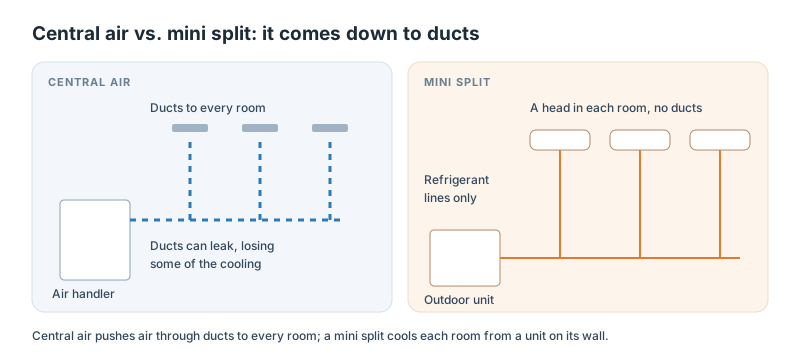
The core difference: ducts
Everything flows from one distinction. Central air pushes conditioned air through ductwork to every room; a mini split delivers it straight from an indoor unit mounted in the room, with no ducts.
That matters more than it sounds, because ducts leak.
A typical duct system loses a substantial share of the energy moving through it, ENERGY STAR says leaky ducts can reduce heating and cooling efficiency by as much as 20%, and the DOE puts duct air losses at about 30% of a cooling system's energy consumption, from leaks, poor insulation, and connections running through unconditioned attics and crawlspaces. So a central AC rated at, say, SEER2 16 delivers noticeably less than that in practice once duct losses are counted. A mini split has no ducts, so its rated efficiency is much closer to what you actually get, and combined with inverter compressor technology, that's why mini splits are generally the more efficient option.
The 8 key differences, head to head
| # | Category | Mini split | Central air | Edge |
|---|---|---|---|---|
| 1 | Energy efficiency | Higher SEER2, no duct losses | Lower effective efficiency after about 30% duct loss | Mini split |
| 2 | Install (no existing ducts) | Moderate per zone | Much higher (includes ductwork) | Mini split |
| 3 | Install (existing good ducts) | Per-zone cost adds up | Just replace the unit | Central air |
| 4 | Zone control | Independent temperature per room | Usually one thermostat for the house | Mini split |
| 5 | Aesthetics | Visible indoor heads on walls | Hidden, just vents | Central air |
| 6 | Noise | Very quiet indoor heads | Air rushing through ducts/vents | Roughly even |
| 7 | Maintenance | No ducts to clean, wash filters | Duct cleaning, filter changes | Mini split |
| 8 | Resale/familiarity | Growing acceptance | Universally expected and understood | Central air (slightly) |
The pattern: mini splits win on efficiency, ductless installation, and zoning; central air wins on aesthetics, cost-when-you-already-have-ducts, and buyer familiarity. Which set matters more is what decides it for your home.
Efficiency, in more detail
Mini splits are more efficient for two compounding reasons: no duct losses (the DOE puts these at about 30% of a cooling system's energy consumption), and inverter compressors that modulate output to match demand instead of cycling fully on and off. In real-world conditions this adds up to meaningfully lower energy use than a comparable ducted system.
But two caveats keep this from being a blanket "mini splits always cost less to run":
- If you're comparing against central air with good existing ducts, and especially against cheap natural gas heating, the operating-cost gap narrows.
- On the heating side specifically, a mini split heat pump's advantage depends on your local electricity-to-gas price ratio, the same crossover math we cover in our heat pump guide. On cheap gas, a high-efficiency furnace can be competitive to run.
For the actual dollar figures at your rate and climate, our mini split electricity use and cost-to-run guide lets you estimate real numbers rather than trusting a generic comparison.
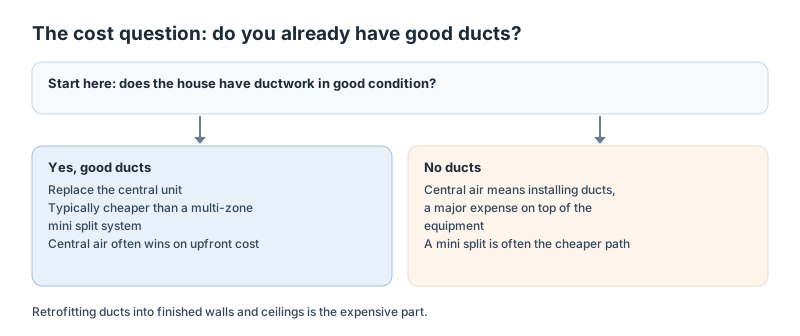
Cost: it hinges entirely on your ductwork
This is where the decision usually gets made, and it splits cleanly:
If you DON'T have ductwork: central air requires installing ducts, which is a major expense on top of the equipment, often making a mini split the clearly cheaper path to cooling those spaces. Retrofitting ducts into a finished home is disruptive and costly.
If you DO have good ductwork: you can simply replace the central unit, which is typically cheaper than installing a multi-zone mini split system, so central air often wins on upfront cost.
For per-scenario pricing, see our mini split installation cost guide. And note on incentives: the federal 25C/25D tax credits expired for installs placed in service after December 31, 2025 (under the OBBBA), but state and utility rebates and the IRA HEAR/HOMES programs remain active in 2026 for qualifying heat pump systems, worth checking before you decide.
Zoning: the mini split's signature advantage
With central air, one thermostat typically governs the whole house, which is why you get hot and cold spots and pay to condition empty rooms. A mini split gives each indoor head its own control, so you can cool the bedroom without freezing the living room, or heat only the rooms you're using. If uneven temperatures or "one room is always uncomfortable" is your problem, zoning is a direct fix, and it's central air's biggest weakness.
When each one wins (the decision framework)
Choose a mini split if:
- Your home has no ductwork, or the existing ducts are in poor condition.
- You're adding AC to specific rooms, an addition, a garage, or a finished basement.
- You want room-by-room temperature control.
- Efficiency and lower operating cost are priorities and you're replacing electric resistance, oil, or propane heat.
Choose central air if:
- You already have ductwork in good condition and just need to replace the system.
- You're conditioning many rooms with similar usage and want one simple whole-house system.
- You prefer no visible indoor equipment.
- Lowest upfront cost matters most and the ducts are already there.
For the fuller picture on mini splits themselves, see our complete mini split guide, and to understand how they work, how a mini split works.
Frequently asked questions
Is a mini split cheaper than central air? It depends entirely on your ductwork. Without existing ducts, a mini split is usually cheaper than central air (which would require installing ductwork).
With good existing ducts, replacing a central unit is often cheaper than a multi-zone mini split. Operating cost also favors mini splits in most cases, but the gap narrows against cheap natural gas.
Are mini splits more efficient than central air? Generally yes. Mini splits avoid duct losses, which the DOE puts at about 30% of a cooling system's energy consumption, and their inverter compressors modulate to match demand. That combination means lower real-world energy use than a comparable ducted system.
Do mini splits heat as well as cool? Yes, most are heat pumps that do both. Cold-climate models heat efficiently well below freezing. Whether heating costs less than a gas furnace depends on your local electricity-to-gas price ratio (see our heat pump guide for that math).
Is central air better for resale value? Central air is universally expected and familiar to buyers, which gives it a slight edge in general resale terms. Mini splits are increasingly accepted, and in homes that never had AC at all, adding a mini split is a clear value and comfort upgrade.
Which is better for a home without ductwork? A mini split, in most cases. Adding ductwork for central air to a home that lacks it is expensive and disruptive, while a mini split delivers conditioned air without ducts and adds zoning as a bonus.
About these figures
The core efficiency claim, that the DOE puts duct air losses at about 30% of a cooling system's energy consumption, is from the U.S. Department of Energy. The efficiency advantages of ductless delivery and inverter compressor operation reflect DOE and ENERGY STAR guidance. Tax-credit information reflects the current federal rules (the 25C/25D credits expired for installs placed in service after December 31, 2025 under the OBBBA; IRA HEAR and HOMES rebates remain active).
Cost comparisons depend heavily on whether a home already has usable ductwork, so rather than assert fixed dollar figures, we describe the cost logic and link to dedicated cost and running-cost guides where you can estimate real numbers at your own rates. The right choice depends on your ductwork, room count, climate and priorities.
Sources & References
Related Articles
AC Dry Mode Explained: What It Does & When to Use It
explainer • 7 min read
What Is a Mini Split and How Does It Work? (Ductless AC Explained)
explainer • 10 min read
Mini Split Air Conditioners: Cost, Efficiency and Installation (2026)
guide • 11 min read
How Much Electricity Does a Mini Split Use? (Watts, kWh & Cost to Run)
data-analysis • 12 min read