
Your electric bill charges you for kilowatt-hours, but appliances are labeled in watts, and the rate on your bill may be split across several lines. This page connects the three: the calculator turns any appliance's wattage and hours into dollars, and the state table shows what a kilowatt-hour actually costs where you live.
A kilowatt-hour costs the average U.S. household about 18 cents: 18.19 cents from January through July 2026, according to the U.S. Energy Information Administration. State averages range from 12.36 cents in North Dakota to 46.28 cents in Hawaii. To find any appliance's cost, multiply its watts by the hours it runs, divide by 1,000, and multiply by your rate.
kWh Cost Calculator
Estimated electricity cost for any appliance.
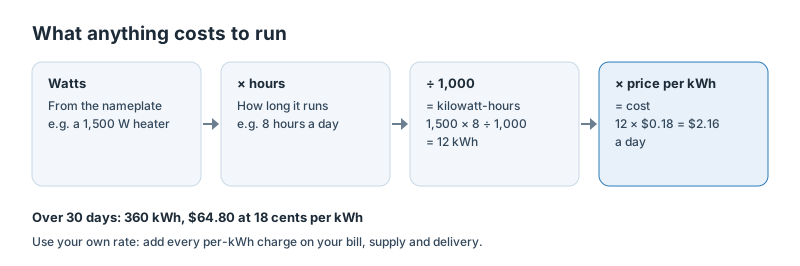
The formula
Cost = watts × hours ÷ 1,000 × price per kWh.
A kilowatt-hour is 1,000 watts running for one hour. A 1,500-watt space heater running 8 hours uses 1,500 × 8 ÷ 1,000 = 12 kWh. At 18 cents that's $2.16 a day, or $64.80 over 30 days.
Your rate is on your bill, often split into supply (generation) and delivery charges. Add up every per-kWh charge to get the rate to use. For an all-in figure that includes fixed monthly fees, divide the bill total by the kWh you used.
Electricity prices by state
Average residential prices from the EIA, in cents per kWh. The "Jan to Jul 2026" column averages out seasonal swings; July shows the latest month. The bill column multiplies each state's January-to-July average by 863 kWh, roughly what an average U.S. home uses in a month (EIA 2024 data), so it isolates the effect of price: actual usage varies by state and season.
| State | Jan to Jul 2026 average | July 2026 | Monthly bill at 863 kWh |
|---|---|---|---|
| Alabama | 16.54¢ | 16.40¢ | $143 |
| Alaska | 27.09¢ | 28.83¢ | $234 |
| Arizona | 15.44¢ | 15.38¢ | $133 |
| Arkansas | 13.61¢ | 14.33¢ | $117 |
| California | 33.25¢ | 33.61¢ | $287 |
| Colorado | 16.72¢ | 17.00¢ | $144 |
| Connecticut | 27.97¢ | 24.16¢ | $241 |
| Delaware | 17.86¢ | 18.48¢ | $154 |
| District of Columbia | 24.66¢ | 25.21¢ | $213 |
| Florida | 15.30¢ | 15.03¢ | $132 |
| Georgia | 15.40¢ | 16.27¢ | $133 |
| Hawaii | 46.28¢ | 48.00¢ | $399 |
| Idaho | 12.96¢ | 13.73¢ | $112 |
| Illinois | 19.22¢ | 19.22¢ | $166 |
| Indiana | 17.04¢ | 16.73¢ | $147 |
| Iowa | 14.20¢ | 15.99¢ | $123 |
| Kansas | 15.21¢ | 15.27¢ | $131 |
| Kentucky | 14.27¢ | 13.81¢ | $123 |
| Louisiana | 13.35¢ | 12.72¢ | $115 |
| Maine | 29.99¢ | 32.41¢ | $259 |
| Maryland | 21.30¢ | 21.41¢ | $184 |
| Massachusetts | 30.14¢ | 30.49¢ | $260 |
| Michigan | 21.53¢ | 23.05¢ | $186 |
| Minnesota | 16.25¢ | 17.45¢ | $140 |
| Mississippi | 15.19¢ | 14.54¢ | $131 |
| Missouri | 13.96¢ | 16.09¢ | $120 |
| Montana | 13.95¢ | 14.99¢ | $120 |
| Nebraska | 12.90¢ | 13.78¢ | $111 |
| Nevada | 13.53¢ | 12.77¢ | $117 |
| New Hampshire | 26.79¢ | 26.60¢ | $231 |
| New Jersey | 23.98¢ | 25.19¢ | $207 |
| New Mexico | 15.08¢ | 16.09¢ | $130 |
| New York | 29.38¢ | 29.90¢ | $254 |
| North Carolina | 14.94¢ | 15.16¢ | $129 |
| North Dakota | 12.36¢ | 13.41¢ | $107 |
| Ohio | 18.70¢ | 19.45¢ | $161 |
| Oklahoma | 13.58¢ | 14.35¢ | $117 |
| Oregon | 15.40¢ | 15.97¢ | $133 |
| Pennsylvania | 21.04¢ | 21.72¢ | $182 |
| Rhode Island | 29.22¢ | 28.29¢ | $252 |
| South Carolina | 15.93¢ | 15.47¢ | $137 |
| South Dakota | 14.50¢ | 15.37¢ | $125 |
| Tennessee | 13.87¢ | 13.71¢ | $120 |
| Texas | 16.06¢ | 15.88¢ | $139 |
| Utah | 13.16¢ | 13.12¢ | $114 |
| Vermont | 23.95¢ | 23.75¢ | $207 |
| Virginia | 16.83¢ | 17.55¢ | $145 |
| Washington | 14.40¢ | 14.71¢ | $124 |
| West Virginia | 15.47¢ | 15.78¢ | $134 |
| Wisconsin | 19.00¢ | 19.06¢ | $164 |
| Wyoming | 13.95¢ | 14.36¢ | $120 |
| U.S. average | 18.19¢ | 18.31¢ | $157 |
Source: EIA Electric Power Monthly, Tables 5.6.A and 5.6.B, July 2026 data released September 24, 2026. The EIA's average price is total residential revenue divided by kilowatt-hours sold, so it includes fixed and delivery charges spread across usage. That's why it can differ from the energy-charge line on your bill.
What's the average electric bill?
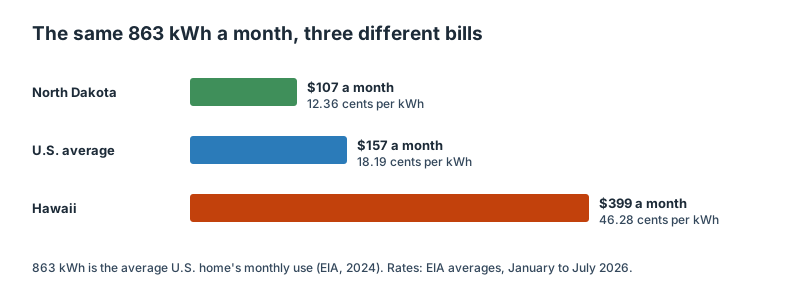
An average U.S. home uses roughly 10,356 kWh a year, about 863 kWh a month (EIA 2024 data; see how many kWh per day is normal). At the January-to-July 2026 national average of 18.19 cents, that's about $157 a month.
The same usage costs about $107 in North Dakota and $399 in Hawaii. Your bill depends on your own usage, which climbs with electric heating, central air, a pool pump or an electric vehicle.
What common appliances cost to run
At 18 cents per kWh and 30 days a month. Wattages are examples; your appliance's label or manual has the real figure, and anything with a thermostat or compressor cycles on and off rather than running at full power the whole time.
| Appliance | Example wattage | Use per day | kWh per month | Cost per month |
|---|---|---|---|---|
| Space heater | 1,500 W | 8 hours | 360 | $64.80 |
| Window AC, 10,000 BTU | 900 W | 8 hours | 216 | $38.88 |
| Desktop computer and monitor | 150 W | 8 hours | 36 | $6.48 |
| LED TV | 100 W | 5 hours | 15 | $2.70 |
| Electric clothes dryer | 5,000 W | 1 hour | 150 | $27.00 |
Time-of-use rates
On a time-of-use plan, the price per kWh depends on when you use it: higher in peak hours (often late afternoon and evening) and lower off-peak. Your utility publishes its own hours and prices. To see the effect, run the calculator twice, once at each rate.
As an example with made-up rates of 40 cents peak and 15 cents off-peak: charging an electric vehicle that uses 300 kWh a month costs $120 on peak and $45 off-peak. Moving flexible loads such as EV charging, dishwashers, laundry and water heating to off-peak hours is what makes these plans pay.
Comparing heating costs by energy source
What one million BTU of delivered heat costs, at 18.19 cents per kWh and an assumed $1.35 per therm of natural gas:
| Heat source | Cost per million BTU of heat |
|---|---|
| Electric resistance (baseboard, space heater) | $53.31 |
| Heat pump averaging a COP of 3 | $17.77 |
| Gas furnace at 95% AFUE | $14.21 |
One million BTU is 293 kWh of electricity. A heat pump moves about three units of heat for each unit of electricity at a COP of 3, which is why it costs a third as much as resistance heat. Gas prices vary as much as electricity prices, so compare using your own rates; our gas vs. electric heating cost guide goes further.
What the calculator can't see
- Time-of-use and tiered rates, where the price changes with the hour or with how much you've used that month.
- Fixed monthly charges, which you pay regardless of usage.
- Demand charges on some plans, based on your highest use in a short window.
- Cycling: a refrigerator or AC runs on and off, so its average draw is below its rated wattage.
The calculator also estimates carbon dioxide from the U.S. grid average of about 0.823 lb per kWh (EPA eGRID2022). Grids that lean on hydro, nuclear or renewables emit less per kWh; coal-heavy grids emit more.
Frequently asked questions
How much does 1 kWh cost?
About 18 cents on average in the U.S.: 18.19 cents from January through July 2026, per the EIA. By state it ranges from 12.36 cents in North Dakota to 46.28 cents in Hawaii.
How do I calculate my cost per kWh from my bill?
Add every per-kWh charge on the bill (supply plus delivery) for your energy rate. For the all-in rate, divide the total bill by the kWh used that month.
Which state has the cheapest electricity?
North Dakota, at 12.36 cents per kWh on average from January through July 2026, followed by Nebraska (12.90) and Idaho (12.96). Hawaii is the most expensive at 46.28 cents.
How much does it cost to run a 1,500-watt heater?
27 cents an hour at 18 cents per kWh (1.5 kWh × $0.18). Eight hours a day for a month is 360 kWh, about $65.
How many kWh does a house use per month?
About 863 kWh on average in the U.S. (EIA 2024 data), though it varies widely with climate, home size and whether heating and hot water are electric.
Sources & References
Related Articles
How to Read Your Electric Meter (Digital + Analog Guide for 2026)
guide • 8 min read
Heating Cost Calculator: Compare Gas vs Electric vs Heat Pump Costs
calculator • 8 min read
How Many kWh Per Day Is Normal? (US Average + By State Data for 2026)
data-analysis • 7 min read
Specific Heat Capacity Calculator: Q = mcΔT for Water, Air and Materials (2026)
calculator • 8 min read