NEWComplete Guide

HVAC Tax Credits 2026: Complete Guide to Federal Credits, IRA Rebates & State Incentives

Federal HVAC tax credits (25C, 25D) are available through December 31, 2026. Here's what's available in 2026 — federal tax credits up to $2,000, state rebates, HOMES, HEAR programs, and how to maximize your savings. Note: Updates for 2027 will be published in January 2027.

HVAC Base TeamUpdated February 7, 202619 min read

Federal HVAC tax credits are still available through December 31, 2026. Section 25C (Energy Efficient Home Improvement Credit) offers up to $2,000 for qualifying heat pumps and $600 for efficient AC systems. Section 25D (Residential Clean Energy Credit) provides 30% back on geothermal systems with no cap. Plus, state rebate programs, utility incentives, and IRA-funded HOMES and HEAR programs are distributing billions in additional savings. Note: This guide will be updated in January 2027 with any changes to federal tax policy.

This guide covers everything you need to know: what expired, what's still available, how to claim 2026 credits on your 2026 tax return, and where to find the best state and local incentives for your HVAC upgrade.

Current Federal Tax Credits for 2026

The Inflation Reduction Act (IRA) tax credits remain in effect through December 31, 2026:

  • Section 25C (Energy Efficient Home Improvement Credit): Up to $2,000 for heat pumps, $600 for AC systems, $500 for furnaces
  • Section 25D (Residential Clean Energy Credit): 30% back on geothermal systems with no cap

These credits have been the backbone of federal HVAC incentives since the Inflation Reduction Act passed in August 2022. They cover heat pumps, central air conditioners, furnaces, boilers, insulation, windows, and geothermal systems.

Important

"Placed in service" is the key date. The IRS defines this as the date your equipment is fully installed and operational — not when you signed a contract, placed an order, or made a payment. Equipment must be installed and operational by December 31, 2026 to qualify for 2026 tax credits.

Timeline of Key Changes

EventDateImpact
Inflation Reduction Act signedAugust 16, 2022Created enhanced 25C/25D credits through 2032
Enhanced 25C took effectJanuary 1, 202330% credit, $3,200 annual cap
PIN requirements beganJanuary 1, 2026Manufacturers required to issue PINs
OBBBA signed into lawJuly 4, 2026Accelerated termination of 25C, 25D
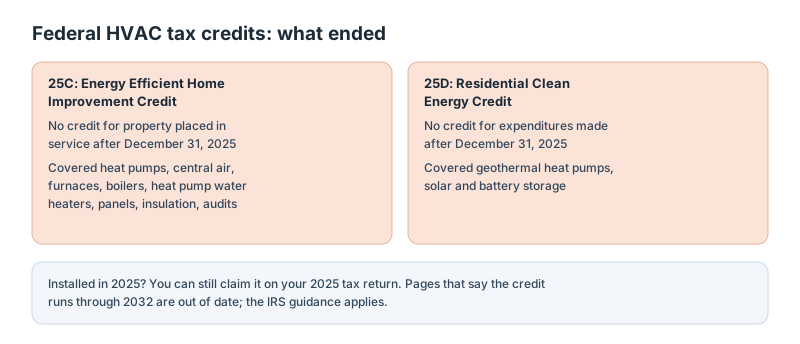
25C and 25D expiredDecember 31, 2026No federal HVAC tax credits for 2026 installations
45L (New Home Credit) expiresJune 30, 2026Builders lose new home efficiency credit
179D (Commercial) expiresJune 30, 2026Commercial building deduction ends

What Federal Credits Were Available (Now Expired)

Understanding what was available helps you determine if you can still claim credits for 2026 installations on your upcoming tax return.

Section 25C Credit Amounts (Through 2026)

EquipmentCreditMax Annual Limit
Air-source heat pumps30% of cost$2,000
Heat pump water heaters30% of cost$2,000
Central air conditioners30% of cost$600
Gas furnaces (95%+ AFUE)30% of cost$600
Boilers (95%+ AFUE)30% of cost$600
Electrical panel upgrades (with HP)30% of cost$600
Insulation & air sealing30% of cost$1,200 combined
Windows & skylights30% of cost$600
Exterior doors30% of cost$250/door, $500 total
Home energy audit30% of cost$150
Combined annual maximum$3,200

Section 25D Credit Amounts (Through 2026)

EquipmentCreditMax Limit
Solar electric (PV) systems30% of costNo cap
Solar water heating30% of costNo cap
Geothermal heat pumps30% of costNo cap
Battery storage (≥3 kWh)30% of costNo cap
Small wind energy30% of costNo cap
Good to Know

Key difference between 25C and 25D: Section 25C had annual caps ($3,200 max) and was nonrefundable. Section 25D had no dollar cap — just 30% of total cost — and allowed unused credits to carry forward. If you have unused 25D credits from 2026 installations, you can still carry them forward on future tax returns under existing IRS rules.

Filing 2026 HVAC Credits on Your 2026 Tax Return

If you installed qualifying equipment before December 31, 2026, you claim those credits when you file your 2026 taxes (typically by April 15, 2026). Here's exactly how.

Step-by-Step Filing Process

Step 1: Gather your documentation. You'll need itemized invoices showing equipment model numbers, the manufacturer's Product Identification Number (PIN) — a 17-character code required for all 25C claims on equipment installed in 2026 — the manufacturer's Qualified Manufacturer Identification Number (QMID), and proof of installation date.

Step 2: Verify equipment eligibility. Your equipment must have met the Consortium for Energy Efficiency (CEE) highest efficiency tier (not including advanced tiers) in effect at the beginning of the year it was installed. Check the ENERGY STAR Product Finder or CEE's qualified product lists.

Step 3: Complete IRS Form 5695. Part I covers Section 25C credits. Part II covers Section 25D credits. Enter equipment costs, calculate 30% of eligible expenses, and apply the annual caps.

Step 4: Transfer to Form 1040. The credit amount from Form 5695 flows to Schedule 3, Line 5 of your Form 1040, reducing your tax liability dollar-for-dollar.

Real-World Example: Claiming a 2026 Heat Pump Installation

The Nguyen family in Phoenix, AZ installed a Carrier Infinity 26 heat pump (SEER2 24, HSPF2 13) in October 2026 for $12,400 total (equipment + installation). Here's their credit calculation:

ItemAmount
Total installed cost$12,400
30% credit$3,720
25C annual cap for heat pumps$2,000
Credit claimed$2,000

They also replaced their insulation ($2,800 installed) and upgraded their electrical panel ($1,900 installed) in the same year:

ItemCost30% CreditCapClaimed
Heat pump$12,400$3,720$2,000$2,000
Insulation$2,800$840$1,200$840
Panel upgrade$1,900$570$600$570
Total$17,100$3,410

Wait — that exceeds $3,200. The heat pump credit has its own $2,000 bucket, and the remaining improvements share a $1,200 bucket. So the Nguyens' combined cap is $3,200, meaning the panel upgrade credit gets trimmed to $360:

CategoryCapClaimed
Heat pump (25C HP bucket)$2,000$2,000
All other improvements (25C general bucket)$1,200$1,200
Total federal credit$3,200$3,200
Warning

Don't forget: 25C is nonrefundable. If the Nguyens only owe $2,500 in federal income tax, they'll receive a $2,500 credit — not $3,200. The remaining $700 cannot be carried forward or refunded. Unlike 25D, unused 25C credits are lost.

Documentation Checklist for 2026 Claims

Keep all of the following for at least 3 years (the IRS recommends keeping basis-related records indefinitely):

  • Itemized contractor invoice with model numbers and installation dates
  • Manufacturer's PIN (17-character code) — required for 2026 25C claims
  • Manufacturer's QMID code
  • AHRI certificate or ENERGY STAR certification
  • Manufacturer's written certification that the product qualifies
  • Photos of installed equipment (recommended, not required)
  • Proof of payment (cancelled checks, credit card statements)
  • Completed IRS Form 5695

What's Still Available in 2026: State & Utility Programs

With federal credits gone, the savings landscape has shifted to state-administered programs, utility rebates, and the remaining IRA-funded rebate initiatives. Here's the current picture.

IRA-Funded State Rebate Programs

The Inflation Reduction Act allocated approximately $8.8 billion for two major rebate programs administered by individual states. Unlike tax credits, these are point-of-sale rebates — meaning you get the discount upfront rather than waiting until tax filing.

HOMES (Home Energy Performance-Based, Whole-House Rebates)

The HOMES program rewards whole-home energy efficiency retrofits. Rebate amounts are based on how much energy your upgrades save.

Energy SavingsStandard HouseholdLow/Moderate Income (≤80% AMI)
20–34% reductionUp to $2,000Up to $4,000
35%+ reductionUp to $4,000Up to $8,000
Multifamily (per unit)Up to $2,000Up to $4,000
Max per household$4,000$8,000

HOMES requires a professional home energy assessment (either modeled or measured savings methodology) and verified energy savings. You can't just swap a furnace — the program incentivizes comprehensive retrofits that address insulation, air sealing, HVAC, and other systems together.

HEAR (Home Electrification and Appliance Rebates)

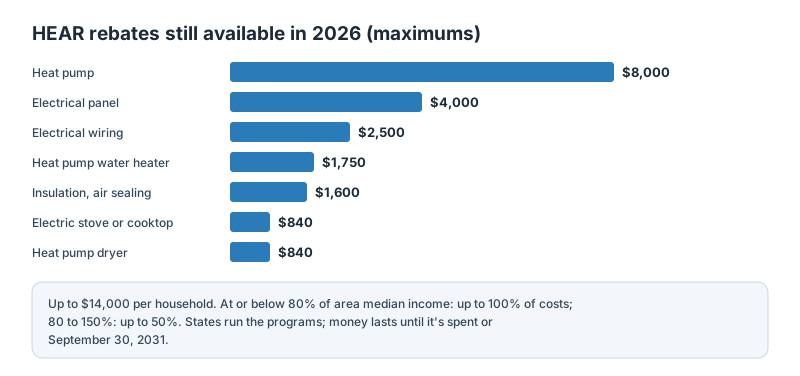
HEAR targets individual appliance upgrades with a focus on electrification. It's only available to households earning less than 150% of area median income (AMI).

EquipmentMax Rebate (≤80% AMI)Max Rebate (80–150% AMI)
Heat pump HVAC$8,000$4,000
Heat pump water heater$1,750$1,750
Electric stove/cooktop$840$840
Insulation & air sealing$1,600$1,600
Electrical panel upgrade$4,000$2,000
Electric wiring$2,500$1,250
Max per household$14,000$7,000
Pro Tip

HOMES and HEAR cannot be combined on the same project, but a household can use both programs for different projects. For example, you could use HEAR for a heat pump installation and HOMES for a separate whole-home weatherization project.

State Program Rollout Status (as of Early 2026)

Program availability varies significantly by state. Some states launched in 2024–2026, while others are still in development.

StatusStates (Examples)
HEAR active and accepting applicationsCalifornia, Colorado, New York, Washington, Maine, North Carolina, Rhode Island, Vermont
HEAR launching Q1–Q2 2026South Carolina, Texas, Pennsylvania, Ohio, Georgia, Florida
HOMES activeNew York, Maine, Rhode Island
HOMES launching 2026Colorado, California, Texas, North Carolina
Still in program designSeveral states — check your state energy office
Warning

Funding is first-come, first-served. California's HEEHRA program for Central and Southern California was fully reserved by January 2026. Once state allocations are exhausted, no additional federal funding is expected. Apply early.

Utility Company Rebates

Nearly every major utility company offers its own efficiency rebates, independent of federal or state programs. These typically range from $200 to $2,000+ and vary by utility, equipment type, and efficiency level.

Utility TypeTypical Rebate RangeCommon Requirements
Electric cooperatives$200–$1,500ENERGY STAR certified
Investor-owned utilities$300–$2,500Specific SEER2/HSPF2 minimums
Municipal utilities$200–$1,000Varies widely
Gas utilities$200–$80095%+ AFUE for furnaces

Real-World Example: Maximizing 2026 Savings Without Federal Credits

Carlos and Maria in Denver, CO need a new heat pump system. Total installed cost: $14,000. Here's how they stack incentives in 2026:

IncentiveSourceAmount
HEAR rebate (household ≤80% AMI)Colorado Energy Office$8,000
Xcel Energy Clean Heat rebateUtility$1,500
Denver metro DRCOG grantRegional$1,200
Total incentives$10,700
Out-of-pocket cost$3,300

That's 76% of the project cost covered — better than any federal tax credit ever offered. The catch? They had to qualify as low-income (≤80% AMI) and use a state-registered HEAR contractor.

Real-World Example: Middle-Income Homeowner in 2026

Jennifer in Raleigh, NC earns $85,000/year (about 120% of her county's AMI). She qualifies for HEAR at the moderate-income tier and is installing a heat pump. Here's her calculation:

IncentiveSourceAmount
HEAR rebate (80–150% AMI)North Carolina Energy Saver NC$4,000
Duke Energy rebateUtility$750
Total incentives$4,750
Heat pump installed cost$11,500
Out-of-pocket cost$6,750

Real-World Example: Higher-Income Homeowner — Limited Options

Dave and Lisa in suburban Dallas, TX earn $180,000/year, well above 150% AMI. Texas hasn't launched its HOMES or HEAR programs yet as of early 2026. Their savings picture is thin:

IncentiveSourceAmount
Oncor utility rebateUtility$400
Manufacturer rebateTrane seasonal promo$1,200
Total incentives$1,600
Mini-split heat pump installed cost$9,800
Out-of-pocket cost$8,200

For higher-income homeowners in states without active IRA rebate programs, utility rebates and manufacturer promotions are the primary savings tools in 2026.

The Post-Federal-Credit Landscape: What to Expect

The elimination of 25C and 25D doesn't mean energy efficiency is dead — it means the incentive structure has fundamentally changed.

Key Shifts in 2026

From tax credits to rebates. Tax credits required waiting until you filed your return the following year. State rebate programs like HEAR offer point-of-sale discounts — you pay less at checkout.

From universal to income-targeted. The 25C credit had no income limit. HEAR is restricted to households earning ≤150% AMI, and the best rebates go to those earning ≤80% AMI. HOMES is available to all income levels, but low-income households get doubled caps.

From national to patchwork. One federal form (5695) covered the entire country. Now you're dealing with your specific state's program rules, your specific utility's rebate requirements, and your specific county's AMI thresholds.

From equipment-based to performance-based. The 25C credit cared about what you installed. HOMES cares about how much energy you save. This favors comprehensive retrofits over one-for-one equipment swaps.

Will Federal HVAC Credits Return?

As of early 2026, there is no pending legislation to reinstate Sections 25C or 25D. The OBBBA represented a deliberate policy decision to phase out these IRA provisions. However, energy policy is always subject to political change. Future legislation could create new incentive programs, though homeowners shouldn't delay needed HVAC replacements waiting for hypothetical credits.

How to Find Every Available Incentive in 2026

Follow this step-by-step process to maximize your savings:

Step 1: Check your state energy office website. Search "[your state] energy office HVAC rebates 2026" or visit the DOE's list of state energy offices. Determine if HOMES and HEAR are active in your state.

Step 2: Verify your income eligibility. HEAR requires household income ≤150% AMI. Look up your county's AMI using HUD's income limits dataset. A family of 4 in Denver County, CO has an AMI of about $110,400 — so 150% AMI is approximately $165,600.

Step 3: Contact your electric and gas utility. Ask specifically about heat pump rebates, high-efficiency AC rebates, and weatherization programs. Some utilities offer enhanced rebates for ENERGY STAR Most Efficient products.

Step 4: Check the DSIRE database. The Database of State Incentives for Renewables & Efficiency (dsireusa.org) catalogs every state and utility incentive program in the country.

Step 5: Ask your HVAC contractor. Good contractors stay current on every available incentive. Ask them to provide a written breakdown of all rebates applicable to your project before signing a contract.

Step 6: Stack incentives. In most cases, you can combine state rebates, utility rebates, and manufacturer promotions. The key rule: total incentives cannot exceed total project cost, and HOMES + HEAR cannot both apply to the same project.

Key Takeaway

Key Takeaways:

  • Federal HVAC tax credits (25C, 25D) expired December 31, 2026 under the OBBBA.
  • If you installed qualifying equipment in 2026, claim it on IRS Form 5695 with your 2026 return (file by April 15, 2026).
  • In 2026, HOMES and HEAR state rebate programs are the primary federal-to-state incentive pipeline — offering up to $8,000–$14,000 for qualifying households.
  • Utility rebates remain available regardless of income and typically range from $200–$2,500.
  • Low-income households (≤80% AMI) get the most generous rebates. Higher-income homeowners have fewer options.
  • Incentive stacking is possible but programs have anti-double-dipping rules.
  • Apply early — many state programs are first-come, first-served with finite budgets.

Frequently Asked Questions

Related Articles