
If your basement smells musty, your windows sweat, or you see condensation and worry mold is next, you need a dehumidifier, and the questions are which type, what size, and what it costs to run.
It covers why excess humidity matters, how dehumidifiers work, which type fits your situation, how to size one and what it costs to buy and run. The one rule that prevents most mistakes: size by both your room's square footage and how damp it is, not square footage alone. Figures come from the EPA, AHAM, the DOE and ENERGY STAR.
A dehumidifier removes excess moisture from indoor air, and the right one depends on your room size, how damp the space is, and whether you need portable or whole-house coverage. The EPA recommends keeping indoor humidity between 30 and 50%; above 60%, mold and dust mites become real problems. Size the unit from ENERGY STAR's sizing chart below, and pick a certified model to keep running costs down.
Why excess humidity matters
The EPA recommends keeping indoor relative humidity between 30 and 50%, and always below 60%. Above that threshold, problems compound: mold can begin growing on damp surfaces within 24 to 48 hours, and dust mites (a leading indoor allergen) thrive above 50% humidity.
Beyond health, sustained high humidity damages your home, warping wood floors, peeling paint, and corroding metal. That musty basement smell is a sign of active microbial growth, not just an annoyance.
The risk scales with humidity like this:
| Relative humidity | Comfort | Impact |
|---|---|---|
| Below 25% | Too dry | Dry skin, static, wood splitting |
| 30–40% | Ideal (winter) | Comfortable, minimal dust mites |
| 40–50% | Ideal (summer) | Optimal comfort, low mold/mite risk |
| 50–60% | Slightly high | Dust mites active, condensation on cold surfaces |
| 60–70% | High | Mold growth likely within 48 hrs, musty odors |
| 70–80% | Very high | Active mold, wood damage begins |
| Above 80% | Dangerous | Rapid mold, health risk |
If you see condensation on windows, visible mold, or a persistent musty smell, your humidity is almost certainly above 60% and you need dehumidification. For the full picture on target humidity levels, see our ideal indoor humidity guide.
How dehumidifiers work (and the two types)
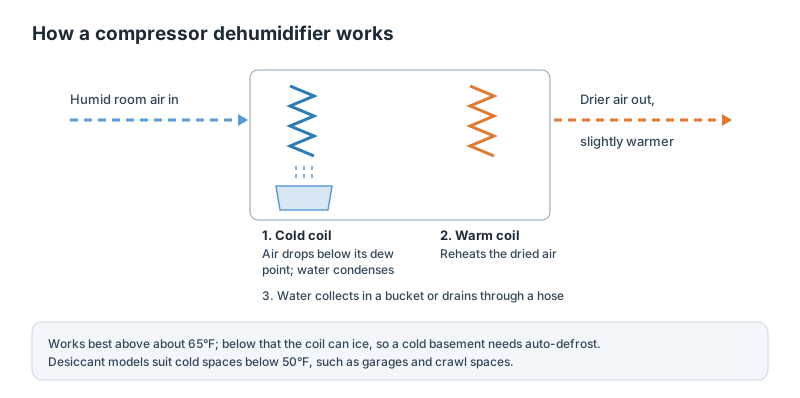
Every dehumidifier does the same basic thing: pull humid air in, extract the water, push drier air back out. But there are two technologies, and the right one depends on your temperature:
Refrigerant (compressor) dehumidifiers are what most consumer units use. A fan draws moist air over cold coils (like a fridge's), the air cools below its dew point, and water condenses out and drains away.
The catch: they work most efficiently above about 65°F. Below that, ice forms on the coils and the unit drops into defrost mode, cutting efficiency, so a compressor unit in a cold basement needs auto-defrost.
Desiccant dehumidifiers use a moisture-absorbing material instead of cold coils, so they excel in cold spaces (unheated basements, garages, crawl spaces below 50°F) where compressor units struggle. They're quieter, but they use more electricity per pint of water removed.
The short version: warm space, compressor unit; cold space (below ~50°F), desiccant.
The types, by capacity
Dehumidifiers are rated by daily moisture removal in pints per day, measured at the AHAM standard test condition:
- Mini / Peltier (a few ounces to ~25 oz/day): compact thermo-electric units, nearly silent, low power. Best for closets, small bathrooms, RVs, spaces under ~200 sq ft with mild dampness.
- Portable (20 to 70 pints/day): the mainstream choice, rated by pints/day. Best for individual rooms, basements, and apartments.
- Whole-house (ducted, 70 to 150+ pints/day): connects to your HVAC ductwork, treats the whole home, and drains automatically. Best for larger homes, consistently humid climates, and persistent humidity that AC alone doesn't fix.
- Commercial / industrial (150+ pints/day): for water-damage restoration, pools, and warehouses.
How to size a dehumidifier (ENERGY STAR's chart)
This is the step people get wrong. You size by two factors: your room's square footage AND how damp it is. ENERGY STAR's current sizing chart gives the minimum capacity for a portable unit in pints per day:
| Condition without a dehumidifier | Under 2,000 sq ft | Over 2,000 sq ft |
|---|---|---|
| Slightly to moderately damp: feels damp, musty odor that comes and goes (50 to 75% humidity) | 20 to 30 | 30 or more |
| Very damp: always feels and smells damp, damp spots on walls or floors (75 to 90%) | 25 to 40 | 40 or more |
| Wet: walls or floor sweat, seepage, or heavy loads like laundry drying (90 to 100%) | 30 to 50 | 50 or more |
When in doubt, size up. A larger unit in a space that needs less reaches your target humidity faster, runs fewer hours per day, and can actually cost less to operate than a smaller unit grinding away 24/7. For a guided calculation, use our dehumidifier sizing calculator.
(Note: these pint ratings are on the current DOE/AHAM test standard, which changed in 2019 to a cooler, more realistic test condition. Ratings from before 2019 ran higher for the same physical unit, so an older "70-pint" is roughly a current "50-pint." Compare units on the same standard.)
What to look for when buying
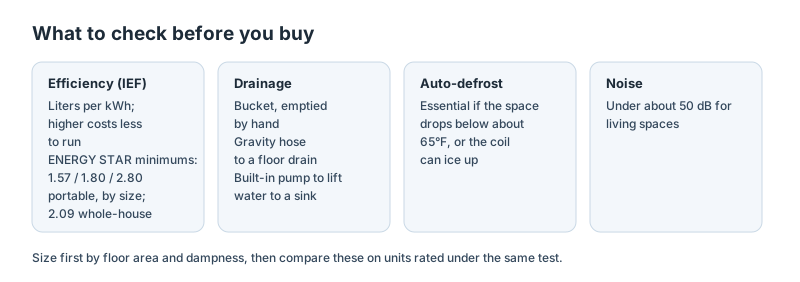
Energy efficiency (ENERGY STAR / IEF). Since 2019, the DOE measures dehumidifier efficiency in IEF (Integrated Energy Factor), liters of water removed per kilowatt-hour, so higher IEF means lower running cost. Current ENERGY STAR minimum IEF requirements are roughly:
| Category | Capacity | Min IEF (L/kWh) |
|---|---|---|
| Portable | up to 25 pt/day | 1.57 |
| Portable | 25–50 pt/day | 1.80 |
| Portable | 50+ pt/day | 2.80 |
| Whole-house | all | 2.09 |
The most efficient portables exceed these minimums, and that efficiency gap adds up to meaningful electricity savings over a season. An ENERGY STAR unit is worth the modest premium if you'll run it a lot.
Drainage. Three options: bucket (you empty it manually, and it auto-shuts when full); gravity drain (a hose runs to a floor drain below the unit, no emptying); and built-in pump (pushes water upward through a hose, essential for basements without a floor drain).
Auto-defrost. Essential if the space ever drops below about 65°F, without it, a compressor unit in a cool basement can ice up and stop removing moisture entirely.
Noise. Ranges from whisper-quiet to louder than conversation; for living spaces, look for a unit rated under about 50 dB. Smart features (Wi-Fi, humidity alerts) are genuinely useful for a basement unit you don't check daily.
What dehumidifiers cost
Upfront: costs scale with capacity, from inexpensive mini units, through mainstream portables, up to whole-house ducted systems (which are a significant installed investment). Prices vary by capacity, efficiency, and features.
Operating cost depends on the unit's wattage, how many hours it runs, and your electricity rate. At an assumed rate of about $0.18/kWh (the rough 2026 U.S. average, your rate will differ), an illustrative monthly estimate looks like this:
| Unit type | Watts | Hrs/day | Est. monthly |
|---|---|---|---|
| Mini/Peltier | ~40 | 24 | ~$5 |
| 35-pint portable | ~350 | 12 | ~$21 |
| 50-pint portable | ~550 | 10 | ~$28 |
| 50-pint (ENERGY STAR) | ~480 | 8 | ~$20 |
| 70-pint portable | ~700 | 10 | ~$36 |
| Whole-house | ~800 | 6 | ~$24 |
Notice that a whole-house unit often costs less to run monthly than a large portable, because it reaches the target humidity faster and cycles off, and by lowering humidity it can let your AC run less in humid climates. These are illustrative figures at fixed assumptions; for an estimate at your rate, use our dehumidifier running cost calculator.
Maintenance
A well-maintained dehumidifier lasts several years. The routine is simple:
- Weekly: empty and rinse the bucket (if not draining continuously), check the drain hose isn't kinked.
- Monthly: clean the washable air filter, wipe the intake grille, check the humidity reading against a separate hygrometer.
- Every 6 months: deep-clean the bucket with a vinegar-water solution to prevent mold, and check the coils for dust (unplug first).
A clogged filter or dusty coils cut efficiency, so the monthly filter clean is the highest-value task.
Frequently asked questions
What size dehumidifier do I need? Size by both your room's square footage and how damp it is, using ENERGY STAR's chart above. A 500 sq ft moderately-damp room needs about 20 pints/day; a 2,000 sq ft wet basement needs about 50.
When in doubt, size up. Use our dehumidifier sizing calculator for a guided estimate.
How much does it cost to run a dehumidifier? It depends on the unit's wattage, run hours, and your electricity rate. A typical 50-pint portable might run roughly $20 to $30 a month at an $0.18/kWh rate, an ENERGY STAR unit less. Use our running cost calculator with your actual rate for a real figure.
Where should I set my dehumidifier? Aim for 30 to 50% relative humidity (the EPA's recommended range), and practically, many people target around 45 to 50% in summer. Below 30% is unnecessarily dry. Most units let you set a target and cycle to maintain it.
Do I need a dehumidifier if I have air conditioning? Sometimes. AC removes some humidity as it cools, but in very humid climates or damp basements it often can't keep humidity below 60% on its own, especially in spring and fall when it's humid but not hot enough for the AC to run much. A dehumidifier handles humidity independent of temperature.
Will a dehumidifier cool my room? No, slightly the opposite.
A compressor dehumidifier returns air a few degrees warmer than it drew in. It makes a humid room feel more comfortable by removing moisture, but it doesn't lower the temperature. A dehumidifier doesn't cool a room: the electricity it uses, plus the heat released as water condenses, warms the air slightly.
About these figures
The recommended 30 to 50% humidity range and the mold and dust-mite thresholds are from the EPA's indoor air quality guidance. The sizing chart (capacity by room size and dampness) is ENERGY STAR's, and the pint-capacity ratings follow the DOE's 2019-revised dehumidifier test procedure (under AHAM-defined conditions), which is why current pint ratings are lower than pre-2019 ratings for the same physical unit. The efficiency figures (IEF and the ENERGY STAR minimums) are per ENERGY STAR and DOE standards.
Cost figures are illustrative market estimates at the stated assumptions; actual prices and running costs vary by unit, efficiency, climate and your electricity rate. The right unit depends on your space size, dampness level and temperature, which the guidance above helps you determine.
Sources & References
Related Articles
Can You Run a Dehumidifier and AC at the Same Time? (2026)
explainer • 7 min read
How Does Humidity Affect Temperature? (Heat Index and Comfort, 2026)
explainer • 6 min read
How Much Does It Cost to Run a Dehumidifier? (2026 Calculator)
calculator • 7 min read
Ideal Indoor Humidity Level: What Should It Be by Season? (2026 Chart)
informational • 9 min read