
If your house feels clammy and stuffy, or so dry your throat is scratchy every morning and you're getting shocked every time you touch a doorknob, your indoor humidity is off.
And the worry underneath that is usually bigger than comfort: is this dampness growing mold somewhere I can't see? Is the dry air making my family sick? What number am I actually supposed to be aiming for?
There is a clear answer from the EPA, and hitting it is usually achievable. This page covers the EPA's target range, why both edges of it matter (mold on one side, dry-air problems on the other), and how to move your home's humidity in the right direction.
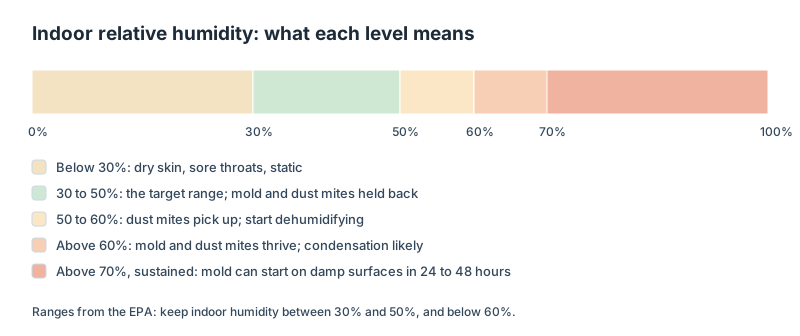
Keep your indoor relative humidity between 30% and 50%, and always below 60%. That's the EPA's recommendation, and it's the single band that simultaneously suppresses mold and dust mites, protects your home, and keeps the air comfortable to breathe. In winter, aim for the lower end (30–40%) to avoid condensation on cold windows.
The number, and why it's a range and not a single setting
The EPA's guidance is specific and worth quoting directly: indoor relative humidity should be kept below 60 percent, and ideally between 30 and 50 percent. That's from the EPA's mold guidance, and it's the number building scientists, HVAC engineers, and remediation pros all cite.
Why a range instead of one magic number? Because the two things you're balancing pull in opposite directions:
- Too humid (above 60%) and you create conditions for mold, dust mites, and that clammy, stuffy feeling.
- Too dry (below 30%) and you get dry skin, scratchy throats, static shocks, cracking wood furniture, and more respiratory irritation.
The 30–50% band is the sweet spot where both problems stay away. If your dehumidifier or humidistat only lets you set one target, 45% is a solid year-round pick, comfortably in the safe zone with margin on both sides.
What happens at each humidity level
Humidity isn't a light switch. Mold doesn't appear the instant you cross 60% and vanish at 59%. What actually matters is how long the air stays humid and whether it's sitting against a damp surface. The risk scales like this:
| Relative humidity | What's happening | What to do |
|---|---|---|
| Below 30% | Too dry: dry skin, sore throats, static, wood shrinking/cracking | Add moisture (humidifier), especially in winter |
| 30–50% | The target range. Comfortable, mold and dust mites suppressed | Maintain it, you're in the safe zone |
| 50–60% | Getting humid. Dust mite activity picks up; mold risk rising | Start dehumidifying; check ventilation |
| Above 60% | Mold and dust mites thrive; condensation likely | Dehumidify now; find the moisture source |
| Persistently damp surfaces | Mold can germinate in 24–48 hours on damp organic surfaces | Act fast; this is active mold territory |
That last row is the one to take seriously. Per the EPA, on a persistently damp surface mold can start growing within one to two days, which is why the standard advice after any leak or flood is to dry everything out within 24 to 48 hours.
Is my humidity making us sick?
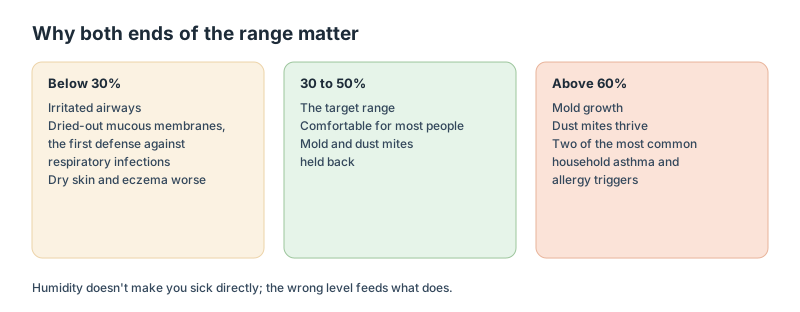
This is the real worry, so let's be straight about it. Humidity itself doesn't poison you, but the wrong level creates the conditions for things that do affect your health:
- Too humid feeds mold and dust mites, two of the most common household asthma and allergy triggers. If someone in your home has unexplained congestion, worse allergies indoors than out, or asthma that flares at home, chronic high humidity is a prime suspect.
- Too dry irritates your airways, dries out the mucous membranes that are your first defense against respiratory infections, and makes dry skin and eczema worse.
So your humidity level isn't making you sick directly, but keeping it between 30% and 50% removes a whole category of things that can. That's the health case for watching the number.
One nuance worth knowing: some research points to a moderate mid-range as better for limiting the spread of certain airborne viruses. That's a slightly higher ceiling than the mold-focused 30–50%, which is why "below 60%" is the hard line everyone agrees on, and 40–50% is the range that keeps everyone reasonably happy.
How to actually measure it (stop guessing)
You can't feel humidity accurately. A room can sit at 60% relative humidity, the EPA's upper limit, and feel perfectly fine, because people are poor judges of humidity in the moderate range that matters.
So get a hygrometer. A digital one is inexpensive, and it's the only way to actually know your number instead of guessing.
Put one in the rooms you care about most (bedrooms, basement, anywhere that's felt damp or dry), and check it across a few days and different weather. Many combination thermostats and air-quality monitors show humidity too.
Without a hygrometer, everything below is guesswork. With one, it's a straightforward "read the number, adjust in the right direction" problem.
How to lower humidity (if you're above 50%)
If your reading is consistently above 50%, especially above 60%, you want to remove moisture:
- Run a dehumidifier in the damp space (basements are the usual culprit). Set it to about 45–50%.
- Use exhaust fans in the bathroom (during and for a while after showers) and kitchen (when cooking). These vent the biggest moisture spikes straight outside.
- Fix the moisture source. Chronic high humidity often has a cause: a slow leak, poor drainage against the foundation, unvented appliances, or a crawlspace pushing moisture up. A dehumidifier treats the symptom; finding the source is the real fix.
- Your AC is a dehumidifier too. Running central air in summer pulls moisture out. If your home is humid and the AC runs constantly without fixing it, the system may be oversized (short-cycling) or need service.
How to raise humidity (if you're below 30%)
If you're below 30%, common in winter with the heat running, you want to add moisture:
- Run a humidifier, especially in bedrooms at night. Clean it regularly, a dirty humidifier becomes a mold and bacteria source of its own.
- Aim for 30–40% in winter, not higher. Push humidity too high when it's cold out and you'll get condensation on your windows and inside your walls, which causes its own mold and rot problems. This is the one time the lower end of the range is the goal.
- Everyday sources help a little: houseplants, air-drying laundry, cooking without the exhaust fan. But in a truly dry house, a humidifier is what moves the needle.
Frequently asked questions
What is the ideal indoor humidity level? Between 30% and 50% relative humidity, and always below 60%, per the EPA. In winter, aim for the lower end (30–40%) to prevent window condensation. About 45% is a good single year-round target.
Is 60% humidity too high indoors? It's at the upper limit. The EPA says to keep indoor humidity below 60%, because above that, mold, dust mites, and condensation all become significantly more likely. If you're at 60%, start dehumidifying and look for the moisture source.
Is 40% humidity too low? No, 40% is comfortably within the ideal 30–50% range. It's actually a good target, especially in winter. You only want to add moisture if you drop below 30%.
Can humidity cause mold? Yes. Sustained humidity above 60% creates conditions for mold, and on a persistently damp surface, mold can germinate within 24–48 hours (EPA). This is why keeping RH below 60% and drying up any water event within 1–2 days are the core mold-prevention steps.
What humidity level kills dust mites? Dust mites struggle to survive extended periods in drier air (toward the lower end of the EPA's 30–50% range). Keeping your home consistently in the 30–50% range makes it inhospitable to them over time, one of the most effective long-term allergy strategies.
About these figures
The core 30–50% target (and the "below 60%" hard limit) is the EPA's recommendation, stated in its mold and indoor-air-quality guidance. The mold-germination timing (24–48 hours on persistently damp surfaces) and the dry-within-48-hours standard are also from EPA moisture guidance. The comfort-range framing aligns with ASHRAE guidance for indoor environments.
The virus-viability nuance reflects published indoor-air research.
Sources & References
Related Articles
Can You Run a Dehumidifier and AC at the Same Time? (2026)
explainer • 7 min read
How Does Humidity Affect Temperature? (Heat Index and Comfort, 2026)
explainer • 6 min read
Dehumidifiers: Sizing, Types and Running Costs (2026)
guide • 10 min read
How Much Does It Cost to Run a Dehumidifier? (2026 Calculator)
calculator • 7 min read