
A dehumidifier's size is its capacity: how many pints of water it can pull from the air in 24 hours. The right capacity depends on two things, how big the space is and how damp it is without a dehumidifier running.
ENERGY STAR's sizing chart puts a damp space under 2,000 sq ft at 20 to 30 pints a day, a very damp one at 25 to 40, and a wet one at 30 to 50. Those are minimums, and ENERGY STAR advises that it's better to oversize than undersize.
Dehumidifier Sizing Calculator
Minimum capacity from ENERGY STAR's current sizing chart.
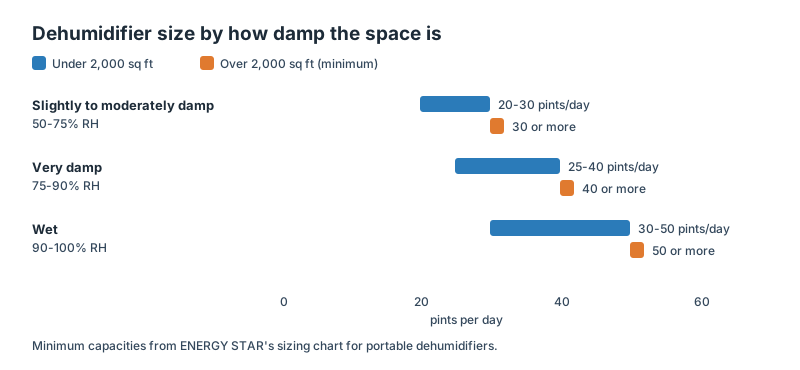
ENERGY STAR's sizing chart
Minimum capacity for a portable dehumidifier, in pints per day:
| Condition without a dehumidifier | Under 2,000 sq ft | Over 2,000 sq ft |
|---|---|---|
| Slightly to moderately damp: feels damp, musty odor that may come and go | 20 to 30 | 30 or more |
| Very damp: consistently feels and smells damp, damp spots on walls and floors | 25 to 40 | 40 or more |
| Wet: walls or floor sweat, seepage, or heavy loads such as laundry drying | 30 to 50 | 50 or more |
If you're replacing a dehumidifier, ENERGY STAR suggests another check: how much water you empty from it each day.
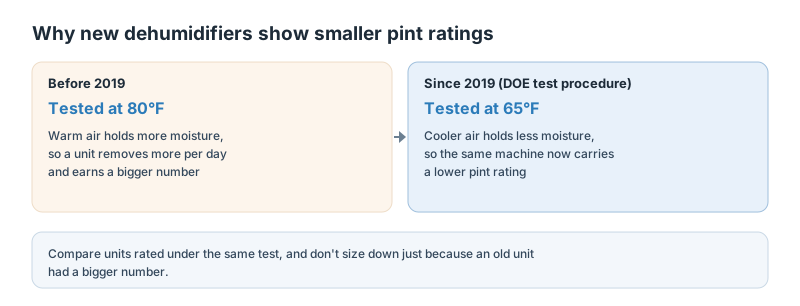
Why capacities look smaller than they used to
Dehumidifiers rated today are tested at cooler conditions than before, 65°F instead of 80°F, under the DOE test procedure that took effect in 2019. Cooler air holds less moisture, so the same machine now carries a lower pint rating. Compare units rated under the same test, and don't size down just because an old unit had a bigger number.
Cold basements
Below about 65°F, frost can form on a dehumidifier's coils, making the compressor cycle without removing much water. For a basement or crawl space that stays cool, ENERGY STAR suggests a model specified for low temperatures.
When a whole-home dehumidifier makes sense
If you have central air and humidity stays high throughout the house, ENERGY STAR notes a whole-home dehumidifier installed in the ductwork may be the better choice. For a single damp basement or room, a portable unit sized from the chart is usually enough.
Getting the most from it
- Set it to 30 to 50% humidity, the range ENERGY STAR and the EPA recommend; in cold climates during heating season, the lower end of that range avoids window condensation.
- Close doors and windows to the space while it runs.
- Use a drain hose to a floor drain or sump if you can't empty the bucket often.
- Reduce the moisture at its source: extend downspouts, slope soil away from the foundation and vent the dryer outdoors.
ENERGY STAR certified dehumidifiers use about 20% less energy than conventional models; see what one costs to run in our dehumidifier running cost calculator.
Frequently asked questions
What size dehumidifier do I need for a basement?
For a basement under 2,000 sq ft, 25 to 40 pints a day if it's very damp, or 30 to 50 if it's wet with seepage, per ENERGY STAR's chart. Choose the upper end if it's large or cool.
Is it better to oversize or undersize a dehumidifier?
Oversize. ENERGY STAR advises that it's better to oversize than undersize; a unit with spare capacity reaches the set humidity and then cycles off.
Why is my new 35-pint dehumidifier rated lower than my old 50-pint one?
The DOE test changed in 2019 to cooler conditions, which gives lower pint ratings for the same moisture removal. Compare models rated under the current test.
What humidity should I set my dehumidifier to?
Between 30% and 50%. In cold climates during the heating season, the lower end of that range prevents condensation on windows.
Sources & References
Related Articles
Can You Run a Dehumidifier and AC at the Same Time? (2026)
explainer • 7 min read
How Does Humidity Affect Temperature? (Heat Index and Comfort, 2026)
explainer • 6 min read
Dehumidifiers: Sizing, Types and Running Costs (2026)
guide • 10 min read
How Much Does It Cost to Run a Dehumidifier? (2026 Calculator)
calculator • 7 min read