
The refrigerant inside your HVAC system is not something you think about until a spec sheet, a bill, or your HVAC tech makes you think about it. Then the worries start: whether a huge bill is coming, whether your system is suddenly worthless, whether someone is overcharging you, and what that "mildly flammable" thing on the new label means.
Take a breath. Most of those worries are smaller than they sound, and a couple probably don't apply to you at all.
This page shows how to find which refrigerant is in your system, whether it's a problem, and what, if anything, to do about it.
The figures below come from the EPA's regulatory tables and ASHRAE's refrigerant safety standard.
The current HVAC refrigerants in 2026 are R-32 and R-454B. They replaced R-410A after a January 1, 2025 EPA cutoff on manufacturing any equipment above 700 GWP. If your home runs older R-410A or R-22, it's still completely legal to service, though R-22 has become scarce and expensive since new production ended on January 1, 2020.
First things first: what's actually in your system?
Before we get into which refrigerant is good or bad, let's answer the only question that matters for your house. What have you got? It takes only a moment.
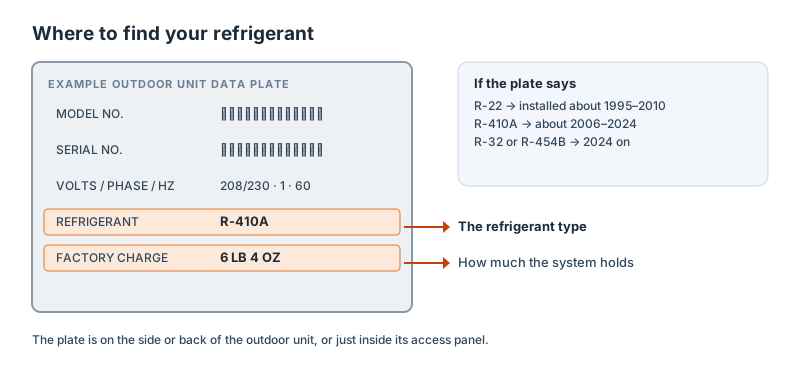
Walk out to your outdoor unit (the condenser or heat pump) and find the data plate, a metal or plastic label on the side, back, or just inside the access panel. Look for "Refrigerant," "Charge," or "Factory Charge"; it names the refrigerant inside.
| If the plate says | You have | Roughly installed |
|---|---|---|
| R-22 or HCFC-22 | R-22 | 1995–2010 |
| R-410A or Puron | R-410A | 2006–2024 |
| R-32 | R-32 | 2024–present |
| R-454B or Opteon XL41 | R-454B | 2024–present |
If the label's worn off, search your model number online. The manufacturer's spec sheet always lists it. Got your answer?
Good. Now find your refrigerant below and we'll tell you whether to worry.
The quick comparison
The GWP and safety figures below come from the EPA's Technology Transitions GWP Reference Table (codified at 40 CFR §84.64) and ASHRAE Standard 34.
| R-22 | R-410A | R-32 | R-454B | R-290 | |
|---|---|---|---|---|---|
| Type | HCFC | HFC blend | HFC (pure) | HFC/HFO blend | Propane |
| GWP (climate impact) | 1,810 | 2,088 | 675 | 466 | 3 |
| Ozone impact (ODP) | 0.055 | 0 | 0 | 0 | 0 |
| Safety class | A1 | A1 | A2L | A2L | A3 |
| Flammable? | No | No | Barely | Barely | Yes |
| Status (2026) | Service only | Phasing out | Current | Current | Small units |
The GWP and safety figures are primary-sourced, from the EPA Technology Transitions GWP Reference Table and ASHRAE Standard 34.
"I've got R-410A. Is my system about to become a paperweight?"
Short answer: no. Not this year, not for years. If your system is more than a couple years old it almost certainly runs R-410A, and this is the worry we hear most, so let's put it to rest.
This is what's actually happening.
R-410A has a GWP of 2,088, which is a technical way of saying that a pound of it, leaked into the air, traps about 2,088 times as much heat as a pound of CO₂ (that's the EPA's figure). That puts it nearly three times over the EPA's new 700-GWP limit for home HVAC. So under the AIM Act of 2020, the EPA stopped new R-410A equipment.
As of January 1, 2025, nobody can manufacture or import new R-410A home AC or heat pump systems.
But the part that matters for you is this: that cutoff stopped manufacturing, not using. Your existing system is completely legal to run and to service. The EPA even finalized a rule (effective July 27, 2026) letting installers put in pre-2025 R-410A equipment until stock runs out.
A few states set their own earlier dates, so a quick check of local code is worth it. But the headline is simple. Nobody is coming to shut off your air conditioner.
What does it cost to keep going? R-410A is still widely available, so servicing it stays affordable for now. That will creep up as the phase-down tightens, the same slow climb R-22 went through, but that's "creep up over years," not "spike tomorrow."
So what should you actually do? Nothing dramatic. Keep up with annual maintenance and leak checks, because a leak is the expensive part now and you don't want to be topping this stuff off every summer.
Start planning a replacement as your system gets up in years, or when a big component dies. Replacing on your own schedule, in the off-season, beats an emergency swap in a July heatwave every time.
"My old system needs a recharge and the quote was scary. Am I being ripped off?"
If you've got R-22 and a tech quoted you a number that made you wince, you're probably not being taken for a ride. R-22 really is that expensive now, and understanding why changes the repair-versus-replace math.
R-22 (the old "Freon") was the standard from the mid-90s to about 2010.
The problem is that it damages the ozone layer; it has an ozone depletion potential of 0.055. So under the Montreal Protocol and the Clean Air Act, new production ended January 1, 2020. Nobody has made a fresh pound in years.
That means every pound today comes from reclaimed, recycled supply, and it's priced like it: scarce and costly, more still once labor is added. Recharging a leaking R-22 system is expensive in refrigerant alone, which is why that scary quote is usually real.
The right move is clear. If you're running R-22 in 2026, your system is well over a decade old, limping along on scarce refrigerant, at an efficiency far below anything new. This is the one case where the answer is genuinely simple.
Stop pouring money into recharges and replace it. The math almost always favors a new system, and every delayed year costs you twice, once in refrigerant and once on your power bill.
"The new refrigerant says 'mildly flammable.' Is it going to catch fire in my house?"
Let's deal with the word that's actually bugging you: flammable.
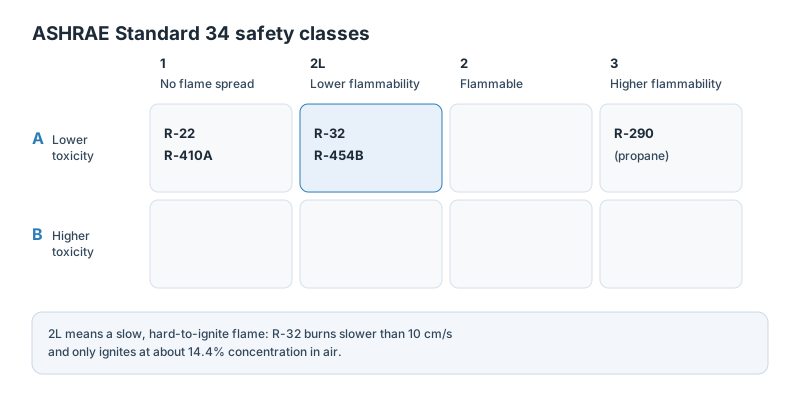
You saw "A2L, mildly flammable" on an R-32 or R-454B system and wondered can this ignite in my house? It's a fair question, and the numbers below answer it; by the end you'll see why the gas stove in your kitchen is the more flammable thing in the room.
"A2L" is a rating under ASHRAE Standard 34. The "A" means low toxicity. The "2L" means lower flammability with a slow flame. In actual figures, that breaks down as follows:
- R-32 only becomes flammable at 14.4% concentration in the air (that's the ASHRAE 34 figure). That's not a small leak. That's a massive, sustained release filling a sealed room. For comparison, the natural gas running through millions of homes becomes flammable at about 5%, far easier to reach.
- Even then, it burns at under 10 cm per second. That slow burn is literally what the "2L" stands for. Propane spreads flame several times faster.
- And igniting it takes far more energy than the little static spark you get shuffling across a carpet, plus that catastrophic concentration, plus a spark right at the leak. That combination essentially doesn't happen in a real home.
On top of the chemistry, modern A2L equipment is built with safety baked in: leak sensors inside the indoor unit, automatic shutoff well below the flammable limit, and refrigerant charge limits sized to your room's volume under UL/CSA 60335-2-40.
Servicing an A2L system also calls for A2L-rated recovery tools and a trained technician, and UL/CSA 60335-2-40 can require leak detection and added ventilation when the refrigerant charge is large for the space. For a homeowner that mostly means hiring a contractor trained on A2L equipment.
The bottom line: if you're comfortable cooking on a gas stove, running a gas furnace, or having a gas water heater in your home, an R-32 or R-454B AC is a lower ignition risk than any of them. This is not the thing to lose sleep over.
"I'm buying a new system. R-32 or R-454B, and does it even matter?"
If you're shopping in 2026 you'll see both, and you're probably wondering which to pick, or worrying you'll choose "wrong." Good news: for you, the practical difference is small. Both are safe, efficient, and compliant. The real breakdown is below.
R-32 is a single-component refrigerant. It's literally half of old R-410A, with the high-GWP half removed.
That gives it a GWP of 675 (a 68% cut from R-410A), it needs noticeably less refrigerant per system, and because it's a pure compound and not a blend, it doesn't get complicated when it leaks. It dominates ductless mini-splits and is widely used across residential systems.
R-454B is a blend (about 69% R-32, 31% R-1234yf) with an even lower GWP of 466 (a 78% cut from R-410A). Its operating pressures sit close to R-410A's, so manufacturers could adapt existing designs more easily, which is why many manufacturers chose it for ducted systems. The trade-off: it needs more refrigerant than R-32, and as a blend it's a bit fussier to service after a leak.
So which should you choose? Let the system decide, not the refrigerant. Pick a ductless mini-split and you'll often get R-32.
Pick a ducted system and you'll get R-454B. What actually determines whether you're happy in five years isn't the refrigerant. It's these:
- Right sizing. Insist on a Manual J load calculation, not a "looks about a 3-ton" guess.
- A quality install by an A2L-trained contractor.
- The right SEER2 for your climate.
- Solid warranty terms.
Get those right and the refrigerant is a footnote.
The other refrigerants you might bump into
You probably won't need these, but if you've seen one on a label, the one-liner for each follows (GWPs from the EPA table):
- R-290 (propane, GWP 3): about as climate-friendly as it gets, but genuinely flammable (A3), so U.S. rules limit it to small factory-sealed units like window ACs and portables. Not used in ducted or split systems here.
- R-134a (GWP 1,430): mostly car AC and commercial refrigeration, not home HVAC.
- R-1234yf (GWP 4): the car-AC replacement for R-134a, and the low-GWP ingredient in R-454B.
- R-407C (GWP 1,774): an older R-22 replacement blend, on its way out.
- R-404A (GWP 3,922): commercial refrigeration, one of the highest-GWP refrigerants still around and a top phase-down target.
- R-744 (CO₂, GWP 1): used in some commercial systems and heat-pump water heaters. Runs at very high pressure.
Frequently asked questions
Is R-410A being phased out? Yes, but only for new manufacturing, not for use. Since January 1, 2025, no new home AC or heat pump can be built with R-410A, because it's over the EPA's 700-GWP limit. Your existing R-410A system is still legal to run and service, and pre-2025 equipment can still be installed until supplies run out.
Can I switch my system to a different refrigerant? No. Each system's compressor, oil, line sizes, and safety parts are engineered for one specific refrigerant's pressures. You can't put R-32 into an R-410A system, or R-410A into an R-22 system. Swapping refrigerants means replacing the outdoor unit (and usually the indoor coil too), which is a full system replacement.
Is R-32 dangerous because it's flammable? Not in normal use. Its A2L rating means it only ignites at a 14.4%-of-air concentration, which is a massive sealed-room leak, and it burns extremely slowly.
The natural gas in millions of homes is easier to ignite. Modern R-32 equipment also has built-in leak detection and automatic shutoffs.
Does the refrigerant change my energy bill? A little, but your install and sizing matter far more. R-32 is modestly more efficient than R-410A, but a badly-sized or badly-installed high-efficiency system will lose to a well-installed standard one every time. Spend your attention on the install, not the refrigerant.
Is R-32 better than R-454B? Neither is clearly better for a homeowner. R-32 is a single compound with a GWP of 675 and needs noticeably less refrigerant, while R-454B is a blend with a lower GWP of 466 whose operating pressures sit closer to R-410A. Both are A2L and both meet the EPA's limit, so let the equipment and the installer decide, not the refrigerant.
About these figures
Every GWP figure here comes from the U.S. EPA's Technology Transitions GWP Reference Table, the values codified in federal regulation at 40 CFR §84.64, on the 100-year IPCC basis the EPA uses. Safety classifications and flammability figures (the 14.4% limit, the sub-10-cm/s burn) are from ASHRAE Standard 34 and the AHRI safe-refrigerant-transition resources. The phase-down dates and 700-GWP threshold come from the EPA's AIM Act rulemakings.
This page carries no refrigerant prices: they swing by region, supplier, and year, and we couldn't tie them to a primary source, so we describe them qualitatively instead. Where any number couldn't be traced to a primary source, we left it out or said so plainly.