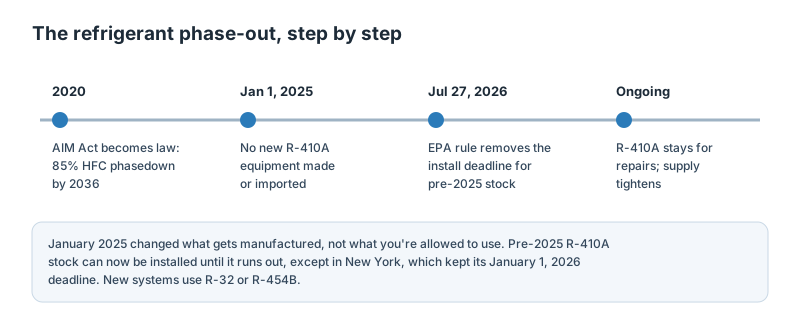
R-410A can no longer be used in newly manufactured residential air conditioners and heat pumps as of January 1, 2026. The EPA's Technology Transitions Rule, enacted under the American Innovation and Manufacturing (AIM) Act of 2020, prohibits the production and import of new residential HVAC equipment using refrigerants with a global warming potential (GWP) above 700 — and R-410A's GWP of 2,088 is nearly three times that limit.
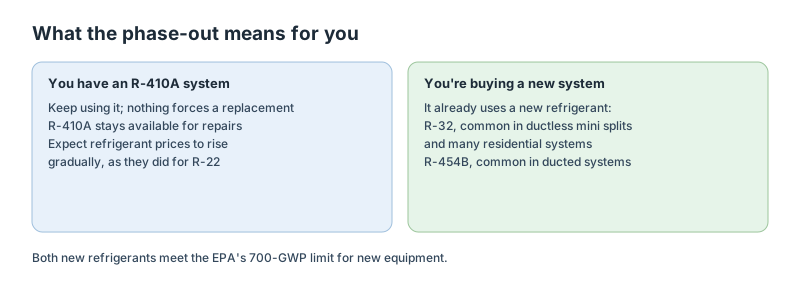
If you own an existing R-410A system, it's still perfectly legal to operate and service. But the writing is on the wall: R-410A supply will tighten, prices will climb, and within the next decade, servicing an R-410A system will become increasingly expensive — just like R-22 (Freon) before it. This article covers every date, rule, and practical implication you need to plan ahead.
The Complete Phase-Out Timeline
The refrigerant transition didn't happen overnight. It's the result of decades of environmental science, international agreements, and cascading regulations. Here's the full timeline from the original CFC phase-out through today's HFC transition:
Historical Context: How We Got Here
The Key Regulatory Mechanisms
Understanding the phase-out requires knowing the difference between two related but distinct rules:
1. The AIM Act (overall HFC phase-down)
The AIM Act doesn't ban specific refrigerants outright. Instead, it uses an allowance allocation system — think of it like cap-and-trade for refrigerants. The EPA allocates production and import allowances based on a baseline level, then reduces those allowances according to a schedule. Each HFC pound is weighted by its GWP, so higher-GWP refrigerants consume more allowances per pound.
The phase-down schedule reduces total allowances from baseline to 85% below baseline by 2036:
The big jump from 10% to 40% in 2024 was the first major squeeze on R-410A supply. The 2029 step to 60% and 2034 step to 70% are the ones that will really drive R-410A prices up for service.
2. The Technology Transitions Rule (sector-specific GWP limits)
This is the rule that directly prohibits R-410A in new equipment. It sets maximum GWP limits by application sector:
The critical distinction: The Technology Transitions Rule bans R-410A in newly manufactured equipment. It does NOT ban the refrigerant itself. R-410A will remain available for servicing existing systems throughout the AIM Act phase-down period. However, the shrinking production allowances under the AIM Act mean less R-410A will be produced each year, driving up prices.
What Exactly Is Banned — and What Isn't
There's a lot of confusion about what the R-410A "ban" actually means. Let's be precise:
What IS Banned (as of January 1, 2026):
- Manufacturing new residential air conditioners using R-410A
- Manufacturing new residential heat pumps using R-410A
- Importing new residential AC/HP equipment using R-410A
- Manufacturing new light commercial AC equipment (≤65K BTU/h) using R-410A
What Is NOT Banned:
- Operating your existing R-410A system
- Repairing your existing R-410A system
- Recharging your existing R-410A system with R-410A
- Selling R-410A inventory manufactured before 2026 (for both equipment and bulk refrigerant)
- Selling R-410A equipment that was manufactured before January 1, 2026 (distributor stock can still be sold)
- Producing R-410A for use in servicing existing equipment (subject to AIM Act allowance limits)
- Recovering and recycling R-410A from decommissioned systems
Bottom line for homeowners with R-410A systems: Your system isn't illegal. You don't need to rush out and replace it. But be strategic about planning your replacement, because the longer you wait, the more expensive R-410A service will become.
The R-22 Precedent: What History Tells Us About R-410A Pricing
The best predictor of how R-410A's phase-out will play out is the R-22 phase-out that preceded it. The parallels are striking and instructive:
The pattern is clear: prices start rising gradually 3-5 years before a major phase-down step, then spike sharply as the ban takes effect. For R-410A, here's the projected price trajectory based on the R-22 precedent and AIM Act schedule:
Critical planning insight: A typical R-410A recharge for a 3-ton system requires 7-10 lbs of refrigerant. At 2026 prices, that's $56-150 in refrigerant cost. By 2032, that same recharge could cost $210-500 in refrigerant alone — not counting the $150-300 labor to diagnose and perform the recharge. If your R-410A system has a slow leak and needs annual top-offs, the economics will push you toward replacement much sooner than the system's mechanical age would suggest.
What's Replacing R-410A: The New Refrigerant Landscape
Several low-GWP refrigerants have emerged as R-410A replacements. Here's the competitive landscape as of 2026:
Market Share Breakdown (2026 Estimates)
Based on manufacturer announcements and product launches through early 2026:
Residential split systems and heat pumps:
- R-32: ~55-60% of new installations
- R-454B: ~30-35% of new installations
- Other (R-454C, R-290 for small units): ~5-10%
Ductless mini-splits:
- R-32: ~80%+ (dominant due to established global supply chain from Asian manufacturers)
- R-454B: ~15%
- Other: ~5%
Light commercial:
- R-454B: ~45-50%
- R-32: ~35-40%
- Other: ~10-15%
State-Level Regulations: A Patchwork of Rules
While the federal AIM Act and Technology Transitions Rule provide the baseline, several states have enacted their own regulations that may affect you:
Building code updates matter. Beyond refrigerant rules, many states and municipalities have updated their mechanical codes to address A2L refrigerant installations. The International Mechanical Code (IMC) 2024 edition includes A2L provisions. However, local code adoption varies — some jurisdictions are still working through the adoption process. Your HVAC contractor should know the specific requirements in your area.
Practical Planning Guide for Homeowners
Scenario 1: Your R-410A System Is Less Than 8 Years Old
Recommendation: Keep it running. Your system likely has 7-12 more years of useful life. R-410A will remain available for service throughout this period, though at increasing cost.
Action items:
- Schedule annual maintenance to minimize refrigerant leaks
- Have your technician check for leaks at every service visit — fix small leaks before they become expensive
- Budget $200-500/year for potential refrigerant costs starting around 2029
- Start planning for replacement around year 12-15 (2034-2038), when R-410A costs peak
Scenario 2: Your R-410A System Is 8-12 Years Old
Recommendation: Plan your replacement proactively. You're in the sweet spot where you can choose the timing rather than being forced by a breakdown.
Action items:
- Get a system assessment from a qualified contractor (check efficiency, refrigerant charge, electrical draw)
- Start getting quotes for R-32 or R-454B replacement systems
- Consider replacing before the next major repair — a $1,500 compressor repair on a 12-year-old R-410A system is money you'll never recover
- If you're in a hot climate, the efficiency gains of a new R-32 system (SEER2 16-22+) vs your aging R-410A system (likely SEER 13-16) can save $200-600/year in energy costs
Scenario 3: Your R-410A System Is 12+ Years Old
Recommendation: Replace soon. You're approaching end-of-life, and every year you wait means higher R-410A service costs when something breaks.
Action items:
- Get replacement quotes now while the market has adjusted to R-32/R-454B pricing
- Don't wait for a July heat wave failure — replacements during peak season cost 10-20% more and have longer lead times
- If your system still runs, plan a fall or spring replacement when contractors are less busy and may offer off-season pricing
- Check for utility rebates and federal tax credits (the Inflation Reduction Act provides up to $2,000 for qualifying heat pump installations through 2032)
Scenario 4: You Still Have an R-22 System
Recommendation: Replace immediately. R-22 is already in its end-stage phase-out, with prices at $50-100+/lb from reclaimed supply only. A single recharge can cost $500-1,500+.
Action items:
- Every day you run an aging R-22 system is money lost to inefficiency and risk of catastrophic failure with no affordable repair option
- Skip directly to a modern R-32 or R-454B system — don't consider used R-410A equipment, as you'd just be stepping into the next phase-out cycle
- You'll likely see 30-50% energy savings going from R-22 equipment (SEER 8-12) to modern R-32 equipment (SEER2 15-22+)
Real-world example — the cost of waiting: The Petersen family in Minneapolis ran their 2007 R-410A system until the compressor failed in November 2026. Emergency replacement during the heating season cost $11,200 for a 3.5-ton heat pump. Their neighbor, who proactively replaced a similar-age system in September 2026 during the off-season, paid $8,900 for the same equipment. The Petersens also paid $380 for their last R-410A recharge in 2024 — refrigerant that went straight into the atmosphere when the compressor failed.
The Supply Chain Transition: Where We Stand in 2026
Manufacturer Readiness
By February 2026, the major HVAC manufacturers have fully transitioned their residential product lines:
Daikin: Transitioned to R-32 across residential and light commercial lines. As the world's largest HVAC manufacturer and a pioneer in R-32 (they waived R-32 patents in 2012 to encourage adoption), Daikin had a significant head start. Full R-32 product lines available in the U.S. since mid-2024.
Carrier: Primarily adopted R-454B for ducted residential systems. Their Infinity and Performance series now use R-454B. Some models also available with R-32. Full transition completed by Q4 2024.
Trane: Mixed approach — R-454B for many ducted systems, R-32 for select product lines. All new residential products compliant since January 2026.
Lennox: Adopted R-454B for most residential lines. Dave Lennox Signature and Merit series transitioned by late 2024.
Rheem/Ruud: Transitioned to R-454B for ducted products and R-32 for ductless lines.
Goodman/Amana (Daikin subsidiary): R-32 across residential product lines, leveraging Daikin's global R-32 expertise.
Mitsubishi Electric: R-32 for all ductless and ducted mini-split systems. As a Japanese manufacturer, they've had R-32 products in other markets for over a decade.
Fujitsu: R-32 across all residential product lines. Extensive R-32 field experience from Japanese and Australian markets.
Distributor Inventory
Some distributors may still have R-410A equipment manufactured before January 1, 2026. This inventory is legal to sell but represents a shrinking pool. The key considerations if you're offered R-410A equipment from remaining stock:
Potential advantages:
- Slightly lower equipment cost (distributors may discount to clear inventory)
- Established service infrastructure; your local techs are familiar with R-410A
Significant disadvantages:
- You're buying into a declining refrigerant with rising service costs
- The system's 15-20 year lifespan will extend deep into the R-410A scarcity period
- Lower resale value for your home if future buyers see an obsolete refrigerant system
- You miss out on R-32's efficiency advantages, especially in hot climates
Our recommendation: Unless the R-410A equipment is being offered at a substantial discount (20%+ below equivalent R-32 equipment), there's no financial logic in buying outgoing R-410A technology in 2026. The long-term service cost risk far outweighs any upfront savings.
Technician Training
The technician readiness picture has improved significantly since the transition took effect:
- EPA Section 608 certification has been updated to include A2L refrigerant handling
- Major manufacturers have trained over 200,000 U.S. technicians on A2L procedures through 2026
- HVAC trade schools have updated curricula to include A2L safety and handling
- State licensing boards in most states now require A2L competency for new licenses
However, gaps remain in rural areas and among smaller contractor shops. Always verify A2L training before hiring.
The Reclamation Market: Extending R-410A Availability
Reclaimed R-410A — refrigerant recovered from decommissioned systems, purified to AHRI 700 standards, and re-sold — will become increasingly important as production quotas tighten.
The reclamation industry infrastructure is more mature than it was during the R-22 phase-out:
- Multiple certified reclaimers operate nationally (A-Gas, Hudson Technologies, National Refrigerants)
- EPA requires proper recovery during system decommissioning (Section 608)
- Reclaimed R-410A is chemically identical to virgin refrigerant when processed to AHRI 700 specifications
- Current reclaimed R-410A pricing runs 10-30% above virgin supply; this gap will close as virgin supply shrinks
For contractors and homeowners: When decommissioning an R-410A system, insist that the refrigerant be properly recovered — not vented. This serves the environment and feeds the reclaimed supply chain that keeps servicing costs manageable for other R-410A system owners. Venting refrigerants has been illegal under Section 608 since 1993, punishable by fines up to $44,539 per day per violation.
Financial Incentives for Transitioning
Several financial programs can offset the cost of replacing aging R-410A (or R-22) systems with modern low-GWP equipment:
Federal Tax Credits (Inflation Reduction Act)
Utility Rebates
Most major utilities offer rebates for high-efficiency HVAC installations. These vary widely by location but commonly range from $200-1,500. Check with your utility or visit the DSIRE database (dsireusa.org) for programs in your area.
State Programs
Several states offer additional incentives beyond federal credits. California's TECH Clean initiative, New York's Clean Heat program, and Massachusetts's Mass Save program provide substantial rebates, particularly for heat pump installations.
Real-world example — stacking incentives: Maria in Connecticut replaced her 14-year-old R-410A system with a cold-climate heat pump (R-32) in October 2026. Total installed cost: $14,500. She received a $2,000 federal tax credit, a $1,250 Eversource utility rebate, and a $500 state incentive — reducing her effective cost to $10,750. Her annual heating and cooling costs dropped by approximately $1,100 (switching from oil heat + AC to heat pump). Net payback period: about 3.5 years.
Industry Outlook: What's Coming Next
The refrigerant transition isn't over with R-32 and R-454B. Here's what the HVAC industry is watching:
Further GWP reductions: R-32's GWP of 675 meets current requirements, but the Kigali Amendment's long-term targets may push for even lower GWP solutions. R-290 (propane, GWP 3) is already used in Europe and gaining ground in small-capacity U.S. equipment. UL has updated standards to allow larger R-290 charges in self-contained equipment.
Natural refrigerants: CO₂ (R-744), ammonia (R-717), and propane (R-290) are gaining traction globally. CO₂ heat pump water heaters are already popular in Japan. The technology exists but faces cost, safety, and infrastructure hurdles for widespread residential HVAC adoption in the U.S.
Updated GWP metrics: The IPCC's Sixth Assessment Report (AR6) revised GWP values for many refrigerants. R-32's AR6 GWP is 771 (up from 675 in AR5), while R-410A's dropped slightly to 1,924. Future regulations may reference AR6 values, which could affect which refrigerants meet GWP thresholds.
Right to repair implications: As systems become more complex with integrated leak detection and manufacturer-specific controls, questions about independent technician access and right-to-repair are emerging in several state legislatures.
Key Takeaways
- R-410A is banned in new equipment since January 1, 2026 — but your existing system is legal to operate and service.
- R-410A prices will rise significantly through 2036 as production quotas tighten under the AIM Act. Plan accordingly.
- R-32 and R-454B are the primary replacements, both with GWPs well under the 700 limit and good real-world track records.
- The R-22 price history is your crystal ball. R-22 went from $7/lb to $50-100/lb during its phase-out. R-410A will follow a similar curve.
- Don't buy remaining R-410A inventory unless heavily discounted. The long-term cost of ownership tilts heavily toward modern R-32 or R-454B systems.
- Stack financial incentives — federal tax credits, utility rebates, and state programs can reduce replacement costs by $2,000-4,000+.
- Time your replacement strategically. Off-season (fall/spring) installation is cheaper and less stressful than emergency summer replacement.
- Verify contractor A2L training before hiring for any R-32 or R-454B installation.