
You're standing at your outdoor unit trying to figure out one thing: how old is this system, and am I about to be hit with a big replacement bill? The manufacture date is hiding in your serial number, and once you can read it, you'll know where your system sits in its lifespan and whether you should be budgeting for a new one.
This page shows how to do that, brand by brand, and where each reading comes from. Lennox publishes its serial format in a model and serial number guide, and Rheem's date code is spelled out in its recall notices with the U.S. Consumer Product Safety Commission (CPSC).
We couldn't find the same from Goodman, Carrier, Trane or York. For Goodman and Trane, serial numbers listed in CPSC recall notices fit a reading, which this page shows and labels as a fit, not a published rule. When the date matters (a warranty claim, an insurance question, a home sale), get it from the manufacturer.
First, find your serial number. It's on the metal data plate: on the side or back of the outdoor condenser (for AC and heat pumps), or inside the cabinet door on a furnace.
Look for "Serial No." or "S/N", and don't confuse it with the model number. Then find your brand below.
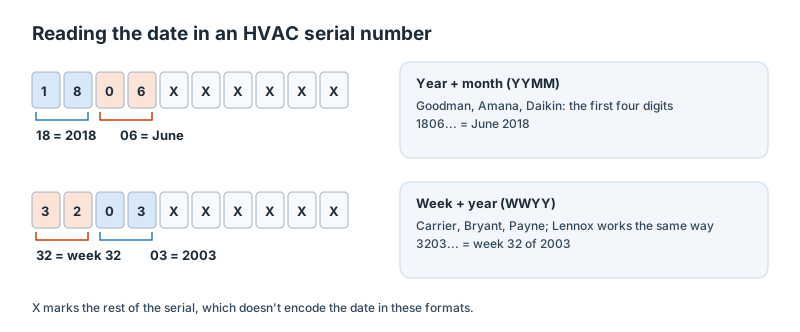
The quick version: what format is my brand?
| Brand family | What the serial shows | Where that comes from |
|---|---|---|
| Lennox | Location code (2 digits), year (2 digits), month letter, unique number | Lennox's model and serial guide |
| Rheem / Ruud | Four digits after the letter M in the middle: week, then year | Rheem's CPSC recall notices |
| Goodman / Amana / Daikin | First four digits fit year, then month | Fit to CPSC recall serials; not published by Goodman |
| Trane / American Standard | First two digits fit the year | Fit to CPSC recall serials; not published by Trane |
| Carrier / Bryant / Payne | No published format found | Ask Carrier or your dealer |
| York / Johnson Controls | No published format found | Ask the manufacturer |
Lennox
Lennox's model and serial number identification guide (Form 210965, March 2025) splits the serial into a two-digit location code, a two-digit year code (21 means 2021), a month code letter (A for January, B for February, C for March) and a five- or six-digit unique number[1]. The locations it lists are 15, 17, 18 and 19 for Saltillo, Mexico; 20 for Gainesville, Florida; 56 for Stuttgart, Arkansas; and 57, 58 and 59 for Marshalltown, Iowa. Its own example, 59 21 CO 05716, is a Marshalltown unit from 2021.
The first two digits are a place, not a date, so don't read them as a week or a year. The guide lists month letters only as far as C; for a later letter, check the month with Lennox. Older serials fit the same layout: Lennox garage heaters in a 2011 CPSC recall carried serials from 5609H to 5610M, location 56 and the years 2009 and 2010[2].
Rheem and Ruud
Rheem's recall notices with the CPSC describe the date code as the four digits after the letter M in the middle of the serial number, the first two giving the week and the last two the year[3]. A 2009 recall of Rheem and Ruud oil furnaces listed date codes such as 0106 through 5206, which read as weeks 1 to 52 of 2006[4]. If your Rheem or Ruud serial has a different letter in the middle, or none, confirm the date with Rheem.
Goodman, Amana and Daikin
Goodman says its serial number is a ten-digit code that helps it identify when the unit was produced, but its pages don't explain how to read it[5]. Goodman acquired Amana in 1997[6], and Daikin completed its purchase of Goodman Global on November 1, 2012[7]. The CPSC's 2017 recall of Goodman, Amana and Daikin furnaces covered serial numbers beginning 1609, 1610, 1611 and 1612, sold from September 2016 through January 2017[8].
That fits the first four digits being the year, then the month: 1609 would be September 2016. It's a fit to one recall list, not a published rule.
Trane and American Standard
We couldn't find a Trane document that explains its serial numbers. Two CPSC recall notices give a fit: furnaces sold in July and August 2016 had serial numbers beginning 16304 to 16324[9], and packaged units sold from January 2024 through March 2025 had serials such as 24061381FA to 24453189FA[10].
In both, the first two digits match the year the units went on sale. Treat that as a fit, not a rule, and confirm with Trane.
Carrier, Bryant and Payne
We couldn't find a Carrier document that explains its serial numbers. Carrier's warranty lookup says only that the serial is on the unit's rating plate[11], so get the manufacture date from Carrier or your dealer, with the full serial number.
York (Johnson Controls)
We couldn't find a York or Johnson Controls document that explains its serial numbers either, so for a York unit, ask the manufacturer for the date.
Once you know the age, what it means
Most people decode a serial to answer the replacement question:
- Under 10 years: you're in the smooth stretch. Keep up with annual maintenance and replacement shouldn't be on your radar yet.
- 10 to 15 years: the "watch it" zone. ENERGY STAR suggests considering replacement once a heat pump or central AC is more than 10 years old, so this is when to start budgeting and, if a major component like the compressor or coil fails, to weigh replacement against repair.
- Over 15 years: on borrowed time. The DOE puts a central air conditioner's life at 15 to 20 years and ENERGY STAR flags furnaces and boilers over 15 for replacement, and ENERGY STAR says a correctly installed ENERGY STAR heat pump or air conditioner can save up to 20 percent on heating and cooling costs[12]. Plan the replacement on your schedule, ideally in the off-season, rather than in an emergency.
Knowing your system's age turns "should I repair or replace?" from a guess into a real decision. A major repair on a 6-year-old system is easy. The same repair on a 16-year-old unit rarely makes sense.
Frequently asked questions
How do I tell the age of my HVAC system? Find the serial number on the data plate (side or back of the outdoor unit, or inside the furnace cabinet). Lennox's guide reads it as location, year, then a month letter; Rheem's recall notices put a week-then-year date code after the letter M. We couldn't find published formats for Goodman, Carrier, Trane or York, so confirm their dates with the manufacturer.
Where is the serial number on an HVAC unit? On the metal data plate. For AC and heat pumps, it's on the side or back of the outdoor condenser.
For furnaces, it's inside the cabinet, behind the front or blower-compartment door. Look for "Serial No." or "S/N", not the model number.
Why does my decoded date look wrong? Usually because the format doesn't match the brand: a Lennox serial starts with a location code, not a date, and a Rheem date code sits after the letter M in the middle, not at the start. If it still looks wrong, ask the manufacturer with the full serial number.
Can I trust these decode rules completely? Only the Lennox and Rheem rules come from the manufacturers' own documents. The Goodman and Trane readings fit serial numbers in CPSC recall notices but aren't published rules, and we found nothing published for Carrier or York. For a warranty claim, an insurance question or a sale, get the date from the manufacturer.
How long do HVAC systems last? ENERGY STAR suggests considering replacement of a heat pump or central AC once it is more than 10 years old, and a furnace or boiler once it is more than 15; the DOE puts a central air conditioner's life at 15 to 20 years. Lifespan depends heavily on maintenance, climate, and install quality. Once your system is old and facing a major repair, replacement usually makes more financial sense than fixing it.
About these figures
The Lennox format is from Lennox's model and serial number identification guide (Form 210965, March 2025). The Rheem and Ruud date code is from Rheem's CPSC recall notices of 1999 and 2009. Goodman's description of its serial is from its warranty pages.
The Goodman, Trane and older Lennox readings are fits to serial numbers and sale dates in CPSC recall notices, not published rules. We couldn't find Carrier, Trane or York documentation of their formats. Goodman's 1997 purchase of Amana is from Amana's history page, and Daikin's 2012 purchase of Goodman from Daikin's announcement.
The replacement ages are from ENERGY STAR's When is it time to replace? page, and the air conditioner lifespan from the DOE's Energy Saver 101 home cooling guide. Every source was checked on October 29, 2026.
Sources & References
- Lennox: Model and Serial Number Identification Guide, Form 210965 (March 2025), location code, two-digit year, month letter, five- or six-digit unique number; example 59 21 CO 05716
- CPSC: Lennox Industries Recalls to Repair Garage Heaters (2011), serials 5609H to 5610M
- CPSC and Rheem: Recall to Repair Electric Furnaces and Air Handlers (1999), date code is the four digits after the letter M, week then year
- CPSC: Rheem Recalls to Repair Oil-Fired Furnaces (2009), date codes 0106 through 5206, week then year
- Goodman: The Gas Furnace Warranty (the serial number is a ten-digit code identifying when the unit was produced)
- Amana: Amana History (Amana acquired by Goodman in 1997)
- Daikin Industries: completion of its acquisition of Goodman Global (November 2, 2012; closed November 1 U.S. time)
- CPSC: Goodman Recalls Furnaces (2017), serials beginning 1609, 1610, 1611, 1612; sold September 2016 through January 2017
- CPSC: Trane Recalls Furnaces (2017), serials beginning 16304 through 16324; sold July through August 2016
- CPSC: Trane Recalls Gas/Electric Packaged Units (2025), serials such as 24061381FA to 24453189FA; sold January 2024 through March 2025
- Carrier: Warranty Lookup (the serial number is on the unit's rating plate; confirm a Carrier, Bryant or Payne unit and its coverage by serial number)
- ENERGY STAR: When is it time to replace? (heat pump or AC more than 10 years, furnace or boiler more than 15; up to 20% savings)
- U.S. DOE: Energy Saver 101, Home Cooling (PDF), a central air conditioner lasts 15 to 20 years