
Carbon monoxide is the home hazard people fear most for good reason: you can't see, smell or taste it, and by the time you feel it you may be too impaired to act. If you're choosing a detector and wondering how many you need, where they go and whether an inexpensive one is enough, this page answers those questions.
It covers how many detectors you need and where they go, the difference between a basic alarm and a low-level monitor, and how to read a CO reading so you know when to keep an eye on it and when to get everyone out. Figures come from the CDC, CPSC, EPA and the UL safety standard.
You need a CO alarm on every level of your home and outside each sleeping area, at minimum. Carbon monoxide mixes evenly with room air, so a detector works at any mounting height. A standard UL-listed alarm is required to stay silent below 30 ppm and can take up to 4 hours to sound at 70 ppm, which is why homes with vulnerable occupants often add a low-level monitor.
Why this actually matters (the numbers, from the CDC)
Carbon monoxide poisoning isn't a rare freak event.
According to the CDC, unintentional, non-fire-related CO poisoning causes more than 400 deaths a year in the U.S. and sends more than 100,000 people to the emergency room. It's the kind of hazard that's completely preventable with a working alarm, and completely deadly without one, because the early symptoms (headache, dizziness, fatigue, nausea) feel much like the flu. People go to sleep thinking they're coming down with something, and don't wake up.
That's the whole case for taking this seriously. A CO alarm is an inexpensive device that removes one of the few household risks that can kill a healthy person in their sleep.
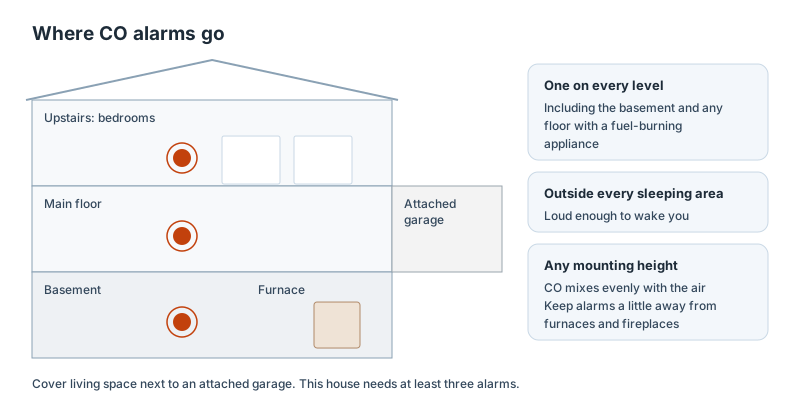
How many do you need, and where do they go?
The rule is simple: one on every level of the home, and one outside each separate sleeping area. A two-story house with a basement and bedrooms upstairs needs at least three: basement, main floor, and outside the upstairs bedrooms.
Because CO mixes evenly with the air (its density is nearly the same as air's), you don't have to fuss about mounting height the way you do with smoke detectors. Wall, ceiling, or outlet height all work. What matters is location, not height: put them where they'll wake you (outside bedrooms) and on every floor, not tucked in a closet or the far corner of the garage.
A few placement specifics worth knowing:
- Near bedrooms is the priority: the alarm has to be loud enough to wake a sleeping person.
- Every level, including a finished basement and any floor with fuel-burning appliances.
- Attached garage: if your garage connects to the house, that's a CO source (vehicle exhaust), so the adjacent living space should be covered, even in an all-electric home.
- Not too close to the appliance itself: mount CO alarms a little away from a furnace or fireplace to avoid brief start-up spikes that aren't a real emergency.
What the numbers on your detector actually mean
If your detector has a digital display (and it should), you'll see a ppm reading, parts per million. The table below shows how to read it, and this is where the sourcing matters, because the alarm thresholds are set by an actual safety standard, UL 2034, not by the manufacturer's guess.
| CO level | What UL 2034 requires | What it means for you |
|---|---|---|
| Below 30 ppm | Alarm must not sound (for 30 days) | Considered background; but not necessarily harmless long-term |
| 70 ppm | Alarm within 60–240 minutes | Symptoms can begin with prolonged exposure |
| 150 ppm | Alarm within 10–50 minutes | Headache, fatigue, nausea within hours |
| 400 ppm | Alarm within 4–15 minutes | Serious symptoms within minutes; emergency |
For reference, the EPA's outdoor air-quality standard (NAAQS) is 9 ppm averaged over 8 hours, so anything sustained above that indoors is worth investigating, even though your standard alarm won't make a sound until 70 ppm.
"Is a basic detector actually good enough?" (The blind spot nobody mentions)
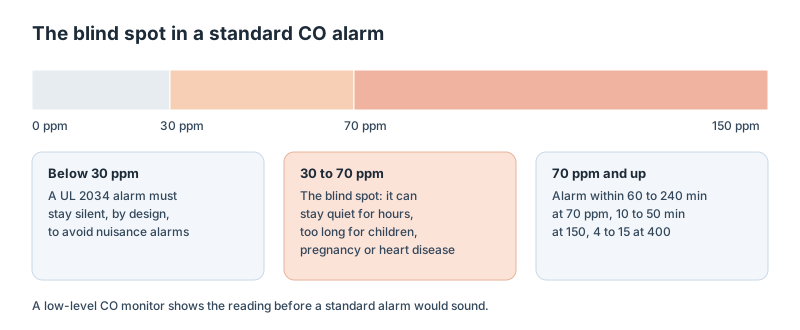
Almost nobody tells you this when you buy a basic CO alarm, and it's the single most important thing on this page: a standard UL 2034 alarm is legally required to stay silent below 30 ppm, and can wait up to 4 hours before sounding at 70 ppm.
That's not a defect. UL 2034 was designed that way on purpose, to prevent "nuisance" alarms that would flood fire departments with false calls from harmless background CO. The trade-off is a real blind spot: a slowly-failing furnace or water heater can put out a steady low level in that silent band, and your standard alarm will never make a sound, even with the sensor sitting right in the exhaust.
For most healthy adults, that's an acceptable trade-off. But for a pregnant woman, a small child, an older adult, or someone with heart disease, hours of exposure at 30 to 70 ppm is not "safe", it's a slow medical problem the alarm is designed to ignore.
That's the real reason low-level CO monitors exist. They display real-time ppm down to low levels and alert you well before a standard alarm would, so a failing appliance shows up as a low reading on the screen and you can call a technician before it becomes dangerous (or expensive).
If anyone in your home is in a vulnerable group, a low-level monitor is worth the extra cost. If not, a good UL-listed alarm with a digital display is genuinely fine.
The practical takeaway: buy a UL-listed alarm with a digital display (so you can actually see the ppm, not just a red light), and add a low-level monitor if you have a vulnerable household member or a fuel-burning appliance you're worried about.
Standalone vs. interconnected
Two more choices worth understanding:
- Standalone alarms sound only where the CO is. Fine for a small home.
- Interconnected alarms (hardwired or wireless) all sound together when one detects CO, so a basement leak wakes you upstairs. In a larger or multi-story home, this is the safer setup, and it's often what newer building codes require for new construction.
You'll also see combination smoke/CO alarms, which are a reasonable space-saver, though a dedicated CO unit with a display gives you more information.
Do you legally have to have one?
Probably, yes. The large majority of U.S. states require carbon monoxide alarms in residential dwellings through statute or building code, per the National Conference of State Legislatures (NCSL). The details vary: some apply the requirement to new construction, some at the sale or rental of a home, some to any dwelling with a fuel-burning appliance or attached garage.
Check your state's specifics in the NCSL compilation, which tracks all 50 states, but CO alarms are inexpensive and effective enough that the legal question barely matters. The CDC and CPSC recommend them whether or not your state requires them.
Maintenance: the part people forget
A CO alarm that's dead is worse than no alarm, because you think you're protected. Keep it working:
- Test it monthly with the test button.
- Replace the batteries on schedule (or use a 10-year sealed-battery model so you can't forget).
- Replace the whole unit at the end of its rated life. CO sensors wear out; most units have a limited rated life, and many now have an end-of-life chirp. If yours is past its rated life, replace it, the sensor may no longer respond reliably.
Frequently asked questions
Where should I put a carbon monoxide detector? On every level of your home and outside each separate sleeping area, at minimum. Because CO mixes evenly with room air, mounting height doesn't matter much, wall, ceiling, or outlet height all work. Prioritize spots where the alarm will wake sleeping people.
How many carbon monoxide detectors do I need? At least one per floor plus one outside each sleeping area. A typical two-story home with a basement needs about three. Larger homes need more, and interconnected units (all sounding together) are safer in multi-story houses.
Why doesn't my CO detector go off at low levels? By design. Under the UL 2034 safety standard, alarms are required not to sound below 30 ppm, and can take up to 4 hours to alarm at 70 ppm, to prevent nuisance alarms from harmless background CO. If you want to catch low, chronic levels (important for vulnerable people or a failing appliance), you need a low-level CO monitor, not a standard alarm.
What CO level is dangerous? It depends on both concentration and time. The EPA's outdoor standard is 9 ppm over 8 hours.
Sustained levels of 70 ppm can cause symptoms over hours; 150 ppm brings headache and nausea within hours; 400 ppm causes serious symptoms within minutes. If your alarm sounds or your monitor shows a rising reading, get everyone outside and call for help.
How long do carbon monoxide detectors last? Most have a limited rated life, because the sensor degrades over time. Many newer units chirp at end-of-life. Replace the whole unit (not just the batteries) when it reaches its rated age or signals end-of-life.
About these figures
The death and emergency-room figures are from the CDC (unintentional, non-fire-related CO poisoning surveillance). The alarm response thresholds (the 30/70/150/400 ppm windows) are from the UL 2034 safety standard, as documented in the CPSC's CO alarm conformance testing. The 9 ppm outdoor air-quality figure is the EPA's National Ambient Air Quality Standard for carbon monoxide.
State requirements are from the National Conference of State Legislatures (NCSL) compilation of CO detector statutes, and code/placement guidance follows NFPA 72 (which absorbed CO-alarm requirements after NFPA 720 was withdrawn in 2018).
Sources & References
Related Articles
UV Lights for HVAC Systems: Do They Work? (2026)
explainer • 7 min read
VOCs in Your Home: Sources, Health Effects, and How to Reduce Them (2026)
guide • 7 min read
Whole-House Ventilation Systems: ERV vs HRV Explained (2026)
comparison • 7 min read
Indoor Air Quality Testing: What to Test, How, and What the Results Mean (2026)
explainer • 7 min read