
The power's out (or you're prepping for when it is), and the one thing you really don't want to lose is a fridge and freezer full of food. So the question is simple: what size generator do you actually need to keep them running, without buying way more generator than necessary or, worse, one that trips its breaker every time the compressor kicks on at 2 AM?
Below are the answer and the method behind it: how much power a fridge and freezer need (less than you'd think to run, more to start), what size generator that adds up to, and a money-saving approach: you often don't need to run it continuously.
Wattage figures are typical ranges; your appliance's nameplate gives its own. The food-safety timelines come from the FDA and CDC.
To run a standard refrigerator and freezer together, you generally need a generator rated for at least about 2,000 starting watts. The catch that trips people up: a fridge and freezer draw far more power to start their compressors (a surge of roughly 800 to 1,500 watts each) than to keep running (roughly 100 to 400 watts each). Size for the starting surge, not the running load, and you won't get a tripped breaker when the compressor cycles on.
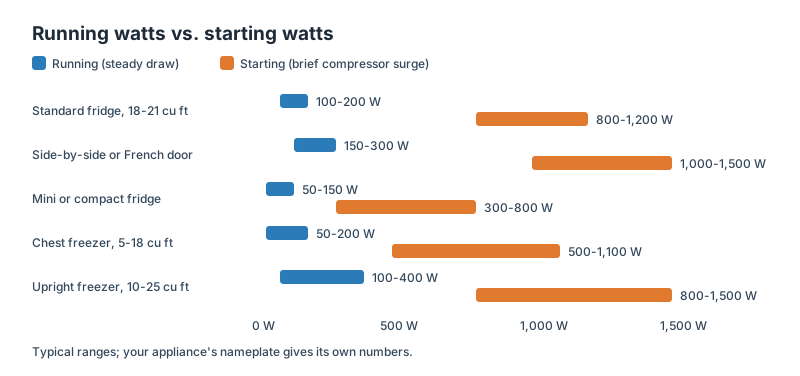
How much power a fridge and freezer actually use
The key numbers are running watts (steady draw) and starting watts (the brief compressor surge). Typical ranges by appliance:
| Appliance | Running watts | Starting watts |
|---|---|---|
| Standard top/bottom-freezer fridge (18–21 cu ft) | ~100–200W | ~800–1,200W |
| Side-by-side / French door (22–28 cu ft) | ~150–300W | ~1,000–1,500W |
| Mini / compact fridge | ~50–150W | ~300–800W |
| Chest freezer (5–18 cu ft) | ~50–200W | ~500–1,100W |
| Upright freezer (10–25 cu ft) | ~100–400W | ~800–1,500W |
To find your own numbers: look for the nameplate sticker on your fridge or freezer (inside the door, on the back, or behind the kick plate). It lists amps and volts; multiply amps × volts for running watts. Starting watts are harder to read off the plate; a common rule of thumb is that the surge runs several times the running watts.
What size generator that adds up to
The sizing rule, and this is the important part: you do NOT add up all the starting watts. Compressors don't all start at the same instant. Instead:
- Add the running watts of everything you want to power at once.
- Add the single largest starting surge from any one appliance (not all of them).
- Add about a 20% margin for reliable operation.
That total is your minimum generator size. Worked example:
Fridge + chest freezer + a few LED lights + phone charger: Running: fridge ~150W + freezer ~100W + lights ~50W + charger ~15W = ~315W running. Largest single surge: the fridge compressor at ~1,200W (adds ~1,050W over its running draw). Peak need: ~315 + 1,050 = ~1,365W. With a 20% margin, about 1,640W, so a ~2,000W inverter generator handles this comfortably.
Rough guide for common combinations:
| What you want to power | Approx. minimum generator |
|---|---|
| Standard fridge only | ~1,500–2,000W |
| Fridge + a freezer | ~2,000–2,200W |
| Fridge + freezer + lights/charger | ~2,200–3,000W |
| Fridge + freezer + sump or well pump | ~3,500–5,000W (pumps have big surges) |
| Fridge + freezer + furnace blower | ~3,000–5,000W |
| Fridge + freezer + window AC | ~3,500–5,500W |
For your specific appliances, use the generator sizing calculator below or on our generator guide. Note that pumps (sump, well) and AC compressors have large starting surges that often drive the generator size more than the fridge does.
Generator Sizing Calculator
Pick the appliances you need during an outage, we compute starting + running watts and the right generator.
You may not need to run it continuously (the cycling trick)
The money-saver most people miss: a fridge and freezer hold their cold for hours after the power (or generator) stops, so you can run the generator intermittently. This can cut your fuel use dramatically.
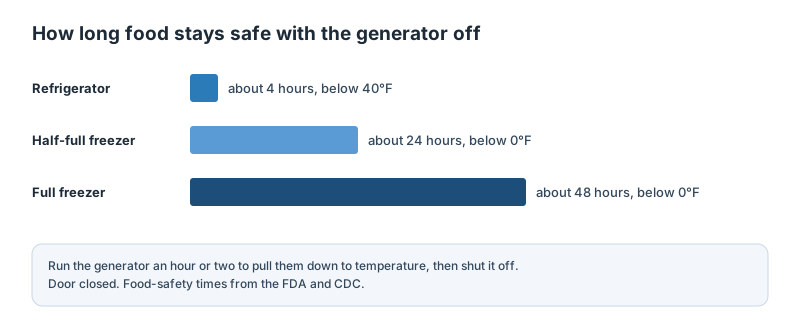
The food-safety timelines below are from the FDA and CDC, and they're the numbers to trust:
| Appliance | Stays safe (door closed) | Safe temperature |
|---|---|---|
| Refrigerator | about 4 hours | below 40°F |
| Full freezer | about 48 hours | below 0°F |
| Half-full freezer | about 24 hours | below 0°F |
So a practical approach: run the generator for an hour or two to pull the fridge and freezer down to temperature, then shut it off. A closed fridge stays safe for about 4 hours; a full freezer stays frozen for up to about 48.
Cycling like this, rather than running 24/7, can cut fuel consumption substantially. Two rules make it work: keep the doors closed (every opening dumps cold air), and keep the freezer full (a packed freezer acts like a block of ice and holds cold far longer than a half-empty one).
One safety note from the FDA: when power is restored, check temperatures. Discard refrigerated perishables (meat, dairy, eggs, leftovers) that have warmed above 40°F (when in doubt, throw it out), and never taste food to judge whether it's safe.
A few things that change your numbers
- Older fridges use much more power. A pre-2010 refrigerator can draw far more than a modern ENERGY STAR model does. If your fridge is especially old, it may pull noticeably more running and starting watts, pushing you toward a larger generator. A modern ENERGY STAR fridge is easier on a small generator.
- Ice makers and water dispensers add a bit of intermittent load, budget a little extra.
- Hot garages or outdoor fridges work harder in summer heat and draw more, so size up if that's your setup.
- A soft-start device (also called a hard-start kit) installed on the fridge or freezer can reduce the compressor's starting surge substantially, which can be the difference between a successful start and a tripped breaker if your generator is borderline on surge capacity.
Inverter vs. conventional generators
Two quick points that matter for a fridge:
- Inverter generators produce cleaner, more stable power (low total harmonic distortion), which is safer for the electronics in modern refrigerators. A conventional (non-inverter) generator can produce voltage fluctuations that may stress sensitive electronics over time, if you use one, add a surge protector between the generator and the fridge.
- Fuel efficiency: running only a fridge and freezer puts a light load on the generator (often 10 to 15% of a 2,000W-class unit's capacity), so fuel use is modest, and cycling stretches it much further. For a fuel-duration estimate, see how long a generator runs on 5 gallons.
Frequently asked questions
Will a 2,000-watt generator run a refrigerator and freezer at the same time? Usually yes, though it can be tight. A fridge (~150W running) and freezer (~100W running) only draw about 250W combined to run. The risk is both compressors surging at the same moment.
In practice that's rare, and most ~2,000W-class inverter generators handle both. For extra safety, stagger startup: plug in the fridge first, let it stabilize, then plug in the freezer.
Can a generator damage my refrigerator? A conventional (non-inverter) generator can produce voltage spikes that may stress a modern fridge's electronics over time. Inverter generators produce clean, stable power that's safe for electronics. With a conventional generator, use a surge protector between it and the fridge.
How long can I run my fridge on a generator? As long as you have fuel. Running just a fridge and freezer is a light load, so fuel lasts a long time, and cycling the generator (running it intermittently) stretches it much further. See our generator fuel-duration guide for an estimate based on your generator and tank size.
How long does food stay safe if I can't run the generator? Per the FDA and CDC, a refrigerator keeps food safe about 4 hours with the door closed, a full freezer about 48 hours (24 if half full). Keep the doors shut, keep the freezer full, and check temperatures when power returns, discard refrigerated perishables that have warmed above 40°F; when in doubt, throw it out.
Do I need to size for starting watts or running watts? Starting watts. The compressor surge (roughly 800 to 1,500W for a fridge or freezer) is much higher than the running draw, and it's what trips an undersized generator. Add your total running watts plus the single largest starting surge, then add about 20% margin.
About these figures
The food-safety timelines (a refrigerator safe about 4 hours, a full freezer about 48 hours, half-full about 24 hours, at or below 40°F and 0°F) are from the FDA and CDC guidance on food safety during power outages. Refrigerator energy-use context references ENERGY STAR (modern certified refrigerators use substantially less power than older models). The generator-sizing method (running watts plus the single largest starting surge, plus a safety margin) is the standard approach for portable generator load calculation.
Fuel-cost figures depend on your generator's efficiency and local fuel price.
Sources & References
Related Articles
How Many Amps Does a Generator Produce? (Calculator + Chart, 2026)
calculator • 7 min read
Portable Generator Safety: Carbon Monoxide, Placement and Connection (2026)
guide • 7 min read
Home Generator Guide: Types, Sizing, Fuel and Safety (2026)
guide • 9 min read
How Much Propane Does a Generator Use per Hour? (Charts + Tank Runtime)
reference • 7 min read