
You're standing at your outdoor unit trying to figure out one thing: how old is this system, and am I about to be hit with a big replacement bill? The manufacture date is hiding in your serial number, and once you can read it, you'll know where your system sits in its lifespan and whether you should be budgeting for a new one.
This page shows how to do that, brand by brand. One caveat first: HVAC manufacturers don't publish their serial-number formats as official consumer documentation.
The decode rules below are compiled and cross-checked from multiple industry references, and they're reliable for reading your system's age. Where the date matters legally (a warranty claim, an insurance or legal question), confirm it with the manufacturer's official product-registration lookup; this is a solid reference, not a substitute for the manufacturer's record.
First, find your serial number. It's on the metal data plate: on the side or back of the outdoor condenser (for AC and heat pumps), or inside the cabinet door on a furnace.
Look for "Serial No." or "S/N", and don't confuse it with the model number. Then find your brand below.
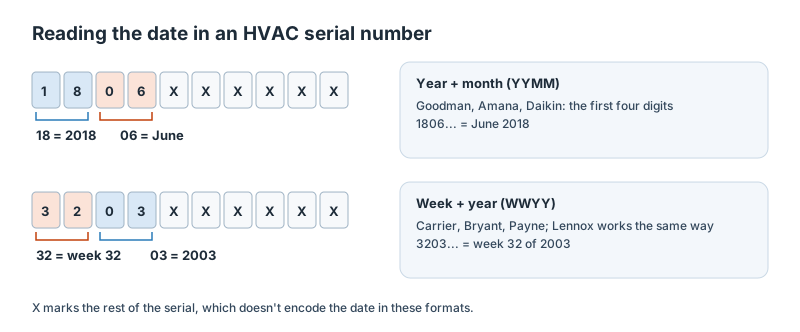
The quick version: what format is my brand?
| Brand family | Date format | Example |
|---|---|---|
| Carrier / Bryant / Payne | Week + Year (first 4 digits: WWYY) | 3203... = week 32 of 2003 |
| Goodman / Amana / Daikin | Year + Month (first 4 digits: YYMM) | 1806... = June 2018 |
| Rheem / Ruud | Month-letter + Year | first chars encode month + year |
| Lennox | Week + Year (like Carrier) | 0819... = week 8 of 2019 |
| Trane / American Standard | Read the printed date on the plate (2002+) | see below |
| York / Johnson Controls | Letter + digit code | see below |
The two you can trust most are Goodman and Carrier, their formats are simple, consistent, and agree across every reference. Let's go through each.
Goodman, Amana, and Daikin (the easiest)
Goodman has the simplest serial format in the industry, and Amana (Goodman-owned since 1997) and Daikin (which bought Goodman in 2012) use the same one on residential units.
Format: the first four digits are YYMM, year, then month.
- First two digits = the year.
- Next two digits = the month (01–12).
Example: a serial starting 1806 = June 2018. A serial starting 2011 = November 2020.
No letter codes, no ambiguity, just read the first four digits. This is the one format you can be confident about without a second opinion.
Carrier, Bryant, and Payne
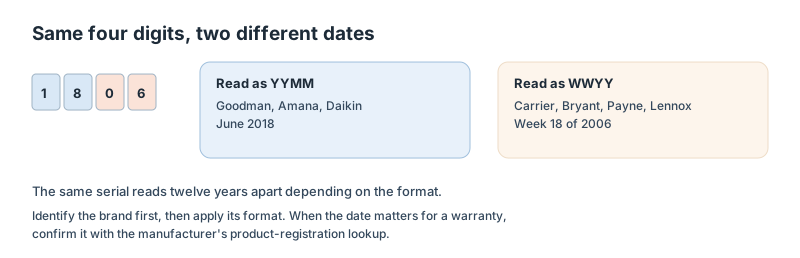
Carrier (and its sister brands Bryant and Payne) use a week-and-year code, and the key is that the week comes first. This trips people up constantly, because Goodman does the opposite.
Format: the first four digits are WWYY, week, then year.
- First two digits = the production week (01–52).
- Next two digits = the year.
Example: a serial starting 3203 = week 32 of 2003 (early August 2003). A serial starting 0120 = week 1 of 2020.
The common mistake: reading it as year-first. If you decode a Carrier serial and get a date that seems wrong (like a unit "made" after you bought it), you probably read the digits backward, remember, Carrier is week-first, year-second.
Lennox
Lennox generally uses the same WWYY format as Carrier: first two digits are the week, next two are the year. A serial beginning 0819 points to week 8 of 2019 (late February 2019).
One caveat worth knowing: some Lennox product lines begin with a plant-code letter before the digits, and references aren't perfectly consistent on every Lennox line. So read the first four digits as week-then-year, but if the result looks off, that's a brand where double-checking against the manufacturer lookup is worth it.
Rheem and Ruud
Rheem and its sister brand Ruud use a month-letter system, which is different from the digit-based brands.
- First character = the month, encoded as a letter: A = January, B = February, and so on through M = December, skipping the letter I (to avoid confusing it with the number 1).
- The next two digits = the year.
So the month letters run A(Jan), B(Feb), C(Mar), D(Apr), E(May), F(Jun), G(Jul), H(Aug), J(Sep), K(Oct), L(Nov), M(Dec), note the jump from H to J. Read the first letter for the month, the following digits for the year.
Trane and American Standard (just read the plate)
The good news for Trane owners, and the thing most decode guides get confused about: since around 2002, Trane and American Standard have printed the manufacture date in plain language right on the data plate. You usually don't need to decode anything, look for a "MFG DATE" or a clearly-dated field on the nameplate and read it directly.
The letter-code decoding you'll see floating around applies to older, pre-2002 Trane units, whose serials used a letter for the year plus a week code. If your Trane is from this century, skip the decoding and just read the printed date. If it's genuinely old (pre-2002) and you need to decode the serial, that's the case to confirm with Trane's lookup, because the older letter schemes are the least consistently documented.
York (Johnson Controls)
York (and its Coleman and Luxaire lines, under Johnson Controls) uses a letter-and-digit code that encodes the year and month in the early characters of the serial. York's scheme is one of the more complex ones and the community references vary, so for York specifically, we'd point you to the manufacturer lookup rather than have you rely on a compiled rule, the risk of misreading is higher than it's worth for a date you can confirm directly.
Once you know the age, what it means
Most people decode a serial to answer the replacement question:
- Under 10 years: you're in the smooth stretch. Most components are still within their warranty period, which on a registered system usually has years left to run. Keep up with annual maintenance and replacement shouldn't be on your radar yet.
- 10 to 15 years: the "watch it" zone. ENERGY STAR suggests considering replacement once a heat pump or central AC is more than 10 years old, so this is when to start budgeting and, if a major component like the compressor or coil fails, to weigh replacement against repair.
- Over 15 years: on borrowed time. The DOE puts a central air conditioner's life at 15 to 20 years and ENERGY STAR flags furnaces and boilers over 15 for replacement; an old, low-efficiency system also costs far more to run than a modern one. Plan the replacement on your schedule, ideally in the off-season, rather than in an emergency.
Knowing your system's age turns "should I repair or replace?" from a guess into a real decision. A major repair on a 6-year-old system is easy. The same repair on a 16-year-old unit rarely makes sense.
Frequently asked questions
How do I tell the age of my HVAC system? Find the serial number on the data plate (side/back of the outdoor unit, or inside the furnace cabinet) and decode the manufacture date using your brand's format. Goodman uses YYMM (year then month); Carrier and Lennox use WWYY (week then year); Rheem uses a month-letter code; and Trane (2002+) prints the date in plain text on the plate.
Where is the serial number on an HVAC unit? On the metal data plate. For AC and heat pumps, it's on the side or back of the outdoor condenser.
For furnaces, it's inside the cabinet, behind the front or blower-compartment door. Look for "Serial No." or "S/N", not the model number.
Why does my decoded date look wrong? The most common cause is reading week-first vs year-first backward. Carrier and Lennox put the week first (WWYY); Goodman puts the year first (YYMM).
If your date seems impossible, try reading it the other way. If it still looks off, confirm with the manufacturer's lookup.
Can I trust these decode rules completely? For reading your system's approximate age, yes, they're cross-checked across multiple industry references. But manufacturers don't publish these formats officially, so for a warranty claim, insurance question, or anything legal, verify the date through the manufacturer's official product-registration lookup. Treat this as a reliable reference, not the authoritative record.
How long do HVAC systems last? ENERGY STAR suggests considering replacement of a heat pump or central AC once it is more than 10 years old, and a furnace or boiler once it is more than 15; the DOE puts a central air conditioner's life at 15 to 20 years. Lifespan depends heavily on maintenance, climate, and install quality. Once your system is old and facing a major repair, replacement usually makes more financial sense than fixing it.
About these figures
HVAC manufacturers do not publish their serial-number date formats as official consumer documentation. The decode rules on this page are compiled and cross-referenced from multiple independent HVAC industry and technical references, and are reliable for determining a system's approximate age.
The brands with the simplest, most consistently documented formats (Goodman/Amana YYMM, Carrier/Bryant WWYY, Rheem month-letter) are presented with confidence; brands with more complex or less consistently documented schemes (York, older Trane) are flagged for manufacturer verification. Where the manufacture date carries warranty, insurance or legal weight, confirm it through the manufacturer's official product-registration lookup; this page is a general reference, not a substitute for the manufacturer's record.
Sources & References
- Carrier, Warranty Lookup, check coverage and confirm a Carrier, Bryant, or Payne unit by its serial number.