
You need to know what size wire a circuit calls for, whether you're planning a project, checking an existing installation, or just trying to understand what the electrician quoted. And the stakes are real: undersized wire on a circuit that draws more than it's rated for overheats, and that's a fire risk. So the numbers here need to be right, and they're taken directly from the National Electrical Code.
Below is the complete AWG wire gauge and ampacity reference, the NEC Table 310.16 values for copper and aluminum across all three temperature columns, plus physical dimensions, resistance for voltage-drop math, and the code rules that determine which number actually applies. One important note up front: this is a reference to help you understand wire sizing and talk to your electrician, but a new or modified circuit should be sized and installed to your local code by a licensed electrician, because the correct wire depends on your specific conditions (insulation type, temperature, run length, load) and the work is safety-critical.
The core residential ampacities: 14 AWG copper is good for 15 amps, 12 AWG for 20 amps, and 10 AWG for 30 amps, on standard branch circuits. These caps come from NEC 240.4(D) and are fixed regardless of insulation type. Larger wire follows NEC Table 310.16, but the number that applies depends on the wire's temperature rating and your terminations, explained below.
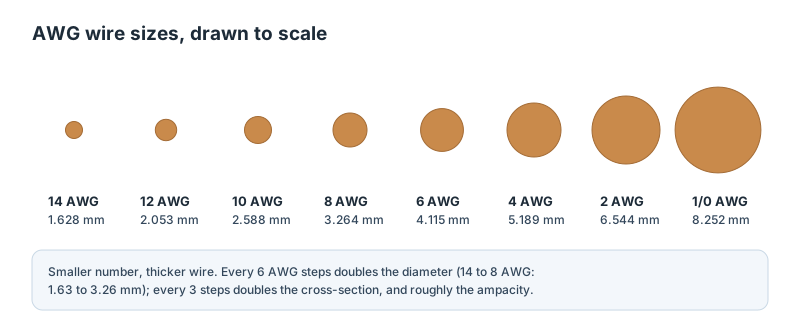
The NEC Table 310.16 ampacity chart (copper)
These are the allowable ampacities from NEC Table 310.16 for copper conductors, based on no more than three current-carrying conductors in a raceway or cable at an ambient temperature of 30°C (86°F). The three columns correspond to the wire's insulation temperature rating.
| AWG | 60°C (TW, UF, NM-B) | 75°C (THW, THWN, XHHW) | 90°C (THHN, THWN-2, XHHW-2) |
|---|---|---|---|
| 14 | 15 | 20 | 25 |
| 12 | 20 | 25 | 30 |
| 10 | 30 | 35 | 40 |
| 8 | 40 | 50 | 55 |
| 6 | 55 | 65 | 75 |
| 4 | 70 | 85 | 95 |
| 3 | 85 | 100 | 115 |
| 2 | 95 | 115 | 130 |
| 1 | 110 | 130 | 145 |
| 1/0 | 125 | 150 | 170 |
| 2/0 | 145 | 175 | 195 |
| 3/0 | 165 | 200 | 225 |
| 4/0 | 195 | 230 | 260 |
Two rules govern which column you actually use, and getting them wrong is the most common wire-sizing mistake:
- The termination rule (NEC 110.14(C)): you must use the column matching the lowest-rated component in the circuit, usually the breaker or equipment terminals. Most residential breakers and devices are rated 75°C, so even 90°C wire is limited to its 75°C ampacity at the terminations. You can't use the higher 90°C number just because the wire allows it.
- The NM-B (Romex) rule (NEC 334.80): standard NM-B cable, even though its conductors are 90°C-rated, must be sized using the 60°C column. So 12 AWG NM-B is 20 amps, not 25. This is why the 60°C column matters for typical home wiring.
- The small-conductor cap (NEC 240.4(D)): regardless of ampacity, 14 AWG is capped at a 15A breaker, 12 AWG at 20A, and 10 AWG at 30A for branch circuits.
Aluminum conductor ampacities (NEC Table 310.16)
Aluminum carries roughly 61% the current of copper for the same gauge, so it needs to be sized larger. It's standard and code-permitted for service-entrance and feeder conductors (6 AWG and larger), but uncommon and generally not recommended for small branch circuits.
| AWG | 60°C | 75°C | 90°C |
|---|---|---|---|
| 12 | 15 | 20 | 25 |
| 10 | 25 | 30 | 35 |
| 8 | 30 | 40 | 45 |
| 6 | 40 | 50 | 55 |
| 4 | 55 | 65 | 75 |
| 3 | 65 | 75 | 85 |
| 2 | 75 | 90 | 100 |
| 1 | 85 | 100 | 115 |
| 1/0 | 100 | 120 | 135 |
| 2/0 | 115 | 135 | 150 |
| 3/0 | 130 | 155 | 175 |
| 4/0 | 150 | 180 | 205 |
A useful rule of thumb: aluminum needs to go up about two AWG sizes to match copper's ampacity. And always confirm the terminations are rated for aluminum (marked AL-CU) and use the required anti-oxidant compound.
Physical dimensions
For conduit-fill calculations and wire identification, here are the standard AWG dimensions.
| AWG | Diameter (in) | Diameter (mm) | Cross-Section (mm²) | Area (kcmil) |
|---|---|---|---|---|
| 14 | 0.0641 | 1.628 | 2.08 | 4.11 |
| 12 | 0.0808 | 2.053 | 3.31 | 6.53 |
| 10 | 0.1019 | 2.588 | 5.26 | 10.38 |
| 8 | 0.1285 | 3.264 | 8.37 | 16.51 |
| 6 | 0.1620 | 4.115 | 13.30 | 26.24 |
| 4 | 0.2043 | 5.189 | 21.15 | 41.74 |
| 2 | 0.2576 | 6.544 | 33.62 | 66.36 |
| 1/0 | 0.3249 | 8.252 | 53.49 | 105.6 |
| 2/0 | 0.3648 | 9.266 | 67.43 | 133.1 |
| 4/0 | 0.4600 | 11.68 | 107.2 | 211.6 |
Wire resistance (for voltage-drop math)
Resistance determines voltage drop over distance, which matters on long runs to HVAC equipment, detached garages, and outbuildings. These are standard values in ohms per 1,000 feet.
| AWG | Copper (Ω/1000 ft) | Aluminum (Ω/1000 ft) |
|---|---|---|
| 14 | 3.14 | 5.17 |
| 12 | 1.98 | 3.25 |
| 10 | 1.24 | 2.04 |
| 8 | 0.778 | 1.28 |
| 6 | 0.491 | 0.808 |
| 4 | 0.308 | 0.508 |
| 2 | 0.194 | 0.319 |
| 1/0 | 0.122 | 0.201 |
| 2/0 | 0.0967 | 0.159 |
| 4/0 | 0.0608 | 0.100 |
The voltage-drop formula: VD = (2 × L × I × R) / 1000, where L is the one-way run length in feet, I is the current in amps, and R is the resistance above. The NEC recommends keeping voltage drop under 3% on a branch circuit (under 5% total including the feeder). On any run over about 50 feet, this can require going up a wire size even when the ampacity table says the smaller wire is fine.
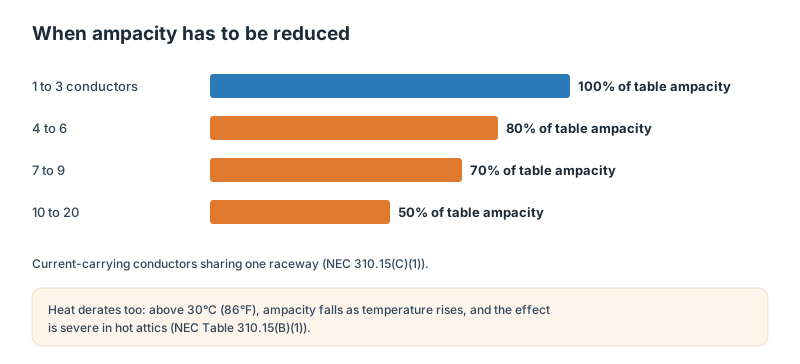
The two adjustments that change the numbers
The ampacity values above assume standard conditions. Two factors require you to reduce them:
Conduit fill (NEC 310.15(C)(1)), when more than three current-carrying conductors share a raceway:
| Conductors | Adjustment |
|---|---|
| 1–3 | 100% (no derating) |
| 4–6 | 80% |
| 7–9 | 70% |
| 10–20 | 50% |
Ambient temperature (NEC Table 310.15(B)(1)), when it's hotter than 30°C (86°F): ampacity drops as temperature rises, and the effect is severe in hot attics. For example, a 12 AWG copper NM-B conductor (20A at 30°C using the 60°C column) loses a significant share of its ampacity in a 50°C (122°F) attic. That's why HVAC wiring run through hot attics often needs to be upsized, and it's one of the trickier parts of sizing, another reason to have an electrician verify it.
Wire sizing by application (reference)
These are the typical pairings for common circuits, as a reference. Always confirm against your equipment's nameplate (the MCA sets the minimum wire size, the MOP sets the maximum breaker) and your local code.
| Application | Circuit | Typical wire | Typical breaker |
|---|---|---|---|
| Lighting | 120V, 15A | 14 AWG | 15A |
| Outlets (kitchen, bath, general 20A) | 120V, 20A | 12 AWG | 20A |
| Central AC (2–3 ton) | 240V | 10 AWG | 30A (check nameplate) |
| Central AC (4–5 ton) | 240V | 8–6 AWG | 40–50A (check nameplate) |
| Electric water heater | 240V | 10 AWG | 30A |
| Electric dryer | 240V | 10 AWG | 30A (4-wire) |
| Electric range | 240V | 6 AWG | 50A (4-wire) |
| EV charger (continuous load) | 240V | see note | see note |
| Sub-panel feeder | 240V | sized to load | sized to load |
Air conditioners and heat pumps are sized from their nameplate: the MCA sets the minimum wire size and the MOP the maximum breaker. Under NEC Article 440 that breaker can be larger than a general-purpose circuit would use for the same wire, which is why the table shows 8 to 6 AWG on 40 to 50 A for larger AC units.
A critical note on EV chargers and other continuous loads: the NEC requires circuits for continuous loads (drawing for 3+ hours) to be sized at 125% of the load. So a 48-amp EV charger needs a 60-amp breaker and wire rated accordingly, not the wire that 48 amps alone would suggest. This 125% rule catches a lot of people, and it's one of several reasons EV and other high-draw circuits should be sized by an electrician.
For 240-volt circuits specifically, our 220/240V wire sizing guide walks through the four factors (continuous load, temperature rating, copper vs aluminum, and run length) that change the size.
How the AWG system works
The AWG numbering isn't arbitrary. It's based on the number of drawing dies the wire passes through during manufacturing, so a smaller number means fewer passes and thicker wire. The mathematical relationship: each AWG step changes the diameter by a factor of about 1.123 (the 39th root of 92). The practical consequences:
- Every 6 AWG steps doubles the wire's diameter.
- Every 3 AWG steps doubles the cross-sectional area (and roughly the ampacity).
The scale runs from 40 AWG (fine electronics wire) down to 1 AWG, then continues as 1/0, 2/0, 3/0, and 4/0 (spoken "one-ought" through "four-ought"). Above 4/0, wire is measured in kcmil (thousands of circular mils), like 250 or 350 kcmil.
Frequently asked questions
What amperage can each wire gauge handle? Per NEC Table 310.16, copper wire handles: 14 AWG up to 15A, 12 AWG up to 20A, 10 AWG up to 30A (branch-circuit caps per 240.4(D)); then 8 AWG 40–55A, 6 AWG 55–75A, and so on depending on the insulation temperature column. The figure for your circuit depends on the wire type and your terminations, and NM-B (Romex) uses the more conservative 60°C column.
Why does the same wire show different amperages? Because the ampacity depends on the insulation's temperature rating (the 60°C, 75°C, or 90°C column). But you can't always use the highest number, NEC 110.14(C) requires using the column matching your lowest-rated component (usually 75°C breakers), and NM-B cable must use the 60°C column per NEC 334.80.
What wire do I need for a long run? Start with the ampacity table, then check voltage drop with VD = (2 × L × I × R) / 1000. If the drop exceeds 3% on a branch circuit, go up a wire size. Long runs to detached garages or outbuildings frequently need upsizing for voltage drop even though the ampacity would otherwise be fine.
Can I use aluminum wire? Aluminum is standard and code-permitted for service-entrance and feeder conductors (6 AWG and larger) and needs to be sized up about two AWG versus copper. It's uncommon and generally not recommended for small 15A and 20A branch circuits. Always use AL-CU-rated terminations and anti-oxidant compound.
Do I need an electrician, or can I do this myself? The ampacity table helps you understand and plan, but a new or modified circuit almost always requires a permit and inspection, and the fire risk from undersized or improperly terminated wire makes this work most people should have a licensed electrician do or verify. Wire sizing depends on conditions (temperature, run length, load type, terminations) that a general chart can't fully capture for your specific install.
About these figures
The ampacity values (copper and aluminum, 60°C/75°C/90°C columns) are from NEC Table 310.16 (National Electrical Code, NFPA 70), and the sizing rules are the corresponding NEC articles: the small-conductor caps (240.4(D)), the termination temperature rule (110.14(C)), the NM-B 60°C requirement (334.80), conduit-fill and ambient-temperature derating (310.15(C)(1) and 310.15(B)(1)), and voltage-drop recommendations (210.19). Wire dimensions and resistance are standard AWG engineering values.
Because conductor sizing depends on insulation type, terminations, ambient conditions, load type, and run length, the pairings shown are typical references, not universal answers, and every circuit should be sized to the specific equipment nameplate and local code, and installed or verified by a licensed electrician. NFPA 70 is the authoritative U.S. electrical standard, adopted (sometimes with amendments) by your local jurisdiction.
Sources & References
Related Articles
3-Phase Power Calculator: kW to Amps, Amps to kW (2026)
calculator • 5 min read
Electrical Panel Upgrade Cost: 100 to 200 Amp (2026 Guide)
cost-guide • 8 min read
How Many Amps Does a House Use? (Service Size and Load, 2026)
explainer • 7 min read
Water Heater Wire & Breaker Size Chart: AWG Gauge & Amps (2026)
reference • 8 min read