
You know you're supposed to change your HVAC filter, but the nagging question is: am I doing it often enough to protect my system, or am I overthinking it and wasting money on filters? Maybe you can't remember the last time you swapped it, or you're staring at one that looks a little gray and wondering if it's a problem.
The straight answer is backed by the actual guidance from ENERGY STAR and the Department of Energy, not a filter company trying to sell you a subscription. We'll cover how often to change it (it depends on your filter type and household), why a dirty filter genuinely costs you money, and the simplest way to never have to guess again. The short version: check it monthly, and for a standard filter, change it every 1 to 3 months.
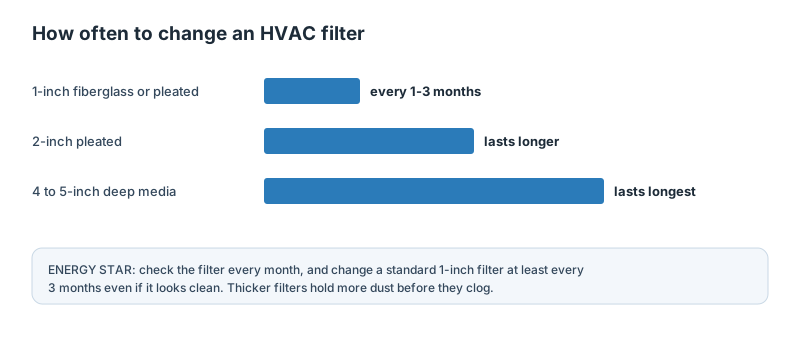
Change a standard 1-inch HVAC filter every 1 to 3 months, and a thick 4-to-5-inch media filter only once or twice a year. ENERGY STAR recommends checking your filter every month, especially during heavy-use winter and summer months, and changing it whenever it looks dirty, or every 3 months at the latest. Pets, allergies, and heavy system use all shorten that interval.
How often, by filter type
Filter thickness is the biggest factor, because a thicker filter has far more surface area to hold dust before it clogs:
| Filter type | Typical change interval |
|---|---|
| 1-inch fiberglass or pleated (standard) | Every 1–3 months |
| 2-inch pleated | A few times a year |
| 4-to-5-inch deep-pleated media | Only once or twice a year |
These are starting points. The official guidance from ENERGY STAR is the simplest rule to actually follow: check your filter every month (especially in peak winter and summer), and if it looks dirty after a month, change it.
Even if it doesn't look dirty, change a standard filter at least every 3 months. You don't need to track dates; look at it monthly and let what you see decide.
What makes you change it more often
The intervals above are for a typical home. These factors push you toward the shorter end (or more often):
- Pets. Dander and hair clog filters faster. A home with dogs or cats often needs changes on the shorter end of the range.
- Allergies or asthma. If someone in the home is sensitive, a cleaner filter (changed more often) genuinely helps, and you may want a higher-MERV filter too.
- Heavy system use. ENERGY STAR notes that systems running for much of the year need more frequent changes. Peak summer and winter are when filters load up fastest.
- Local air quality. High pollen, wildfire smoke, nearby construction, or dusty conditions all shorten filter life.
- More people in the home. More occupants means more dust and activity, and faster-loading filters.
If any of these apply to you, lean toward checking monthly and changing sooner rather than waiting for the calendar.
Why a dirty filter actually costs you (the real reason to keep up)
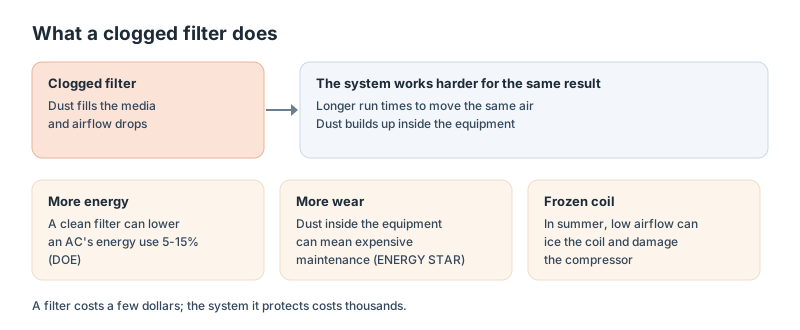
This is the part worth taking seriously, because it's not just about clean air. A clogged filter restricts airflow, and that forces your system to work harder for the same result. The numbers here are sourced, not scare tactics:
- It wastes energy. According to the Department of Energy, keeping a clean filter can lower an air conditioner's energy use by 5 to 15%. That's money leaking out of your utility bill every month the filter stays dirty, and it dwarfs the small cost of a replacement filter.
- It strains the system. As ENERGY STAR puts it, a dirty filter makes the system work harder, and a clean filter prevents dust and dirt from building up inside the equipment, which is what leads to "expensive maintenance and/or early system failure."
- In summer, it can freeze your coil. Restricted airflow can drop the evaporator coil below freezing, icing it up and eventually blocking airflow completely, which can damage the compressor. (This is one of the most common causes of an AC that suddenly stops cooling, more on that in our AC not cooling guide.)
The math is lopsided: a filter costs a few dollars, and changing it on time protects a system worth thousands. This is genuinely the cheapest, highest-return maintenance you can do.
The easiest way to never forget
You don't need an app or a subscription. Two simple approaches work:
- The monthly-look method (what ENERGY STAR recommends): pick a memorable monthly trigger, the first of the month, or when you pay a recurring bill, and just look at the filter. If it's dirty, change it. If not, put it back. It takes only a moment.
- Buy in bulk and set a reminder. Keep a few of the right-size filters on hand (write the size, like 16x25x1, on your phone), and set a recurring calendar reminder for your interval. Having the filter ready removes the main excuse.
One upgrade worth mentioning: if your system can fit a 4-to-5-inch media filter cabinet, switching from 1-inch filters means you change them far less often (only once or twice a year instead of monthly-ish) and often get better filtration with less airflow restriction. It's one of the better low-effort improvements you can make.
Which filter should you actually buy?
How often to change it is only half the question; the other half is which filter, its MERV rating. Higher MERV captures more, but too high can restrict airflow on some systems. Our MERV rating guide covers which rating suits your home, and why filter depth matters more than the number for airflow.
Frequently asked questions
How often should I change my HVAC filter? Check it every month, and change a standard 1-inch filter every 1–3 months (ENERGY STAR's guidance is monthly checks, and changing at least every 3 months). Thick 4–5 inch media filters last much longer, only needing a change once or twice a year. Pets, allergies, heavy use, and poor air quality all mean changing it more often.
What happens if I don't change my air filter? A clogged filter restricts airflow; per the DOE a clean filter can lower an air conditioner's energy use by 5–15%, and a clogged one strains the system and can lead to expensive repairs or early failure. In summer it can freeze the evaporator coil and stop cooling entirely. Air quality also drops as the filter stops capturing particles effectively.
How do I know if my filter is dirty? Look at it. Hold it up to a light, if you can't see light through it, or it's coated gray with dust, it's overdue. ENERGY STAR recommends checking monthly and changing whenever it looks dirty, rather than relying only on the calendar.
Do pets mean I need to change my filter more often? Yes. Pet dander and hair load filters faster, so homes with cats or dogs typically need changes on the shorter end of the range (closer to monthly for a 1-inch filter). A higher-MERV filter can also help capture more dander.
Is a more expensive filter worth it? It depends on your needs and system. A higher-MERV filter captures more particles (better for allergies), but too high a MERV can restrict airflow on some systems.
And a thicker media filter lasts much longer. See our MERV guide for how to choose the right one for your home.
About these figures
The core filter-change guidance, checking monthly, changing a standard filter at least every 3 months, and the reason (a dirty filter slows airflow, makes the system work harder, and leads to expensive maintenance or early failure), is from ENERGY STAR's Heat & Cool Efficiently guidance. The figure that a clean filter can lower an air conditioner's energy use by 5–15% is from the U.S. Department of Energy.
Filter-change intervals by thickness and the household factors that shorten them (pets, allergies, usage, air quality) are consistent across HVAC and filtration sources. Filter prices are general market ranges, labeled as such, not fixed figures.
Sources & References
Related Articles
HVAC Ductwork Guide: Types, Sizing, Sealing and When to Replace (2026)
explainer • 7 min read
HVAC Maintenance Checklist: Seasonal DIY Guide (2026)
guide • 8 min read
HVAC Maintenance Cost: What a Tune-Up Covers and What Drives the Price
cost-guide • 7 min read
Is Air Duct Cleaning Worth It? What the EPA Says (2026)
analysis • 7 min read