You can reduce HVAC noise by 10–25 dB without replacing your entire system — that's the difference between a vacuum cleaner and a quiet conversation. The most cost-effective approach combines vibration isolation pads under the outdoor unit ($20–$60, saves 3–8 dB), a compressor sound blanket ($80–$200, saves 2–5 dB), and acoustic duct liner on your supply runs ($300–$1,500, saves 5–12 dB). Total cost: $400–$1,760. Total noise reduction: 10–25 dB, perceived as roughly 2–5 times quieter.
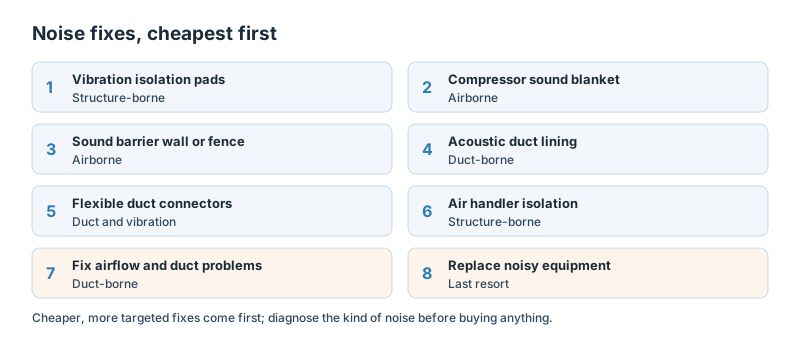
This guide covers eight proven solutions ordered from cheapest to most expensive, with exact dB reduction data, material costs, and real installation examples. Whether your outdoor condenser is keeping you up at night or your ductwork sounds like a wind tunnel, there's a fix here that matches your budget.
Before You Start: Diagnose the Noise Source
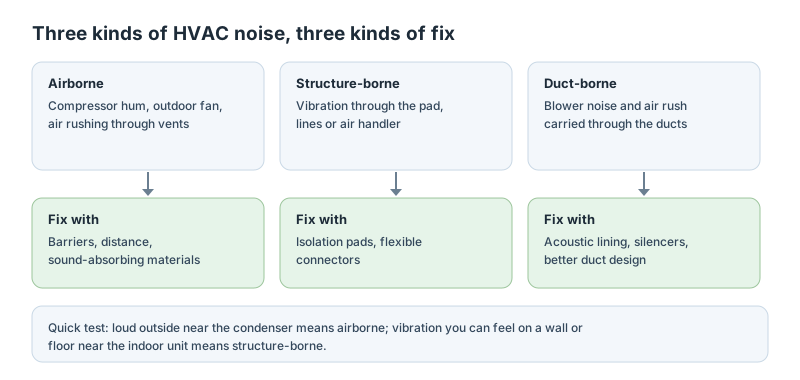
Before spending money on soundproofing, figure out exactly where the noise is coming from. HVAC noise falls into three categories, and each requires a different solution.
Airborne Sound
This is the noise you hear directly through the air — the hum of the compressor, the whir of the outdoor fan, the rush of air through ducts. You reduce airborne sound with barriers, distance, and absorption materials.
Structure-Borne Vibration
This is noise transmitted through solid materials — the outdoor unit vibrating through a concrete pad into your foundation, refrigerant lines buzzing against framing, or the air handler shaking a closet floor. You reduce structure-borne noise with isolation (rubber pads, flex connectors, decoupling).
Duct-Borne Noise
This is sound that travels through the ductwork from the blower into your rooms. It includes both the blower motor noise and aerodynamic noise from air flowing through ducts, fittings, and registers. You reduce duct-borne noise with acoustic lining, silencers, and proper duct design.
Quick diagnostic test: Stand outside near the condenser. Is it loud? That's airborne sound from the outdoor unit. Go inside and put your hand on the wall near the unit or on the floor — do you feel vibration? That's structure-borne. Stand near a supply register and listen — do you hear rushing, whistling, or humming? That's duct-borne noise.
A $30 smartphone sound meter app (like NIOSH SLM for iPhone or Sound Meter for Android) is accurate enough to measure before-and-after noise levels. Take readings at the same position, time of day, and HVAC operating mode for valid comparisons. Professional-grade meters cost $200–$500 if you need higher precision.
Solution 1: Vibration Isolation Pads — $20–$60
Expected noise reduction: 3–8 dB (structure-borne noise) Difficulty: Easy (DIY) Time: 30 minutes
Vibration isolation pads are the single best bang-for-your-buck HVAC noise reduction. These rubber or neoprene pads sit between the outdoor unit and its mounting surface, preventing the compressor's vibration from transmitting through your home's structure.
Why They Work
An air conditioner's compressor oscillates at 50–60 Hz (matching the AC power frequency), creating vibrations that travel through rigid connections. When the condenser sits directly on a concrete pad, those vibrations transmit through the pad into the ground and into your home's foundation. When mounted on a deck or wall bracket without isolation, vibrations travel directly into the building structure, amplified by the resonance of wooden framing.
Rubber isolation pads decouple the unit from the structure. The rubber absorbs vibration energy and converts it to tiny amounts of heat rather than passing it along. It's the same principle as wearing rubber-soled shoes on a hard floor.
Types and Specifications
| Pad Type | Material | Thickness | Load Rating | Noise Reduction | Cost |
|---|---|---|---|---|---|
| Basic rubber pads | Recycled rubber | 3/4" | 100 lbs each | 3–5 dB | $20–$30 (set of 4) |
| Neoprene waffle pads | Neoprene rubber | 1" | 150 lbs each | 4–6 dB | $30–$45 (set of 4) |
| Spring isolators | Steel springs + rubber | 2–3" | 200 lbs each | 5–8 dB | $40–$60 (set of 4) |
| Cork-rubber composite | Cork + rubber blend | 1" | 120 lbs each | 4–7 dB | $35–$50 (set of 4) |
Installation Steps
- Turn off the HVAC system at the thermostat and the disconnect switch.
- If the unit sits on a pad, lift one corner at a time (have a helper — condensers weigh 100–250 lbs) and slide pads under each corner. The unit should have four support points.
- If wall-mounted on a bracket, place pads between the bracket and the wall, and between the unit's feet and the bracket.
- Ensure the unit is level after pad installation. Unlevel condensers cause premature compressor wear and can actually increase vibration.
- Check that refrigerant lines have slight flex and don't pull tight — the pads raise the unit slightly.
Real-world example: Kevin in New Jersey had a Carrier 24ACC636 condenser sitting directly on his patio slab, 8 feet from his bedroom wall. Inside the bedroom, he measured 42 dB of low-frequency hum attributed to vibration transmission. After installing 1" neoprene waffle pads ($35 from Amazon), the bedroom measurement dropped to 35 dB — a 7 dB reduction. The outdoor noise level didn't change (it was already propagating through the air), but the annoying indoor hum was eliminated.
Solution 2: Compressor Sound Blanket — $80–$200
Expected noise reduction: 2–5 dB (airborne noise from compressor) Difficulty: Easy (DIY) Time: 45 minutes
A compressor sound blanket (also called a compressor wrap) is a mass-loaded vinyl (MLV) and fiberglass composite blanket that wraps around the compressor inside the outdoor unit. It dampens the compressor's mechanical noise before it radiates through the unit's cabinet.
How It Works
The blanket uses two noise-reduction principles. The fiberglass layer absorbs mid-to-high-frequency sound (500 Hz and up). The mass-loaded vinyl layer blocks low-frequency noise transmission (below 500 Hz) through sheer mass — sound waves can't easily pass through heavy, limp material.
The combination targets the compressor's full noise spectrum. The compressor is the single loudest component in the outdoor unit, so wrapping it attacks the noise at its source.
Product Options
| Product | Material | Reduction Claimed | Actual Tested Reduction | Fits | Cost |
|---|---|---|---|---|---|
| Brinmar?"Universal | MLV + fiberglass | Up to 5 dB | 2–4 dB | Most condensers | $100–$150 |
| Quiet Fence Compressor Wrap | MLV + acoustic foam | Up to 7 dB | 3–5 dB | Specific models | $120–$180 |
| Generic MLV blanket (cut-to-fit) | MLV only | Up to 3 dB | 1–3 dB | Custom cut | $80–$120 |
Never wrap a compressor blanket around the entire outdoor unit — only around the compressor itself. The condenser coil and fan need unrestricted airflow. Blocking airflow causes the system to overheat, dramatically reducing efficiency and potentially damaging the compressor. Always leave the fan and coil area completely open.
Installation
- Turn off the system and disconnect power.
- Remove the outdoor unit's top panel and/or side panel to access the compressor (usually requires a 5/16" or 1/4" hex head socket).
- Wrap the blanket around the compressor body, securing with the built-in straps or cable ties.
- Ensure the blanket doesn't contact any refrigerant lines, electrical connections, or the fan motor.
- Reassemble the cabinet panels and restore power.
Solution 3: Sound Barrier Wall/Fence — $200–$2,000
Expected noise reduction: 5–15 dB (airborne noise at specific listening points) Difficulty: Moderate (DIY possible, professional recommended for best results) Time: 4–8 hours (DIY) or 1 day (professional)
A sound barrier wall is a physical barrier between the outdoor unit and the area you want to protect (bedroom window, patio, neighbor's property line). This is one of the most effective solutions because it can dramatically reduce noise at a specific location without touching the equipment.
The Physics of Sound Barriers
Sound barriers work by diffraction: sound waves have to bend over the top and around the sides of the barrier. The amount of noise reduction depends on three factors — the barrier's height relative to the sound path, the barrier's mass (heavier materials block more sound), and the distance between the barrier and both the source and the receiver.
A barrier is most effective when it's close to the source OR close to the receiver, and when it's tall enough to fully block the line of sight between the two. A 6-foot barrier that blocks direct line of sight provides 5–10 dB of reduction. Adding height and mass pushes this to 10–15 dB.
Barrier Material Comparison
| Material | STC Rating | Weight (per sq ft) | dB Reduction (typical) | Cost per Linear Foot (6' tall) | Durability |
|---|---|---|---|---|---|
| Solid wood fence (1" cedar) | 20–25 | 3 lbs | 5–8 dB | $30–$50 | 15–25 years |
| Solid vinyl fence | 18–22 | 2.5 lbs | 4–7 dB | $25–$45 | 25+ years |
| Concrete block wall (4") | 40–45 | 28 lbs | 10–15 dB | $50–$100 | 50+ years |
| Mass-loaded vinyl on frame | 25–30 | 1.5 lbs | 6–10 dB | $35–$60 | 10–15 years |
| Earth berm (dirt mound) | 40+ | N/A | 10–20 dB | $20–$40 (material) | Permanent |
| Acoustic fence panels | 28–35 | 4 lbs | 8–12 dB | $60–$100 | 20+ years |
Design Rules for Maximum Effectiveness
Distance: Place the barrier as close to the outdoor unit as possible while maintaining minimum clearance. Most manufacturers require 12–24 inches of clearance on the service side and 48–60 inches on the airflow side (top). The barrier should be on the side facing the protected area (bedroom, neighbor, etc.).
Height: The barrier should be at least 1 foot taller than the outdoor unit to block line-of-sight. For a typical 30-inch-tall condenser, a 42–48 inch barrier provides good performance. A 6-foot barrier is even better if code allows.
Length: The barrier should extend at least 2 feet beyond each side of the outdoor unit. Sound wraps around short barriers. The longer the barrier, the better the attenuation at the protected point.
Gaps: Any gap in the barrier kills its effectiveness. Sound travels through the path of least resistance. Seal the bottom of the barrier to the ground surface, and ensure there are no holes or cracks.
Don't fully enclose: The outdoor unit needs airflow. A three-sided barrier (back and two sides, open on the top and front/discharge side) is the standard approach. Never enclose the unit on all four sides or cover the top.
Real-world example: Rosa in Houston had a 72 dB condenser positioned 5 feet from her fence and 15 feet from her neighbor's bedroom window. The neighbor measured 58 dB at their window. Rosa built a three-sided L-shaped barrier using 2×4 framing filled with rockwool insulation and faced with 1/2" cement board, 42 inches tall and 8 feet long. Cost: $450 in materials. The neighbor's measurement dropped from 58 dB to 46 dB — a 12 dB reduction that transformed "I can't sleep" to "I can barely hear it."
Landscaping adds a small additional benefit. A dense row of evergreen shrubs (arborvitae, holly) between the barrier and the protected area provides 1–3 dB of additional absorption. More importantly, the visual obstruction makes people perceive the noise as quieter — the psychological effect of not seeing the noise source is well-documented in acoustic research.
Solution 4: Duct Acoustic Lining — $300–$3,000
Expected noise reduction: 5–12 dB (duct-borne noise) Difficulty: Moderate to difficult (professional recommended) Time: 1–2 days
If your noise problem is rushing air, humming, or vibration coming from supply or return registers, the ducts are your primary target. Acoustic duct liner is the most effective solution for duct-borne noise.
Types of Duct Acoustic Treatment
| Treatment | Where Applied | Noise Reduction | Cost per Linear Foot | Best For |
|---|---|---|---|---|
| Fiberglass duct liner (1") | Inside duct walls | 3–6 dB per 10 ft | $3–$6 | Supply ducts near air handler |
| Fiberglass duct liner (2") | Inside duct walls | 5–10 dB per 10 ft | $5–$9 | Return ducts, trunk lines |
| Duct wrap (exterior) | Outside duct walls | 2–4 dB per 10 ft | $2–$5 | Exposed basement/attic ducts |
| Duct silencer/sound trap | Inline, near air handler | 10–25 dB | $150–$500 each | Air handler supply/return |
| Flexible duct sections | Between rigid ducts | 5–15 dB per 5 ft section | $5–$10 | Transition from trunk to branch |
| Acoustic plenum box | Between air handler and trunk | 15–25 dB | $200–$600 | New installations |
How Duct Liner Works
Acoustic duct liner is typically fiberglass board (faced with a smooth, black coating to resist airflow erosion) glued and mechanically fastened to the inside walls of sheet metal ducts. As sound waves travel through the duct, they enter the fiberglass where friction between air molecules and the glass fibers converts acoustic energy to heat. Higher frequencies (1,000+ Hz) are absorbed very efficiently; lower frequencies (below 250 Hz) require thicker liner or longer runs.
The key metric is insertion loss — how many dB per linear foot the liner absorbs at each frequency:
| Frequency (Hz) | 1" Liner (dB/ft) | 2" Liner (dB/ft) | 5 ft Flex Duct (dB/ft) |
|---|---|---|---|
| 125 | 0.3 | 0.6 | 1.0 |
| 250 | 0.8 | 1.5 | 1.8 |
| 500 | 1.5 | 2.5 | 3.0 |
| 1,000 | 2.5 | 3.5 | 4.5 |
| 2,000 | 4.0 | 5.0 | 6.0 |
| 4,000 | 4.5 | 5.5 | 5.5 |
Where to Focus Duct Treatment
You get the most noise reduction from treating the first 10–15 feet of ductwork immediately downstream of the air handler. This is where sound energy from the blower is highest. Treating 15 feet of supply duct with 1" liner gives you roughly 15–40 dB of reduction depending on frequency — enough to silence most blower noise.
The return duct is equally important. Many homes have an open return duct running from the air handler closet/utility room directly to a central hallway, with no lining. This is a direct sound path from the blower into your living space. Lining the return duct or adding a silencer can be transformative.
Real-world example: The Chen family in Atlanta had a 2010 Lennox furnace with a single-speed blower producing 54 dB at the supply register in their master bedroom, directly above the utility room. An HVAC contractor lined 12 feet of the supply trunk with 2" fiberglass duct liner and added a 3-foot duct silencer between the air handler and the trunk. Post-treatment measurement: 38 dB at the same register — a 16 dB reduction. Cost: $1,200 installed.
Solution 5: Flex Connector Installation — $50–$200
Expected noise reduction: 5–15 dB (vibration transfer from air handler to ducts) Difficulty: Moderate (experienced DIY or professional) Time: 1–2 hours
Flex connectors are short sections of flexible duct material (usually reinforced canvas or neoprene) installed between the air handler and the rigid ductwork. They serve as a vibration break, preventing the air handler's motor and blower vibration from transmitting directly into the sheet metal duct system.
Why This Matters
Without flex connectors, the air handler is rigidly bolted to the ductwork. Every vibration from the blower motor travels directly into the sheet metal, which acts like a speaker cone — radiating sound into every room the ducts pass through. A 6-inch section of flex connector breaks this rigid connection, reducing structure-borne duct noise by 5–15 dB.
Many older installations skip flex connectors entirely, or use them only on the supply side. Both supply and return sides need them for maximum benefit.
Specifications
| Connector Type | Material | Length | Noise Reduction | Cost | Airflow Restriction |
|---|---|---|---|---|---|
| Canvas flex connector | Heavy canvas | 4–6" | 5–10 dB | $15–$40 each | Minimal |
| Neoprene flex connector | Reinforced neoprene | 4–8" | 8–15 dB | $25–$60 each | Minimal |
| Vibration-isolating boot | Rubber + canvas | 6–12" | 10–15 dB | $40–$80 each | Very low |
You need one connector on each supply trunk takeoff and one on each return duct connection to the air handler. A typical system needs 2–4 connectors total.
Flex connectors must be properly sized to the duct dimensions and installed without kinks, sags, or compression. A kinked flex connector restricts airflow, increasing air velocity noise and reducing system efficiency. Keep them short (6" is ideal) and fully extended.
Solution 6: Air Handler/Furnace Vibration Isolation — $100–$500
Expected noise reduction: 3–8 dB (structure-borne noise from indoor equipment) Difficulty: Moderate (professional recommended) Time: 2–4 hours
If your air handler or furnace is in a closet, crawlspace, or utility room adjacent to living spaces, isolating it from the building structure can eliminate transmitted hum and vibration.
Isolation Methods
| Method | Application | Noise Reduction | Cost | Notes |
|---|---|---|---|---|
| Rubber isolation mounts | Under equipment feet | 3–6 dB | $40–$100 | Replace hard feet with rubber |
| Vibration isolation platform | Full platform under unit | 5–8 dB | $100–$300 | Cork-rubber-concrete sandwich |
| Hanging/suspended mounts | Ceiling-hung air handlers | 5–10 dB | $150–$400 | Spring hangers + neoprene |
| Inertia base | Concrete slab on springs | 6–10 dB | $200–$500 | For problematic installations |
Building a Vibration Isolation Platform
For a furnace or air handler sitting on a floor, a DIY isolation platform provides excellent results:
- Cut a piece of 3/4" plywood slightly larger than the unit's footprint.
- Layer 1/2" cork or neoprene sheet on top of the plywood.
- Place a second piece of 3/4" plywood on top of the cork.
- Set the unit on this sandwich platform.
- Ensure the unit is level and the drain pan (if applicable) still drains properly.
The cork layer decouples the unit from the floor structure, absorbing vibration before it enters the building. This simple sandwich costs $50–$100 in materials and consistently delivers 4–7 dB of structure-borne noise reduction.
Real-world example: Patrick in Denver had a Trane air handler in a closet adjacent to his home office. The unit's vibration at medium speed registered at 44 dB at his desk (through the shared wall). He built a plywood-cork-plywood platform for $65 in materials and added a flex connector to the supply duct ($35). The combined treatment dropped his desk measurement to 33 dB — an 11 dB improvement for $100 and 3 hours of work.
Solution 7: Outdoor Unit Relocation — $500–$3,000
Expected noise reduction: 6–18 dB (depends on distance change) Difficulty: Professional only Time: 1 day
If none of the above solutions are sufficient, or if the outdoor unit is just too close to a critical area, relocating it may be the best option. Moving the unit even 10–15 feet farther from the sensitive area can achieve dramatic noise reduction based on the inverse square law.
Distance vs. Noise Reduction
| Original Distance | New Distance | Noise Reduction | Cost Estimate |
|---|---|---|---|
| 3 ft | 10 ft | 10 dB | $500–$1,000 |
| 3 ft | 20 ft | 16 dB | $800–$1,500 |
| 5 ft | 15 ft | 10 dB | $500–$1,200 |
| 5 ft | 25 ft | 14 dB | $800–$1,800 |
| 5 ft | 50 ft | 20 dB | $1,500–$3,000 |
What Relocation Involves
Moving an outdoor condenser requires extending the refrigerant lines, electrical wiring, and condensate drain. Each additional 10 feet of line set adds:
- $150–$300 in copper tubing and insulation
- $50–$100 in electrical wiring
- Potential efficiency loss of 1–2% per 10 feet (due to increased refrigerant line friction)
- Additional refrigerant charge ($50–$100)
The total cost depends primarily on labor (2–6 hours at $100–$200/hour) plus materials. Runs over 50 feet require a vacuum and recharge of the entire refrigerant system.
Refrigerant line length limits vary by manufacturer. Most residential systems support up to 50–75 feet of total line length, with some premium mini splits allowing up to 100 feet. Check your equipment manual before planning a relocation. Exceeding the maximum line length will void the warranty and degrade performance.
When Relocation Makes Sense
Relocation is worth considering when the outdoor unit is within 5 feet of a bedroom or neighbor's property line, there's available space 20+ feet away on the same property, the unit was poorly placed during original installation, and acoustic barriers aren't feasible due to space or aesthetic constraints. It's often cheaper and more effective than replacing the entire system with a quieter model.
Solution 8: Equipment Replacement — $5,000–$15,000+
Expected noise reduction: 10–25 dB (depends on old vs. new equipment) Difficulty: Professional only Time: 1–2 days
When your system is 10+ years old, inefficient, and loud, replacing it with a modern variable-speed system provides the biggest noise reduction of any single solution — while also cutting your energy bills by 30–50%.
Old vs. New: Noise Comparison
| System Replaced | New System | Old Outdoor dB | New Outdoor dB | Reduction | Annual Energy Savings |
|---|---|---|---|---|---|
| 10 SEER central AC (2006) | 18 SEER2 two-stage | 76 | 66 | 10 dB | 35–45% |
| 13 SEER central AC (2012) | 20 SEER2 variable | 72 | 58 | 14 dB | 30–40% |
| 10 SEER heat pump (2008) | 20 SEER2 inverter HP | 74 | 56 | 18 dB | 40–50% |
| 80% AFUE furnace (2005) | 98% AFUE modulating | 58 (indoor) | 35 (indoor) | 23 dB | 20–25% |
| Window AC (any age) | Mini split | 55 (indoor) | 22 (indoor) | 33 dB | 40–60% |
What to Prioritize in a Quiet Replacement
Variable-speed compressor: This is the single most important feature for noise reduction. Variable-speed (inverter) compressors run at exactly the capacity needed, typically 30–70% of maximum on most days. At 50% capacity, they're 8–15 dB quieter than a single-stage compressor at full blast.
Variable-speed blower: An ECM (electronically commutated motor) blower ramps up gradually and operates at lower speeds than a PSC motor. This eliminates startup bangs and reduces steady-state duct noise by 5–15 dB.
Sound-rated cabinet: Premium outdoor units use sound-dampening compressor compartments, composite fan blades (instead of stamped metal), and vibration-isolated mounting. Look for AHRI-certified sound ratings.
Communicating controls: Systems where the thermostat, outdoor unit, and indoor unit communicate digitally (Carrier Infinity, Trane ComfortLink, Lennox iComfort) can optimize noise by matching indoor and outdoor fan speeds to the minimum needed for current conditions.
Real-world example: The Martinez family in San Antonio had a 2009 Goodman 13 SEER system with a condenser measured at 73 dB and an indoor air handler at 52 dB (at the bedroom register). They replaced it with a Carrier Infinity 24VNA0 (variable-speed, 20 SEER2) and a matching variable-speed air handler. New measurements: 56 dB outdoors, 32 dB at the bedroom register. Combined with the isolation pads their installer included, the total reduction was 17 dB outdoors and 20 dB indoors. Their summer electric bill also dropped by 38%.
The Complete Noise Reduction Stack: Combining Solutions
Each solution targets a different noise path. Combining them multiplies the effect (though not perfectly additive, since you can't reduce noise below the quietest component in the chain).
Here's a realistic noise reduction plan for a common scenario — a 10-year-old central AC system measured at 72 dB outdoors and 48 dB at the nearest bedroom register:
| Solution | Target | dB Reduction | Cumulative Outdoor dB | Cumulative Indoor dB | Cost |
|---|---|---|---|---|---|
| Starting point | — | — | 72 | 48 | — |
| 1. Vibration pads | Structure-borne | 5 (indoor) | 72 | 43 | $35 |
| 2. Compressor blanket | Airborne (outdoor) | 3 | 69 | 43 | $130 |
| 3. Sound barrier wall | Airborne (outdoor) | 8 | 61 | 41 | $500 |
| 4. Duct liner (12 ft supply) | Duct-borne | 8 (indoor) | 61 | 35 | $800 |
| 5. Flex connectors | Vibration to ducts | 5 (indoor) | 61 | 33 | $80 |
| 6. Air handler isolation | Structure-borne (indoor) | 3 (indoor) | 61 | 31 | $100 |
| Total | All paths | — | 61 (−11 outdoor) | 31 (−17 indoor) | $1,645 |
That $1,645 investment achieves a perceived loudness reduction of roughly 3× outdoors and 4× indoors — without replacing any equipment. The bedroom goes from "can't sleep with the window cracked" to "can barely notice the system."
Case Study: The Full-Stack Treatment
Mike and Laura in suburban Philadelphia had a 2014 Rheem 14 SEER system with these measurements:
- Outdoor unit: 71 dB at 3 feet
- Master bedroom (window open): 52 dB
- Master bedroom (window closed): 44 dB
- Living room (duct register): 46 dB
Their priorities: sleep quality and neighbor relations.
Treatment plan:
- Vibration isolation pads: $35 (DIY)
- Compressor sound blanket: $140 (DIY)
- Sound barrier (6' cedar fence section with MLV lining): $650 (DIY with a borrowed truck)
- Duct liner on 10 ft of supply trunk: $400 (hired HVAC tech)
- Two flex connectors (supply and return): $70 (installed during duct liner work)
- Cork-plywood isolation platform under air handler: $75 (DIY)
Total cost: $1,370
Results:
- Outdoor unit at 3 feet: 63 dB (−8)
- At neighbor's property line (20 ft): 38 dB (−14 from original 52 dB)
- Master bedroom (window open): 38 dB (−14)
- Master bedroom (window closed): 30 dB (−14)
- Living room register: 34 dB (−12)
Neighbor's noise complaint: resolved. Sleep quality: transformed.
DIY vs. Professional: Which Solutions Can You Handle?
| Solution | DIY Feasible? | Tools Needed | Risk Level | Professional Cost Premium |
|---|---|---|---|---|
| Vibration isolation pads | Yes | None (maybe a jack) | Low | +$100–$200 |
| Compressor sound blanket | Yes | Screwdriver, zip ties | Low | +$100–$200 |
| Sound barrier wall | Yes (if handy) | Saw, drill, post-hole digger | Low | +$500–$1,000 |
| Duct acoustic lining | Some homeowners | Tin snips, adhesive, safety gear | Moderate | +$500–$1,500 |
| Flex connectors | Experienced DIY | Tin snips, foil tape, clamps | Moderate | +$100–$300 |
| Air handler isolation | Yes | Basic tools | Low | +$100–$300 |
| Unit relocation | No | Refrigerant tools (EPA cert.) | High | N/A (must be professional) |
| Equipment replacement | No | Full HVAC toolkit | High | N/A (must be professional) |
Working with refrigerant requires EPA Section 608 certification. Do not attempt to disconnect, relocate, or modify refrigerant lines yourself. This is not just a legal requirement — improper refrigerant handling can cause frostbite, chemical burns, and environmental damage. Leave anything involving refrigerant to a licensed HVAC technician.
Maintenance That Keeps Systems Quiet
Regular maintenance prevents noise from creeping up over time. Here's a noise-focused maintenance checklist:
Monthly:
- Clear debris (leaves, grass clippings) from the outdoor unit's coil and fan area
- Check that the outdoor unit isn't tilting or settling unevenly
- Listen for any new sounds during startup, operation, and shutdown
Quarterly (every 3 months):
- Replace air filters (dirty filters increase blower effort and noise by 3–8 dB)
- Inspect vibration pads for deterioration or displacement
- Check flex connectors for tears or sagging
Annually (professional tune-up):
- Clean indoor and outdoor coils (dirty coils force the compressor to work harder = louder)
- Verify refrigerant charge (low charge increases compressor noise)
- Lubricate motor bearings (if applicable — newer ECM motors are sealed)
- Tighten all cabinet panels, screws, and mounting hardware
- Inspect ductwork for disconnected sections or damaged liner
- Check blower wheel balance (unbalanced wheels vibrate and howl)
A system that measured 60 dB when clean and maintained can easily hit 68–72 dB when neglected — coated in dirt, low on refrigerant, with loose panels and a clogged filter. Annual maintenance is the cheapest noise reduction strategy over the life of the system.
Key Takeaways:
- Diagnose the noise source first: airborne, structure-borne, or duct-borne — each needs a different solution
- Vibration isolation pads ($20–$60) are the #1 bang-for-your-buck fix, eliminating 3–8 dB of structure-borne noise
- A sound barrier wall ($200–$2,000) provides the largest single reduction for outdoor noise: 5–15 dB
- Acoustic duct liner on the first 10–15 feet of supply duct eliminates 5–12 dB of indoor duct-borne noise
- Combining all solutions can achieve 10–25 dB total reduction for $400–$1,800 without replacing equipment
- Variable-speed equipment replacement provides the biggest single improvement (10–25 dB) but at 10× the cost
- Regular maintenance prevents 5–10 dB of noise creep from dirt, loose parts, and low refrigerant
- Most solutions (pads, blankets, barriers, isolation platforms) are DIY-friendly — save professional work for ducts and refrigerant